


Client overview
Our client is a Singapore-based company developing an AI system to support building inspection and structural assessment. The goal of the project was to train a computer vision model that could automatically detect visible building defects from photographic data.
Once detected, these issues are reviewed by structural engineers, who use the information to plan inspections and make decisions more efficiently. This approach helps reduce manual effort onsite and allows engineers to focus on high-risk areas first.
The success of this system depends heavily on accurate visual annotation, especially for defects that appear subtle, irregular, or spread across uneven surfaces such as walls and facades.
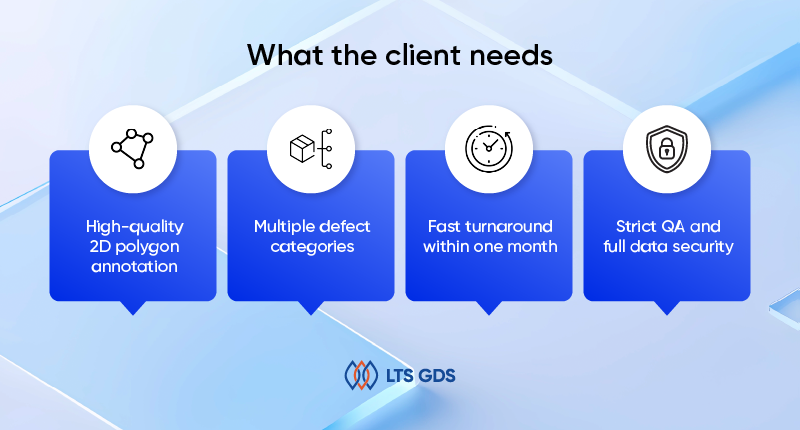
What the client needs
The client had clear expectations for both quality and delivery.
2D Polygon Annotation for Building Defects Detection
High-quality 2D polygon annotation
Each defect needed to be annotated using tight polygon boundaries, following the exact shape of the damaged area. Loose or approximate labeling would reduce the usefulness of the data for model training.
Multiple defect categories
The project covered seven types of building defects, each with distinct visual patterns that required careful interpretation.
Fast turnaround within one month
The dataset had to be fully annotated within a strict one-month timeline to keep the AI development on schedule.
Strict QA and full data security
A well-defined quality assurance process was required, along with strict control over data access and handling.
How we did it
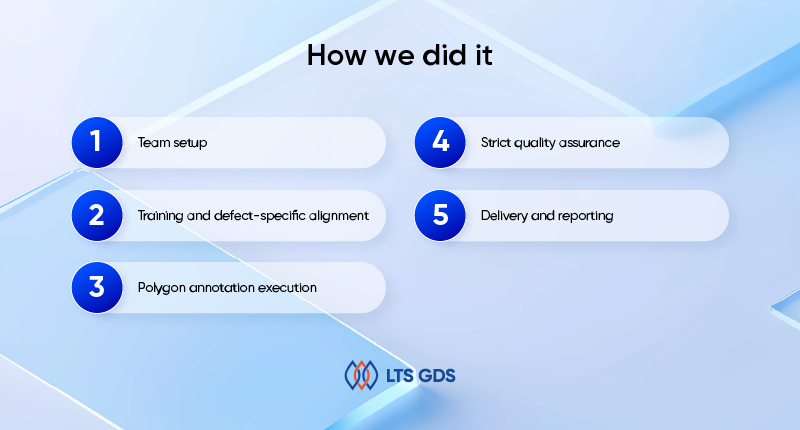
1. Team setup
We assembled a dedicated team of 30 annotators with experience in polygon-based annotation tasks that require precision and consistency.
Before production began, we worked closely with the client to align on:
– Visual definitions and examples for each defect type
– Rules for drawing tight polygon boundaries on uneven surfaces
– How to handle overlapping or adjacent defects
– Annotation output format and acceptance criteria
2. Training and defect-specific alignment
Polygon annotation for building defects requires more than basic labeling skills. Defects such as cracks or corrosion stains often have unclear edges and vary significantly in shape and size.
We conducted focused training sessions covering:
– Visual characteristics of each defect category
– Differences between similar classes (for example, cracks vs. crazing)
– How to draw tight polygons around irregular shapes
– Handling small, thin, or branching defects
3. Polygon annotation execution
The execution workflow was designed to support both speed and consistency:
– Annotators applied 2D polygon labels for all visible defects
– Unclear cases were flagged and discussed promptly to prevent inconsistent interpretations.
– Completed batches were prepared for QA review
4. Strict quality assurance
Quality assurance was embedded into daily operations, not treated as a final checkpoint. We applied a four-layer QA process to control accuracy throughout the project. The QA workflow included:
– Self-check: Annotators reviewed their own work before submission to catch obvious errors.
– Cross-review: Annotated images were reviewed by another team member to identify missed defects or incorrect boundaries.
– Vertical review: QA leads performed deeper inspections across batches to detect systematic issues.
– Final inspection: A final validation step ensured that all outputs met the agreed acceptance criteria before delivery.
When recurring issues were identified, we paused affected tasks briefly to clarify guidelines and realign the team. This prevented errors from spreading across large volumes of data.
5. Delivery and reporting
Annotations were delivered in structured batches throughout the month, allowing the client to review progress early and provide feedback. We maintained regular updates on:
– Number of images and objects completed
– QA results and error trends
– Overall progress against the timeline
This transparent delivery approach helped the client stay confident that the project was on track.
What the results have
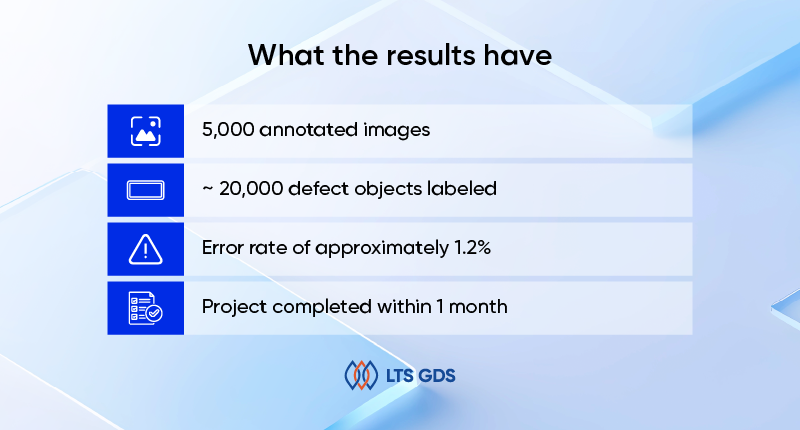
At the end of the one-month project, we delivered:
– 5,000 annotated images
– ~20,000 defect objects labeled
– 7 defect categories annotated with 2D polygon technique
– Error rate of approximately 1.2%
– Project completed within 1 month
All deliverables met the client’s quality, security, and timeline requirements.