



Today’s companies face growing pressure to optimize IT while controlling costs, strengthening security, and navigating complex compliance requirements across regions. These challenges are a major driver behind the rapid growth of the managed services market as organizations increasingly turn to one of the top managed service providers (MSPs) to access specialized expertise and stay focused on their core business.
If your team is in the middle of searching for a vetted MSP to count on for scaling fast in 2026 and beyond, let’s dig in our curated list.
All of the providers were subjected to close scrutiny with various filters, including service capability, industry experience, global coverage, certifications and recognitions, pricing approach, and investment in innovation and technology.
In case this sort of service seems misty, check out the ins and outs of managed services in our recent article.
Top 10 Managed IT Service Providers in 2026
1. LTS GDS
Overview
LTS Global Digital Services or LTS GDS, a subsidiary of LTS Group founded in 2016, offers various BPO services, from data processing services, LLM training services to IT managed services.
LTS GDS operates with more than 50 professionals holding industry-recognized certifications such as CCSP, CISSP, and ITIL. These experts support global teams without any communication barriers as they have a good command of English, Korean, Japanese, and Vietnamese.
To support seamless operations, LTS GDS provides continuous IT coverage through flexible shift models ranging from standard business hours (12/7, 12/5, 8/5) to full 24/7 operations. This structure allows enterprises across North America, Europe, and APAC to maintain service levels and faster response times, regardless of time zone differences.
In addition, service capacity can be adjusted up or down with minimal lead time, helping organizations respond quickly to growth, restructuring, or seasonal workload changes without the overhead of expanding internal teams. Especially, following international standards and compliance frameworks makes LTS GDS protect enterprise infrastructure and data across all managed services.
Website: https://www.gdsonline.tech/
Headquarters: Hanoi, Vietnam
Industry expertise
LTS GDS specializes in autonomous driving, construction, manufacturing, retail, and BFSI sectors. Key clients are leading enterprises across various industries, including Qualcomm, Panasonic, Toshiba, and LG Electronics.
Certifications & recognition
- ISO 27001;
- ISO 9001:2015;
- Cisco Certified Network Associate/ Professional
- Microsoft Partner
- AWS Certified Solutions Architect – Associate/Professional
- Top 10 Leading Companies in BPO & Testing by VINASA
Pricing models
LTS GDS offers flexible pricing tailored to client preferences:
- Time & materials
- Unit-based
LTS GDS is the top choice for SMEs as they emphasize transparent pricing with no hidden fees and include regular service reviews to optimize the portfolio and ensure continued value. Two options are available, including time & materials and unit-based pricing for enterprise clients with different requirements. They emphasize transparent pricing with no hidden fees and include regular service reviews to optimize the portfolio and ensure continued value.
Best for
SMEs across the Automotive, Construction, Retail, Manufacturing, and BFSI sectors are seeking managed services vendors that offer specialized language capabilities in APAC and reliable 24/7 support.
2. ScienceSoft
Overview
ScienceSoft is a well-established IT services company with over 35 years of experience, providing end-to-end managed services. Known for its adaptability and engineering-driven delivery models, the company leverages a large pool of 750+ IT experts to serve clients across the U.S., GCC, and EU in over 70 countries and 30 industries. ScienceSoft has strong expertise in the Healthcare and Financial Services sectors, while also delivering solutions for leading global companies like IBM, eBay, and Ford.
Website: scnsoft.com
Headquarters: Texas, United States
Industry expertise:
Healthcare, financial services, retail, and manufacturing.
Certifications & recognition
- ISO 9001
- ISO 27001
- Microsoft Gold Partner
- AWS Select Consulting Partner
Pricing models
ScienceSoft offers multiple pricing approaches including
- Per-ticket pricing
- Fixed monthly fees
- Time & material
- Mixed model
Best for
SMEs specializing in the Healthcare and Financial Services sectors are seeking specialized IT Helpdesk services with various cost options.
3. Accenture
Overview
Accenture is a dominant multinational professional services company specializing in information technology services and management consulting. Founded in the United States in 1989 and now headquartered in Dublin, Ireland, Accenture is a Fortune Global 500 company that reported substantial revenues of $64.9 billion in 2024.
Accenture operates as one of the largest technology and consulting firms globally, offering comprehensive managed services to clients in more than 120 countries through a global talent pool. Thus, they are able to transform and manage your IT environment at scale.
Website: accenture.com
Headquarters: Dublin, Ireland
Industry expertise
Financial services, healthcare, retail, energy, manufacturing, consumer goods.
Certifications & recognition
- ISO 27001
- ISO 20000
- Partner with Microsoft, AWS, Google Cloud, Oracle, SAP, Salesforce.
Pricing models
- Tiered support packages
- Fixed monthly fees
- Hybrid model
Best for
Accenture is best suited for large multinational corporations and government entities seeking IT managed services on a global scale.
4. Tata Consultancy Services (TCS)

Overview
Tata Consultancy Services (TCS) is a leading Indian multinational technology company and a trusted partner in digital transformation, specializing in comprehensive information technology services and consulting since 1968. As a key part of the Tata Group, TCS delivers world-class IT managed services by leveraging its skilled global workforce of over 600,000 consultants and a mature system of 180 service delivery centers across 55 countries. Utilizing this vast experience, mature systems, and diverse ecosystems, TCS focuses on providing clients with efficient IT operations and especially cybersecurity solutions.
Website: tcs.com
Headquarters: Mumbai, India
Industry expertise
BFSI, retail, manufacturing, telecom, energy.
Certifications & recognition
- ISO 27001
- CMMI Level 5
Pricing models
- Per-user subscriptions
- Tiered packages
- Monthly fixed fee
Best for
Best suited for global enterprises looking for an MSP to deliver a wide range of IT managed services across multiple sectors.
5. Wipro
Overview
With over 75 years of history, Wipro has become a global technology company renowned for providing comprehensive IT, consulting, and business process services. With a vast global talent pool across more than 60 countries, Wipro delivers large-scale Managed IT Services driven by a cybersecurity-first approach, utilizing its 8 Global Cyber Defense Centers to ensure client operational resilience and high security.
Website: wipro.com
Headquarters: Bengaluru, India
Industry expertise
BFSI, retail, manufacturing, energy
Certifications & recognition
- ISO 9001
- ISO 27001
- ISO 20000
- SEI CMMI Level 5
Pricing models
- Per user pricing
- Monthly fixed fee
- Tiered packages
Best for
Wipro’s IT managed services are best suited for large, multinational enterprises that require a vendor capable of integrating large-scale IT operations with an always-on cybersecurity defense.
6. HCL Technologies
Overview
Over 40 years, HCLTech is a global technology company that specializes in comprehensive IT services, consulting, and digital products. With over 200,000 people across 60 countries, HCLTech maintains an operational ecosystem on a global scale. The company delivers industry-leading managed capabilities centered around AI, digital, engineering, cloud, and software for diverse industries, including Financial Services, Healthcare, and Manufacturing.
Website: hcltech.com
Headquarters: Noida, India
Industry expertise
Financial services, manufacturing, public services, life sciences, healthcare, and retail.
Certifications & recognition
- ISO 9001
- ISO 27001
- SEI CMMI Level 5
- Partner with Microsoft, AWS, Google Cloud, SAP, Oracle.
Pricing models
- Output-based pricing
- Per user pricing
- Fixed monthly fees
Best for
HCLTech’s IT managed services are best for large global enterprises seeking to modernize their core IT landscape, particularly those in Financial Services, Healthcare, and Manufacturing.
7. DXC Technology
Overview
DXC Technology is a global IT services leader and a Fortune 500 company built on over 60 years of experience, specializing in helping enterprises run their complex systems and operations. DXC provides end-to-end Managed IT Services in over 60 countries, and they particularly focus on public sector organizations, optimizing data architectures, and ensuring security and scalability across hybrid cloud environments.
Website: dxc.com
Headquarters: Virginia, United States
Industry expertise
Public sector, automotive, manufacturing, and banking.
Certifications & recognition
- ISO 9001
- ISO 27001
- ISO 20000
- PCI-DSS
Pricing models
- Fixed price contracts
- Per user pricing
- Hybrid models
Best for
Best suited for Fortune 500 enterprises and large public sector organizations that need a trusted partner to manage hybrid IT environments. They are ideal for clients prioritizing an end-to-end service focused on data architecture optimization, security, and multi-cloud scalability.
8. Capgemini

Overview
Founded in 1967, Capgemini is a global leader in consulting and technology services, renowned for helping organizations worldwide transform and manage their businesses. Capgemini delivers end-to-end Managed IT Services with a strong focus on leveraging Cloud, Data, AI, and Digital Engineering to address business needs, with a notable specialization in the European market.
Website: capgemini.com
Headquarters: Paris, France
Industry expertise
Automotive, consumer products, energy, and public sector.
Certifications & recognition
- ISO 9001
- ISO 27001
- ISO 20000
- Multiple SOC 2 reports
- Partner with Microsoft, AWS, Google Cloud, Salesforce, SAP, Oracle.
Pricing models
Flexible pricing models depending on different requirements.
Best for
Capgemini’s IT managed services are ideal for large global corporations, particularly those in Europe, seeking a truly integrated partner to manage the full lifecycle and excel at leveraging Cloud, Data, and AI to drive growth.
9. NTT Data
Overview
NTT DATA belongs to the NTT Group, one of the world’s largest technology and telecommunications companies, headquartered in Japan. NTT DATA serves clients in over 70 countries across the world with diverse IT ecosystems, including consulting, industry solutions, business process services, IT modernization, and managed services. The company maintains a particularly strong presence across the APAC region and globally.
Website: nttdata.com
Headquarters: Tokyo, Japan
Industry expertise
Telecom, financial services, public sector, manufacturing.
Certifications & recognition
- ISO 9001
- ISO 27001
- ISO 20000
- Partner with Microsoft, AWS, Google Cloud, SAP, Oracle, VMware
Pricing models
- Fixed price contracts
- Unit-based pricing
- Tiered packages
Best for
NTT DATA’s IT managed services are best suited for global enterprises (particularly strong in the APAC region) seeking comprehensive services, from business consulting to IT operations. These services are powerfully backed by the stability and immense resources of the entire NTT Group.
10. Cognizant
Overview
Founded in 1994, Cognizant is a leading American multinational IT consulting and outsourcing company that transforms clients’ business, operations, and technology models. Cognizant specializes in comprehensive IT infrastructure operations services for the digital era, with strong capabilities in cloud, data, AI, and cybersecurity.
Website: cognizant.com
Headquarters: New Jersey, United States
Industry expertise
Healthcare, manufacturing, retail, and banking.
Certifications & recognition
- ISO 9001
- ISO 27001
- ISO 20000
- SEI CMMI Level 5
- HIPAA
- Partner with Microsoft, AWS, Google Cloud, Rubrik
Pricing models
- Unit-based pricing
- Fixed monthly fees
- Hybrid models
Best for
Cognizant’s IT Managed Services are optimally suited for large enterprises (especially American multinationals) seeking a partner that prioritizes comprehensive IT infrastructure operations with a heavy focus on leveraging advanced capabilities in Cloud, Data, AI, and Cybersecurity.
How to Choose the Right IT Managed Service Provider
In today’s large and highly competitive market, choosing an IT Managed Service Provider goes beyond technical capability. Selecting the wrong partner can lead to delayed projects, operational disruption, and unexpected costs. That’s why businesses need a structured approach to evaluating MSPs, starting with clear priorities and specific expectations.
Below are the key criteria to consider when shortlisting and assessing potential MSPs.
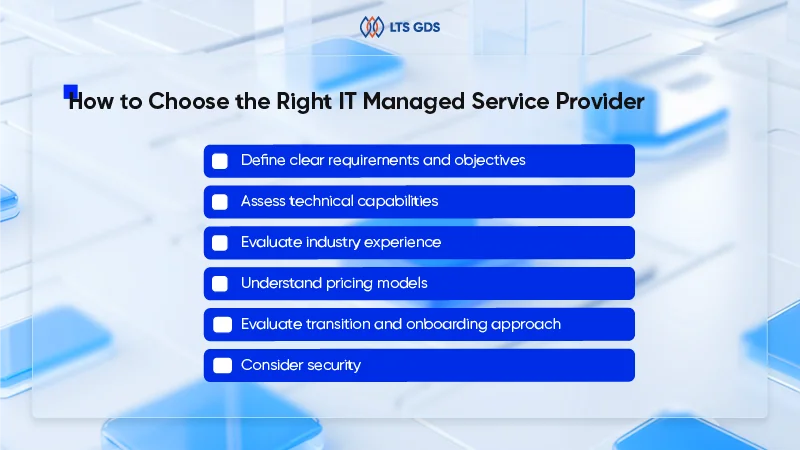
Define clear requirements and objectives
Before comparing vendors, be clear about what you actually need from an MSP. Different providers are strong in different fields. Some questions which clients should ask:
- What specific services do you include ( IT helpdesk, network monitoring, cloud management)?
- What tools and technologies do you use for monitoring, management, and security?
- What certifications (Microsoft, Cisco, specific security frameworks) do your engineers hold?
- Can your services easily scale up or down as our business grows, or our needs change?
- Do you have experience serving clients in our specific industry (e.g., healthcare, finance, manufacturing)?
It is essential to clear priorities to make it much easier to rule out providers that don’t fit.
Assess technical capabilities
When evaluating MSPs, pay attention to how they actually deliver the services you need. If cloud migration matters, start with the platforms they work on most often and the certifications their engineers hold. Ask to see similar projects they’ve handled before and use those examples to judge whether their experience fits your setup.
For cybersecurity, don’t stop generic security statements. Look at how their security team operates day to day, what tools they use to monitor threats, and how they handle real incidents.
Evaluate industry experience
Industry experience affects how smoothly an MSP can execute a project. A provider that has worked in your industry is more likely to understand common challenges, day-to-day workflows, and any regulatory constraints involved.
When reviewing MSPs, check whether they’ve supported companies similar to yours before. Look at the types of systems they managed, the problems they helped solve, and how well they understood the business side.
Understand pricing models
Pricing needs to be clear and predictable. Beyond the base service fee, make sure you understand what you’re paying for and when extra charges apply.
When reviewing pricing, watch for unclear packages and check what is actually included, such as add-on services, contract changes, and exit terms. Hidden fees and surprise charges often become pain points later in managed services engagements, especially when the scope starts to change.
Evaluate transition and onboarding approach
The transition to managed services is a critical phase that can impact current business operations if not done well. Evaluate each provider’s transition methodology, risk mitigation strategies, and track record for successful transitions.
Clients need to request detailed information about their transition approach including timeline, phases, roles and responsibilities, knowledge transfer processes, and stabilization period. Well-structured transitions include comprehensive discovery phases, detailed planning, phased handover with redundancy built in, and an extended stabilization period during which both teams work closely together.
Consider security
If your business handles sensitive data or operates under compliance requirements, security should be checked early before contracts and scopes are finalized. It’s important to understand how an MSP protects your systems in 24/7 operations, not just what’s written in their policies.
Review how security is managed across their delivery setup, including access control, data protection, network monitoring, and incident handling. Ask how delivery centers are secured, who can access your systems, and how security issues are detected and resolved.
How Much Does Managed IT Service Cost?
Choosing the right pricing model is one of the most important steps when evaluating managed service providers. While capabilities, SLAs, and industry expertise determine what an MSP can deliver, the pricing structure determines how the partnership will scale with your business. Let’s examine the key factors that affect IT managed service pricing.
Key Factors Influencing Managed IT Service Pricing
Before we review the common methods MSPs use to structure their fees, it is essential to recognize the core variables that push the cost up or down. Your final price is a calculation based on these defining factors:
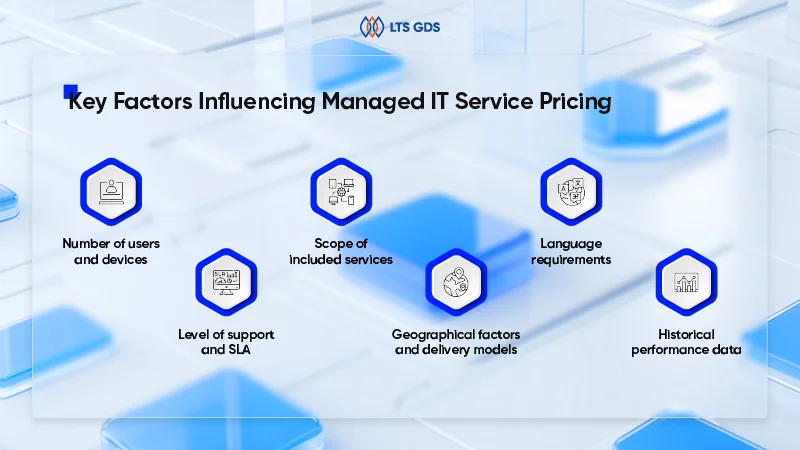
Number of users and devices: This is almost always the most significant factor. More employees (users) and more endpoints (laptops, servers, networking gear) translate to a higher potential workload, more licenses needed, and a larger environment for the MSP to secure and maintain.
Level of support and SLA: Do you require 24/7 coverage or only 9×5 support? How strict does business want the SLA to be? Premium support levels and stricter Service Level Agreement (SLA) guarantees require greater staff availability and resources.
Scope of included services: A true “all-inclusive” plan that covers everything from backup to cloud management and vendor liaison will be priced higher than a break/fix arrangement or a limited co-managed plan.
Geographical factors and delivery models: Geographies affect cost because of various labor costs. Highly developed markets like Singapore or England command premium rates, while locations like Vietnam offer more cost-competitive options. To balance cost and responsiveness, it is key to consider the delivery model:
- Offshore (remote): The lowest cost, best for monitoring.
- On-site: Highest cost, but ensures immediate response.
- Hybrid: Combines both flexibility and cost efficiency.
Language requirements: For multinational or regional operations, language support is a growing cost factor. Providing engineers fluent in specific languages (e.g., JLPT certified Japanese, business-level English, etc.) requires specialized talent acquisition. The need for bilingual or multilingual support for key markets can raise costs by 10-30% due to the scarcity of technical professionals with certified language proficiency.
Historical performance data: MSPs need to analyze current client’s IT system to estimate risk and workload. They look at data like the volume of high-priority tickets (P1-P3), after-hours incidents (nights, weekends), and the frequency of disruptive outages or emergency change requests (CRs) over the past 12-24 months. Higher historical volumes of emergency fixes or frequent after-hours incidents request large resources to adapt, leading to rates 15-25% higher.
There are many factors that impact MSP fees, which is why it’s important to understand the most common pricing models to choose the most suitable package. Check it out!
| Pricing model
|
How it works | Pros | Cons | Best for
|
| Per user pricing | Fixed monthly fee per employee or user. | Simple forecasting; scales with headcount. | Costs grow quickly with workforce size. | Companies with stable user counts. |
| Unit-based pricing | Pay per measurable unit (ticket, call, managed device). Defined unit cost upfront, billed monthly by actual volume. | Cost predictability; transparent; no hidden fees. | Cost may fluctuate with high ticket volumes. | Firms prioritizing financial clarity and usage-based billing. |
| Time & material (T&M) | Pay for actual hours and resources used, often with pre-set maximum limits. | Pay only for what you use; scalable; transparent. | Harder to estimate long-term costs. | Organizations with evolving systems or unpredictable workloads. |
| Tiered support packages | Predefined bundles (Basic/Standard/Premium). | Predictable, easy to budget. | Less customization. | Organizations wanting simplified selection. |
| Fixed monthly fee (all-inclusive) | One monthly cost covering full managed services scope. | Predictable; comprehensive. | Higher baseline cost. | Enterprises seeking full outsourcing. |
| Hybrid model | Combination of per-user/device + fixed fee + incentives. | Flexible and optimized. | Complex to manage. | Large multi-region enterprises. |
Emerging Trends Shaping the Managed Services Market in 2026
The MSP landscape is rapidly evolving, moving beyond simple break-fix support into strategic partnership territory. When selecting a provider in 2026, enterprises must ensure the MSP’s capabilities align with these transformative trends:
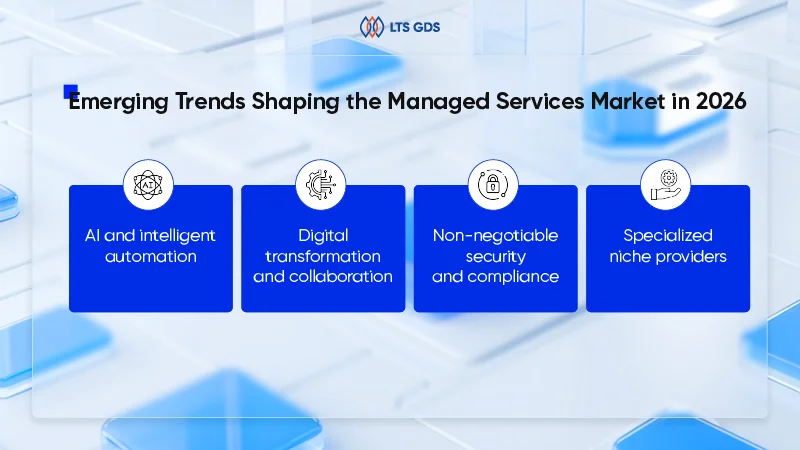
AI and intelligent automation
AI and intelligent automation are revolutionizing service delivery, allowing providers to shift from slow, reactive support toward predictive and even autonomous operations.
What to seek:
- Proof of automation: Ask providers to demonstrate how their AI-powered platforms analyze operational data, predict potential system failures before they occur, and automatically remediate common issues without human intervention.
- Value shift: Look for a reduction in ticket volume and faster resolution times as proof that the MSP is investing in automation.
Digital transformation and collaboration
Rather than managing separate vendors for steady-state operations versus complex transformation projects, organizations now prefer integrated partners who can deliver both. This collaboration utilizes resources and vendor systems.
What to seek:
- Strategic roadmaps: Select MSPs that offer technology consulting services, helping companies develop a strategic roadmap for cloud adoption, infrastructure modernization, or application migration alongside their day-to-day management.
- “Run and change” capability: Ensure the provider has distinct teams capable of handling both the daily operational stability and the strategic change plans.
Non-negotiable security and compliance
More organizations now recognize the important role of security and can no longer ignore it, as it directly affects the stability and integrity of IT systems.
What to seek:
- Integrated security: Request clear information about the security systems and controls the MSP provides across its services.
- Compliance expertise: Verify the MSP’s specific knowledge and proven track record in managing compliance requirements relevant to your industry (e.g., HIPAA, SOC 2, ISO 27001), including the ability to deliver audit-ready documentation.
Specialized niche providers
While global MSPs continue to dominate large enterprise deals, specialized niche providers focusing on specific technologies, industries, or service areas are gaining traction. These providers offer focused expertise at competitive prices.
What to seek:
- Deep vertical expertise: For highly specific or cutting-edge technical needs, explore niche providers who can offer unparalleled depth of knowledge that generalist MSPs might lack.
- Best-of-breed approach: Consider a multi-vendor strategy where you use a specialized niche MSP for a critical domain while a larger MSP handles general operations, leveraging the best capabilities from both.
FAQs about Managed Services Companies
What is a managed service provider (MSP)?
A managed service provider is an external organization that manages and takes responsibility for providing a defined set of IT services to clients on an ongoing basis. Unlike traditional break-fix support models that react to problems, MSPs proactively monitor, maintain, and optimize IT systems under service level agreements that define performance expectations. Managed services can span infrastructure management, application support, cybersecurity, cloud operations, end-user support, and business process services.
How much do managed IT services cost?
Managed service provider pricing varies significantly based on service scope, complexity, user count, and provider characteristics. Small business packages may start around $100-200 per user per month for comprehensive support, while enterprise services for complex environments may range from $500-2000+ per user monthly depending on requirements.
What are the different types of managed services?
Managed services encompass diverse offerings including infrastructure management (servers, networks, storage, data centers), cloud managed services (migration, operations, optimization), application management (monitoring, maintenance, support), managed security services (threat monitoring, incident response, compliance), workplace services (help desk, device management), backup and disaster recovery, and business process services.
At LTS GDS, we offer different IT managed services such as application management, infrastructure management, security to endpoint management, and technical support. Furthermore, we leverage our strategic collaboration with OpenText to provide specialized solutions such as OpenText Network Operations Management, OpenText Network Node Manager, and OpenText Network Automation.
What are the benefits of using managed IT services?
Organizations leverage managed services to access specialized expertise unavailable internally, reduce total IT costs, improve service quality, enhance security posture, achieve operational predictability, scale IT capabilities flexibly, and free internal resources to focus on strategic initiatives rather than routine operations. The specific benefits we’ll see depend on current IT maturity, internal capabilities, and how well the MSP relationship is structured and managed.
What should be included in a managed services SLA?
Comprehensive service level agreements should spell out availability commitments for critical systems (typically 99.5-99.9%+), response time commitments based on incident severity (15 minutes or less for critical issues), resolution time targets considering business impact, performance metrics for key services, security and compliance commitments, reporting frequency and content, escalation procedures for issues and disputes, and consequences for SLA misses including service credits or remediation requirements. Strong SLAs also define exclusions, maintenance windows, and how performance is measured to ensure shared understanding and prevent disputes.
Final Thoughts on Top Managed Service Providers
Global IT managed services market size is projected to grow from USD 259.23 billion in 2025 to USD 282.13 billion in 2026, reaching USD 497.27 billion by 2034. These figures well proves that managed services are becoming more and more prevalent and choosing one of the best managed service providers is a strategic move for businesses to scale.
At LTS Global Digital Services, we specialize in IT managed services with tactical consulting to adapt to customized requirements. If you are looking for a managed services vendor that offers comprehensive IT managed services, contact us right away.