


Client overview
Our client is a university in Italy conducting a government-funded research project focused on insects, larvae, and disease transmission. The research aims to improve early detection and analysis of insect populations that may contribute to the spread of infectious diseases.
The project relied heavily on visual data. Large volumes of biological images had been collected, but the data needed to be accurately annotated before it could be used for analysis and model training. Because the subject matter involved biological and medical research, the client required a vendor with both technical annotation skills and a strong understanding of domain-specific sensitivity and data handling.
What the client needs
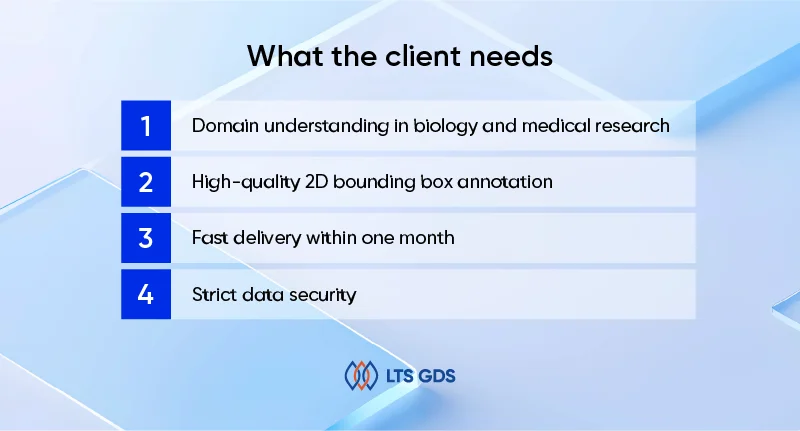
Domain understanding in biology and medical research
Annotating larvae requires attention to small visual details and biological characteristics. The client needed a team capable of working carefully with scientific image data.
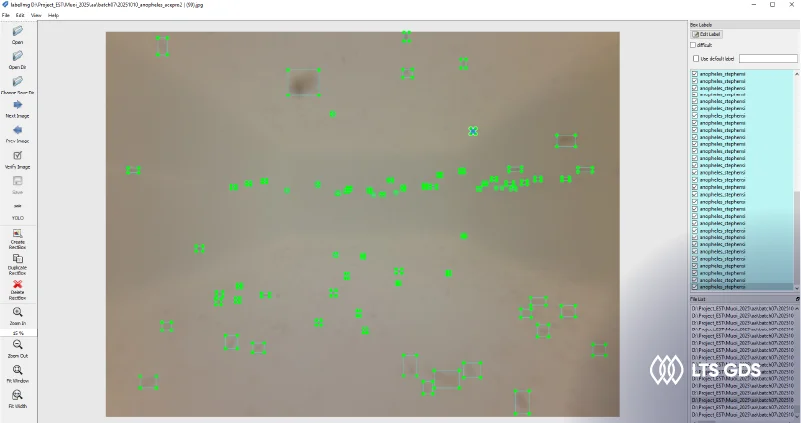
High-quality 2D bounding box annotation
The goal was to detect and localize insects and larvae accurately within images. Bounding boxes had to be tight, consistent, and suitable for downstream analysis.
Fast delivery within one month
The research timeline was fixed. All annotation work had to be completed within a one-month window.
Strict data security
As part of a government-funded project, all data had to be handled securely, with controlled access and approved tools only.
How we did it
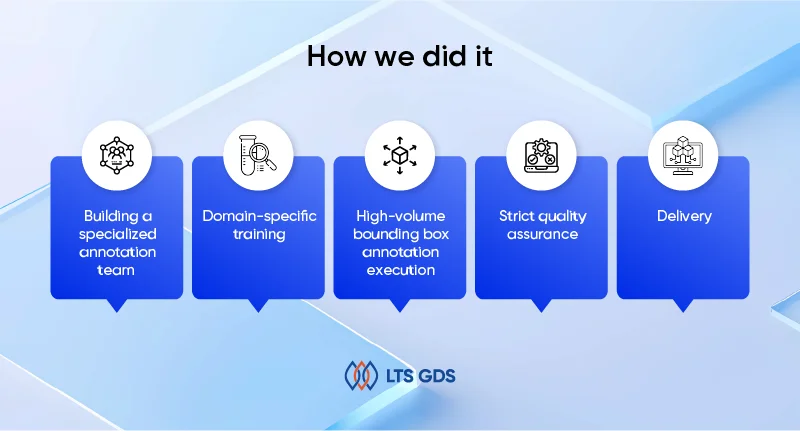
1. Building a specialized annotation team
We began by assembling a dedicated team of 10 annotators. Team members were selected based on prior experience in biological image data. Before starting annotation, we worked with the client to align on:
– Definitions and visual examples for each larvae type
– Bounding box rules, including tightness and overlap handling
– Review and acceptance criteria
2. Domain-specific training
Although the annotation method was 2D bounding box, the subject matter required careful domain understanding. Larvae are small, sometimes partially visible, and can be easily confused with background noise or artifacts. We conducted focused training sessions covering:
– Visual characteristics of each larvae type
– How to distinguish larvae from debris or image artifacts
– Drawing tight bounding boxes without cutting off relevant parts
3. High-volume bounding box annotation execution
After training, the team moved into full production. The execution workflow was designed to support both speed and consistency:
– Images were assigned in controlled batches
– Annotators labeled each larvae instance using 2D bounding boxes
– Each image was reviewed by the annotator before submission
– Completed batches were prepared for QA review
Any unclear or uncertain cases were flagged and discussed immediately to avoid rework later.
4. Strict quality assurance
Quality assurance was embedded into daily operations, not treated as a final checkpoint. LTS GDS applied a four-layer QA process to control accuracy at every stage of production. The QA workflow included:
– Self-check: Each annotator reviewed their own work before submission to catch obvious errors.
– Cross-review: Annotated images were reviewed by another team member to detect missed objects, incorrect box placement, or inconsistent labeling.
– Vertical review: QA leads conducted deeper inspections across batches to identify systematic issues or deviations from guidelines.
– Final inspection: A final validation pass was performed before delivery to ensure the output met the agreed acceptance criteria.
Despite the tight deadline and high object count, this structured QA approach allowed us to maintain a 98% accuracy rate throughout the project.
5. Delivery
Annotations were delivered in structured batches throughout the month, allowing the client to review progress early and provide feedback when needed. We maintained clear and consistent communication on:
– Daily and weekly progress
– Object counts completed
– Quality status and QA findings
What the results have
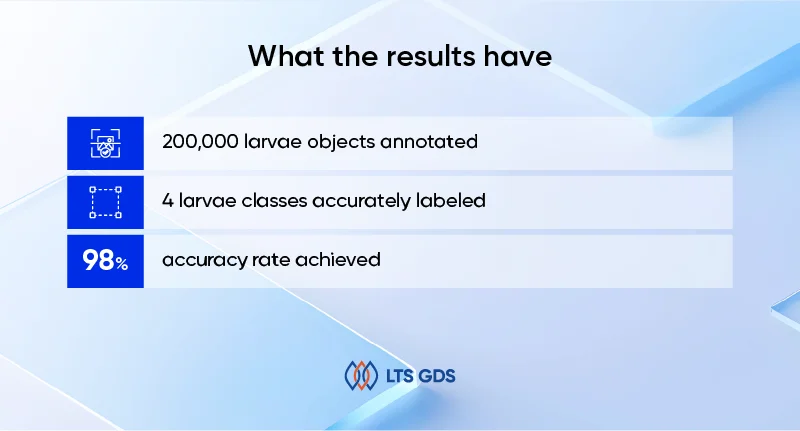
LTS GDS delivered the following results:
– 200,000 larvae objects annotated
– 4 larvae classes accurately labeled
– 98% accuracy rate achieved
All work was completed within the agreed timeframe and complied fully with the client’s security and confidentiality requirements.