


Client overview
Our client is an Israel-based technology company focused on advancing hands-free interaction systems. Their goal is to improve how people communicate with digital devices using only eye movement, eliminating the need for manual input. To support this vision, they are building AI models for accurate gaze detection. These models require large volumes of structured, real-world gaze data collected from human participants.
The project required systematic data collection of users looking at specific on-screen targets under controlled supervision. The final dataset would be used to train AI systems capable of detecting where a person is looking and interpreting gaze intent in real time.
What the client needs
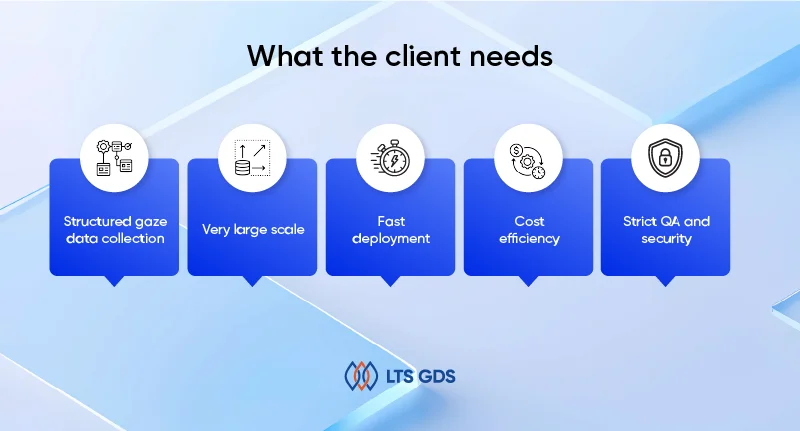
Structured gaze data collection
Participants needed to look at specific targets displayed on a screen. Each session had to follow strict positioning instructions provided by supervisors to ensure consistent capture conditions.
Very large scale
The dataset requirement was significant. The project demanded rapid team ramp-up and the training of more than one hundred participants within a short period.
Fast deployment
The timeline was tight. Data collection needed to begin quickly and scale within weeks.
Cost efficiency
Despite the large scale, the project had to remain budget-conscious.
Strict QA and security
All data collection activities required strict quality control. Participant privacy and data confidentiality were mandatory.
How we did it
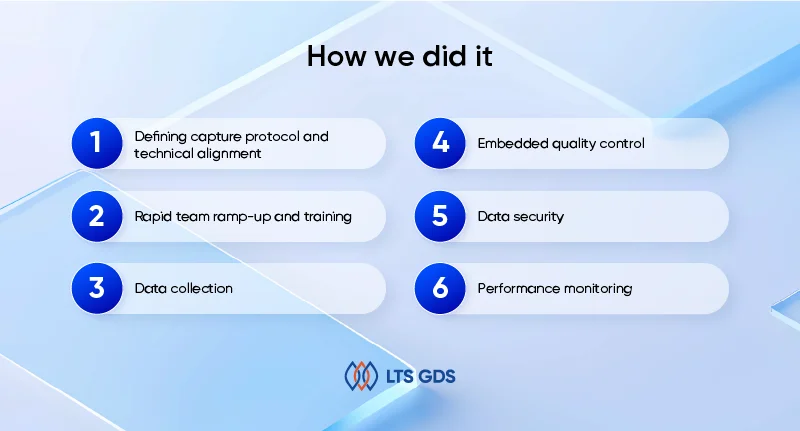
1. Defining capture protocol and technical alignment
Before starting full-scale data collection, we worked closely with the client to define a clear capture protocol. This included agreeing on how gaze targets would be displayed on the screen, how the screen should be positioned, the required distance and posture of participants, lighting conditions, camera setup standards, and the format for file naming and session tracking.
We then conducted pilot sessions to confirm that gaze targets appeared clearly, participants understood the instructions, and all data was recorded correctly within the client’s tool. We also verified that the captured images met the required technical specifications. This early validation helped us avoid rework and ensured a smooth transition into large-scale data collection.
2. Rapid team ramp-up and training
The project required scaling to more than 200 participants within a short time frame. To manage this effectively, we organized the operation around 10 trained supervisors and coordinators, with participants scheduled in controlled batches. This structure allowed us to maintain consistency while increasing volume quickly.
Supervisors were trained first before overseeing participant sessions. Their role was to guide participants through each session, ensure proper head position and eye focus, monitor screen alignment, and confirm that each session was completed correctly.
Training covered precise gaze target instructions, common mistakes such as looking slightly off target or blinking during capture, correcting posture and screen distance, and managing re-captures when image quality did not meet standards. We prepared clear and simple instructions for participants to reduce confusion and accelerate onboarding.
Because gaze data is highly sensitive to small variations, even minor deviations could reduce dataset quality. Supervisors were trained to detect and correct these issues immediately during each session.
3. Data collection
After ramp-up, we moved into full production following a structured session flow: participant briefing, setup and camera check, target display, guided gaze capture, review, and upload through the client’s tool.
Supervisors monitored eye alignment, head movement, lighting, and framing in real time. If issues were found, sessions were repeated immediately. Excel was used to track session counts, quality status, and productivity, while WhatsApp enabled quick coordination when adjustments were needed.
4. Embedded quality control
Quality control was built into daily operations rather than handled at the end. Supervisors reviewed captures immediately after each session, and random samples were rechecked to verify gaze accuracy and compliance with positioning rules. We always monitored recurring issues such as slight gaze misalignment, inconsistent lighting, incomplete target coverage, or motion blur. Accuracy was tracked throughout the project, and only sessions meeting predefined quality thresholds were accepted.
5. Data security
All captured data was uploaded directly into the client’s system, with no files stored locally outside the secure workflow. Access was limited to approved supervisors only. Participant information was separated from image data to protect privacy, and communication tools were used strictly for coordination, not for transferring raw files.
6. Performance monitoring
We closely tracked daily image volume, supervisor productivity, re-capture rates, rejection percentages, and overall accuracy compliance. This helped us maintain the right balance between speed and quality. If any team showed higher error rates, we adjusted supervision levels and provided additional guidance. The ramp-up model allowed us to scale steadily while maintaining consistent standards.
What the results have
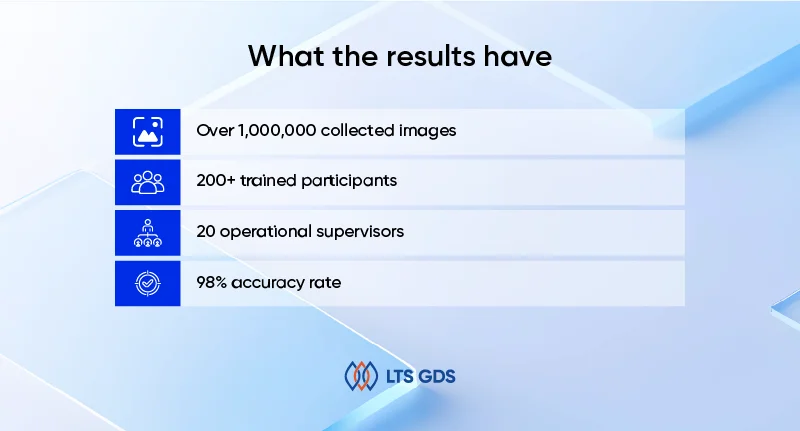
Over a little more than one month, we achieved:
– Over 1,000,000 collected images
– 200+ trained participants
– 20 operational supervisors
– 98% accuracy rate
Secure and structured dataset delivery
The dataset met the client’s technical requirements and was ready for AI model training.