


Client overview
Our client is a global leader in financial markets and financial technology, supporting capital formation, trading, and market infrastructure worldwide. Their network environment spans multiple regions and includes a wide range of network devices and applications that must operate reliably at all times.
Trading volumes and market complexity increased, the client faced several operational challenges:
– Real-time issue detection and alerting were critical, but existing processes lacked consistency
– Comprehensive reporting was required to meet internal governance and regulatory expectations
– Manual operations for taking snapshots, patching, and applying new device images increased risk and operational effort
The client required a dedicated AMS partner to operate and improve OpenText™ Network Operations Management.
What the client needs
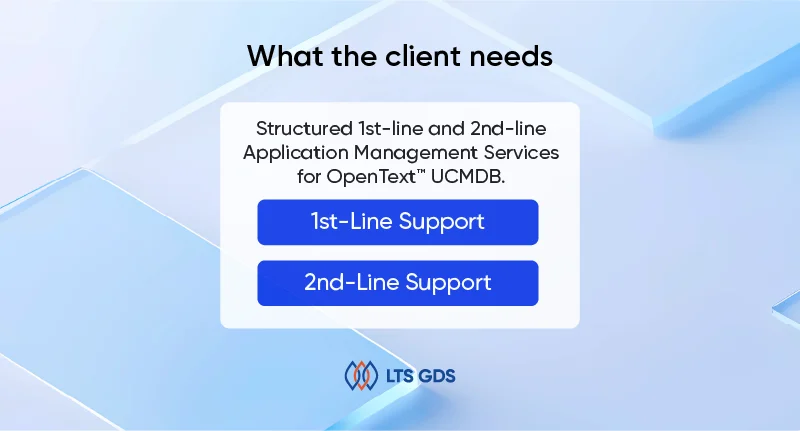
Our client required structured 1st-line and 2nd-line support for network and application operations.
1st-Line Support
– Onboard and configure new network devices on both device and application sides
– Monitor incident dashboards and application health
– Report incidents clearly and escalate when required
2nd-Line Support
– Handle configuration and integration issues
– Configure advanced features on devices and applications
– Work directly with device and application vendors to resolve complex issues
How we did it
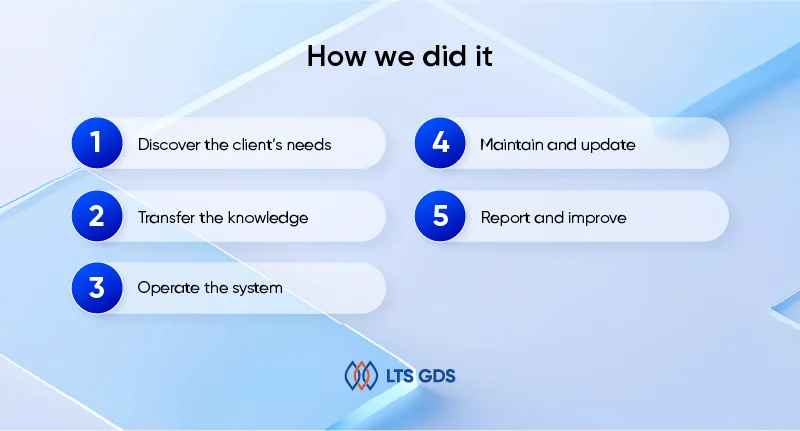
To meet these requirements, we followed a step-by-step process:
1. Discover the client’s needs
– Reviewed the existing OpenText™ Network Operations Management setup
– Analyzed incident patterns, alerting gaps, and reporting requirements
– Assessed network device diversity, including Cisco, Juniper, Fortinet, and other vendors
– Defined roles and responsibilities for 1st-line and 2nd-line support
2. Transfer the knowledge
LTS GDS launched this project by implementing a structured knowledge transfer protocol.
– Collected and reviewed network documentation, configurations, and operational procedures
– Prepared access to operational tools, including Salesforce for ticketing and remote control tools for device access
– Aligned communication channels across chat, calls, and email
– Ran trial operations to validate alert handling, escalation paths, and response timing
3. Operate the system
After onboarding, a 6-member AMS team took responsibility for daily operations.
– Onboarded and configured new network devices using OpenText™ Network Node Manager and Network Operations Management
– Monitored incident dashboards and application health in real time
– Logged and managed incidents through Salesforce
– Performed routine operational tasks and escalated issues based on priority
– Handled configuration issues and advanced feature setup on network devices and applications
– Worked directly with device and application vendors to resolve complex issues
4. Maintain and update
Effective long-term application management required us to concentrate on maintenance.
– Collected incidents, configuration changes, and recurring issues for document.
– Updated internal runbooks and operational guidelines regularly
– Maintained automation workflows for snapshots, patching, and image deployment
– Reviewed device configurations and application settings to ensure accuracy and compliance
5. Report and improve
– Delivered regular service reports covering ticket volume, response times, and SLA compliance
– Reviewed incident trends and automation performance with stakeholders
– Adjusted scope and processes as network complexity and business needs evolved
What the results have
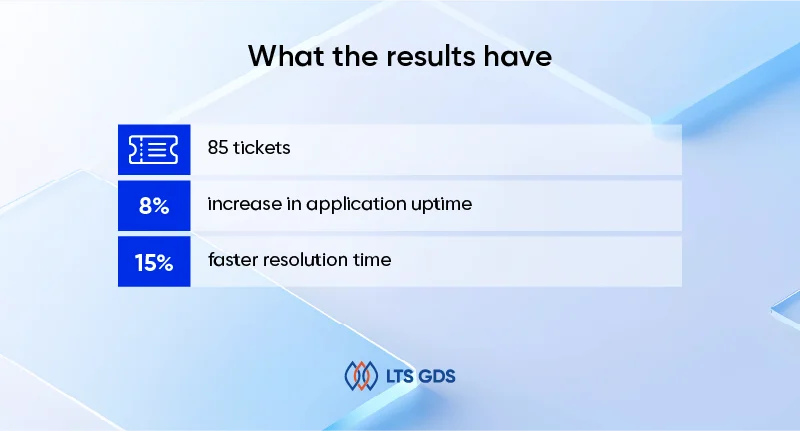
We have successfully achieved the following measurable results:
– 6 dedicated AMS engineers supporting network and application operations
– 85 tickets handled per month on average
– Consistent SLA compliance, with response times maintained at:
- Critical: ≤ 30 minutes
- High: ≤ 1 hour
- Medium: ≤ 2 hours
- Low: ≤ 4 hours
– 8% increase in application uptime
– 15% faster resolution time for OpenText-related tickets
– 98% of devices now able to take snapshots and apply new images automatically