


Client overview
Our client is an automotive software development company based in the UK. They offer digital solutions to a diverse client base, including partners in the automotive ecosystem. Their platforms support the development, testing, and deployment of applications used across multiple environments.
When the business scaled, cloud usage increased rapidly, leading to some challenges:
– 24/7 operations and monitoring
– CI/CD and application delivery pressure increased as release cycles became shorter
– Cloud costs grew quickly, with limited visibility into optimization opportunities
– Talent and skill gaps made it difficult to operate and optimize the cloud environment internally
What the client needs
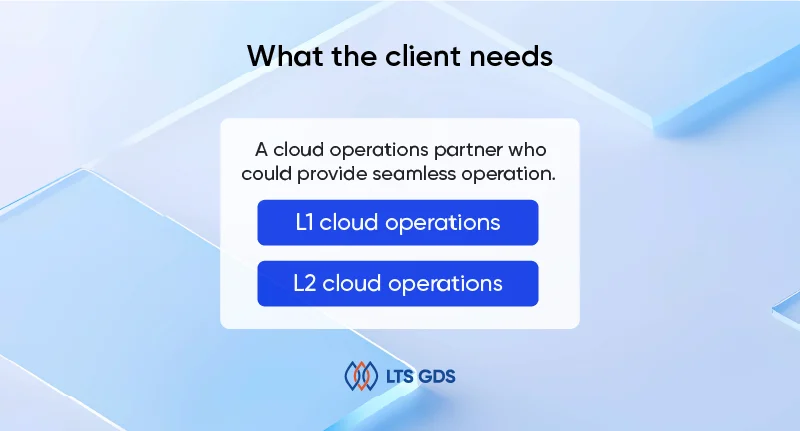
The client required a cloud operations partner who could provide seamless operation.
L1 cloud operations
– Monitoring of cloud infrastructure, applications, and services
– User account and permission management
– Build and configuration of new cloud resources upon request
L2 cloud operations
– Troubleshooting cloud resource and configuration issues
– Performance tuning and security compliance checks
– Support for CI/CD pipelines, configuration management, and release management
How we did it
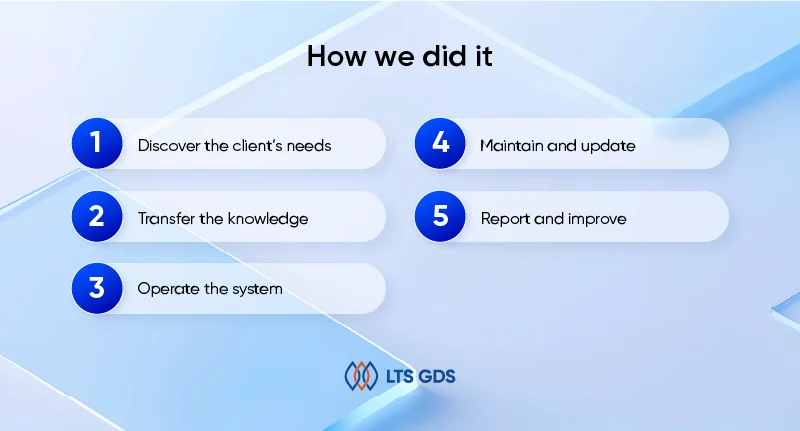
1. Discover the client’s needs
LTS GDS began by analyzing the client’s cloud environment and operational challenges.
– Reviewed existing cloud architecture, applications, and operational workflows
– Assessed monitoring coverage, deployment pipelines, and security controls
– Identified gaps in cloud operations, CI/CD support, and cost management
– Defined clear L1 and L2 responsibilities based on operational complexity
2. Transfer the knowledge
– Collected and reviewed documentation, configurations, and infrastructure definitions
– Understood existing CI/CD workflows, release processes, and dependencies
– Prepared internal teams and aligned tools such as Jira, Azure Monitor, Splunk, and Grafana
– Finalized the operating model and escalation paths
– Ran trial operations to validate monitoring alerts, ticket flows, and response handling
3. Operate the system
After the handover, the dedicated 8-member cloud operations team began full operations:
– Provided continuous monitoring of cloud infrastructure and applications
– Handled service requests, incidents, and changes through Jira
– Managed user accounts and access via Azure Entra ID
– Built and configured new cloud resources using Terraform and Azure Bicep
– Investigated and resolved performance and configuration issues
– Supported CI/CD pipelines using GitHub, GitLab, Azure DevOps, Docker, Kubernetes, and Helm
4. Maintain and update
To keep operations efficient, LTS GDS focused on:
– Documented solutions for incidents, changes, and repeat operational tasks
– Updated internal runbooks and operational guidelines
– Maintained configuration and security data in centralized systems
– Conducted regular reviews to ensure documentation accuracy and relevance
5. Report and improve
To optimize this project, LTS GDS always updated performance reports and suggested innovative solutions for CI/CD workflows and operational processes. Besides, we reviewed service trends and incident patterns with the client, contributing to increasing revenues.
What the results have
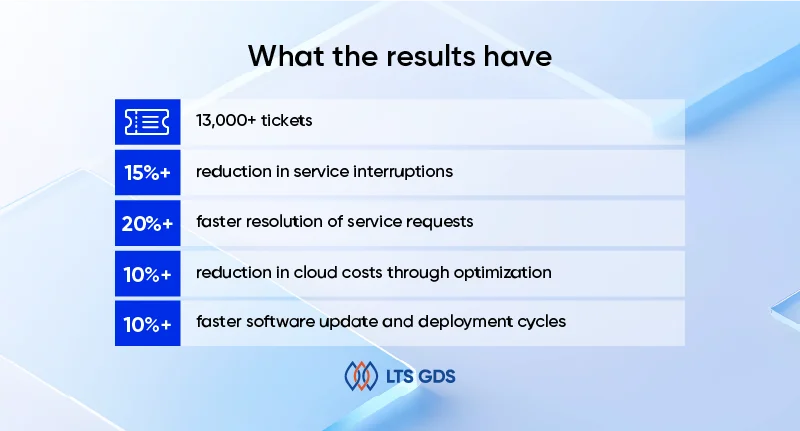
Over the 15-month execution, the following measurable successes have been recorded:
– 13,000+ tickets handled across cloud operations and CI/CD support
– 8 dedicated cloud operations engineers
– Consistent SLA compliance, with response times maintained at:
- Critical: ≤ 30 minutes
- High: ≤ 1 hour
- Medium: ≤ 2 hours
- Low: ≤ 4 hours
– 15%+ reduction in service interruptions
– 20%+ faster resolution of service requests
– 10%+ reduction in cloud costs through optimization
– 10%+ faster software update and deployment cycles