


Enterprise IT security has entered an uncomfortable phase. Threats are accelerating, environments are fragmenting, and expectations for uptime are higher than ever, yet many organizations still approach security as a discretionary cost rather than a core operational capability. The result is a widening gap between the security posture businesses believe they have and the one they actually operate 24/7.
IT security managed services emerged not as a trend, but as a response to this gap. They reflect a broader shift in how enterprises think about risk, accountability, and scale in an environment where internal teams can no longer do everything alone.
This guide provides one perspective on IT security managed services, including their role in modern enterprises, how they differ from in-house security approaches, and how organizations can measure impact and readiness.
What Are Managed IT Security Services?
Managed IT security services refer to the ongoing delivery of security capabilities by an external provider under a defined service model. Unlike project-based consulting, these services are continuous, operational, and governed by service-level agreements.
Security is not something that can be “implemented” once and left untouched. Systems change. Users behave unpredictably. Attack techniques evolve. Managed IT security services exist to absorb that volatility and translate it into repeatable, measurable operations.
A typical managed IT security engagement may include real-time monitoring, threat detection, incident response, vulnerability management, identity controls, backup oversight, and compliance support. The exact scope varies by provider and maturity level, but the principle remains the same: security is delivered as a managed function, not a side responsibility. It’s also essential to distinguish managed IT security services from full managed services models.
Why IT Security Is No Longer Optional
For years, security topics were dominated by fear-based narratives: breaches, fines, and reputational damage. While those risks remain real, the more compelling argument for IT security today is operational.
Downtime is no longer an inconvenience. For digital-first businesses, it is a direct revenue event. Systems that are unavailable, corrupted, or unreliable disrupt not only customers but internal workflows, partner integrations, and decision-making itself. In many cases, the cost of a single prolonged outage exceeds the annual cost of preventative security services.
Yet many organizations still underinvest in security because the value is not immediately visible. IT security does not generate revenue in the way a new product does. It prevents loss. And prevention, by definition, is difficult to quantify until it fails.
Another misconception is that cloud adoption has made security simpler. Enterprises assume that storing documents in platforms like Google Drive or Dropbox constitutes a backup strategy, or that using major cloud providers automatically ensures resilience. In reality, cloud platforms operate on shared responsibility models. They protect their infrastructure; customers remain responsible for data integrity, access control, and recovery.
This gap between perceived and actual protection is where many incidents begin. Data is overwritten, accounts are compromised, backups fail silently, and recovery plans are discovered to be theoretical only after an incident occurs. Therefore, IT security managed services become a key to controlling security overall.
Learn more: When Does a Business Need Managed IT Services
In-House IT Security vs Outsourced Managed IT Security
Choosing between in-house IT security and outsourced managed IT security is a big question of scale and operational capacity. The comparison below illustrates how the two models differ in practice.
| In-House IT Security | Outsourced Managed IT Security | |
| Operational coverage | Limited by internal staffing and working hours, 24/7 coverage is costly and difficult to offer. | Continuous monitoring and response, typically supported by dedicated security operations teams. |
| Expertise | Depends on hiring and retention; deep specialization is hard to maintain across all security domains. | Broad access to specialized security expertise across networks, endpoints, cloud, and identity. |
| Scalability | Scaling requires additional hiring, training, and tooling. | Scales more easily as environments grow or change. |
| Cost | High fixed costs, including salaries, training, and security tools. | Predictable operating expenses under subscription or SLA-based models. |
| Incident response | Response speed varies based on availability and experience. | Defined response processes with documented escalation and accountability. |
| Compliance & reporting | Reporting is often created manually and inconsistently. | Structured reporting is designed to support audits and compliance requirements. |
| Business focus | Internal teams balance security with other IT responsibilities. | Security operations are the provider’s primary focus. |
| Best for | Organizations with mature internal security teams and stable environments. | Enterprises seeking consistent coverage, faster response, and access to specialized capabilities. |
Managed IT Security Services KPIs & Metrics
Measuring the effectiveness of IT security managed services requires looking beyond surface-level activity metrics. The most meaningful indicators focus on how well security operations reduce risk, limit disruption, and support stable day-to-day operations.
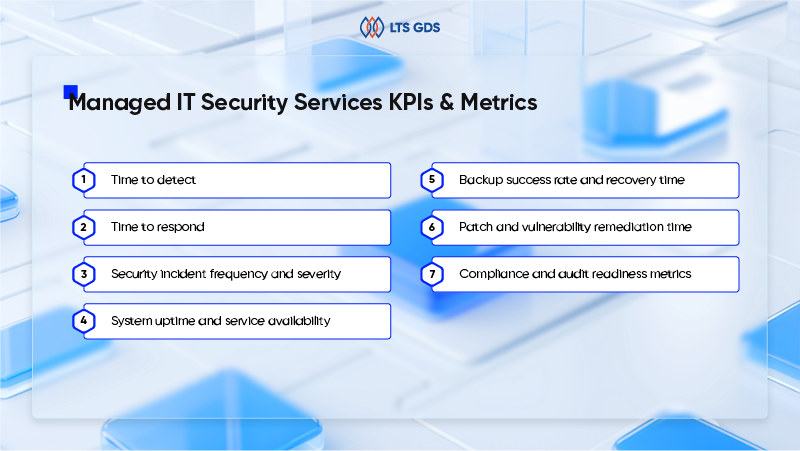
Key KPIs enterprises typically track include:
- Time to detect: Measures how quickly security threats are identified after they enter the environment. Shorter detection times reduce the window of exposure and limit potential damage.
- Time to respond: Tracks the time required to contain and remediate incidents once detected. This metric reflects both process maturity and the provider’s ability to act decisively under pressure.
- Security incident frequency and severity: Looks at how often incidents occur and how serious their impact is. A declining trend often indicates improved preventive controls and more effective monitoring.
- System uptime and service availability: Connects security performance with operational outcomes. Many security failures surface as outages rather than data breaches, making uptime a critical indicator.
- Backup success rate and recovery time: Evaluates whether backups complete successfully and how quickly systems can be restored. These metrics reveal whether recovery plans are operational or merely theoretical.
- Patch and vulnerability remediation time: Measures how quickly known vulnerabilities are addressed across systems. Delays here often correlate with higher breach risk.
- Compliance and audit readiness metrics: Assesses the consistency and quality of security reporting, logging, and documentation. These metrics are particularly relevant for regulated industries.
Read more: Managed IT Services Pricing Guide 2026
Future Trends in Managed IT Security Services
The IT security managed services are transforming rapidly, driven by both technological change and organizational reality.
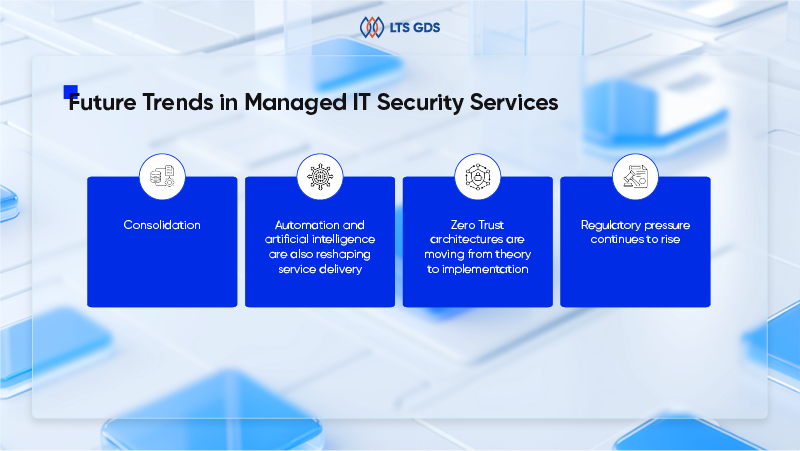
- Consolidation. Enterprises are increasingly uncomfortable managing fragmented ecosystems of tools and vendors. They prefer providers who can integrate security into broader IT operations, reducing complexity and operational friction. This is pushing traditional managed service providers to deepen security capabilities, while specialized security service providers expand operational coverage.
- Automation and artificial intelligence are also reshaping service delivery. Threat detection is becoming more predictive, with behavioral analytics supplementing signature-based approaches. While AI will not replace human expertise, it is changing the economics of monitoring and response.
- Zero Trust architectures are moving from theory to implementation. Managed IT security services are playing a central role in translating Zero Trust principles into enforceable policies across hybrid environments. Identity, rather than perimeter, is becoming the primary control point.
- Regulatory pressure continues to rise. Even organizations outside traditionally regulated industries are facing customer and partner demands for demonstrable security practices. Managed services are increasingly valued not just for protection, but for documentation, audit readiness, and transparency.
These trends suggest that IT security managed services will become less of a standalone offering and more of a foundational layer within enterprise IT strategy.
FAQs about IT Security Managed Services
What are IT security managed services, and how do they differ from traditional IT support?
IT security managed services focus on protecting systems, data, and users through continuous monitoring, threat detection, and response. Unlike traditional IT support, which is typically reactive and centered on availability or user issues, managed security services operate proactively. The emphasis is on identifying risks early, minimizing disruption, and maintaining a consistent security posture as environments change.
Are managed IT security services only for large enterprises?
No. While large enterprises often adopt more complex models, organizations of all sizes use managed security services to access expertise and coverage they cannot sustain internally. Managed services are designed to scale alongside infrastructure and user growth. When environments expand or change, providers can adjust monitoring coverage, tooling, and response capacity without the delays associated with hiring or retraining internal staff.
When does it make sense to outsource IT security instead of keeping everything in-house?
Outsourcing becomes compelling when internal teams struggle to maintain round-the-clock coverage, keep up with specialized skill requirements, or justify the cost of advanced security tooling. For many organizations, the challenge is not expertise, but scale. Managed IT security services help close this gap without requiring constant hiring or retraining.
Do managed IT security services replace internal IT or security teams?
In most cases, they do not. Enterprises adopt a co-managed approach, where internal teams retain ownership of strategy, governance, and business alignment, while managed service providers handle continuous monitoring, response, and optimization. This division of responsibilities allows internal teams to focus on higher-value initiatives.
Are managed IT security services primarily a cost-saving measure?
Cost predictability is an advantage, but it is rarely the primary driver. The larger value lies in reducing exposure to operational disruption, improving response consistency, and enabling internal teams to focus on strategic priorities rather than constant firefighting.
What should enterprises look for when evaluating managed IT security services providers?
Key considerations include the provider’s service scope, clarity of responsibilities, incident response ownership, reporting transparency, and ability to adapt as environments evolve. Enterprises should also assess how well the provider integrates with internal teams and existing IT operations.
How long does it take to implement managed IT security services?
Implementation timelines vary depending on the environment complexity and service scope. Initial onboarding may take several weeks to assess systems, define responsibilities, and establish monitoring, followed by a gradual optimization phase as processes mature.
Looking Ahead: The Role of Managed IT Security
IT security managed services are not a shortcut or a substitute for strategy. They are an operational response to a reality in which threats move faster than internal teams can reasonably keep up with alone.
For modern enterprises, the question is no longer whether to invest in security, but how to structure that investment so it delivers resilience rather than complexity. Managed IT security services offer a way to align protection with operations, cost with outcomes, and responsibility with accountability. Today, stops the opinion “ the security service is a cost center” as it becomes a part of how the business stays online, credible, and competitive.
At LTS Global Digital Services (LTS GDS), we support enterprises with managed IT and security services designed around operating requirements. Our service models emphasize flexibility and predictable cost structures, helping your organizations balance security with long-term value.