


Client overview
Our client is a leading healthcare services firm in the United States, trusted for decades for accounting, advisory, and IT services. Their reputation is built on high-quality services, especially in the healthcare sector.
Their client base grew, so did the volume of IT support requests. Each end client expected fast and professional assistance, regardless of time zone or issue type. However, our client had difficulties in managing IT support at scale while keeping costs under control.
– L2 and L3 engineers were overloaded with basic user requests
– No true 24/7 coverage, despite serving clients with round-the-clock operations
– High cost and long lead time to build an internal L1 helpdesk team
– Need for white-label support, where end users experience seamless service under the client’s brand
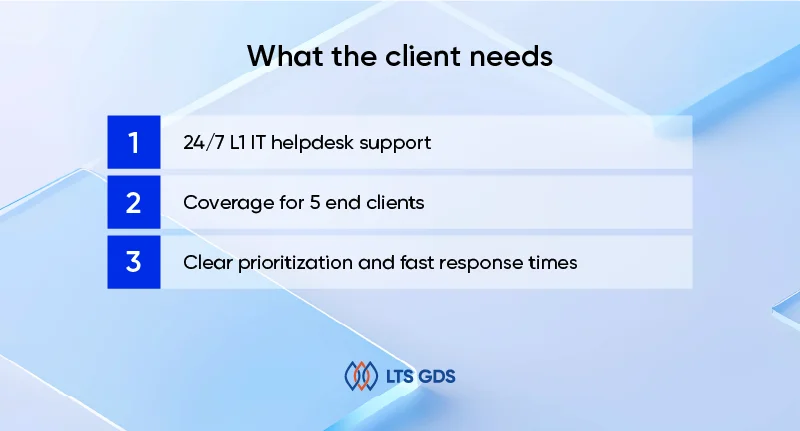
What the client needs
Our client was looking for an IT helpdesk solution that could integrate smoothly with their existing operations including:
– 24/7 L1 IT helpdesk support
– Coverage for 5 end clients, each with different user bases and usage patterns
– Support delivered via email, phone, and ticketing system
– Clear prioritization and fast response times
– White-label delivery to maintain a consistent brand experience
How we did it
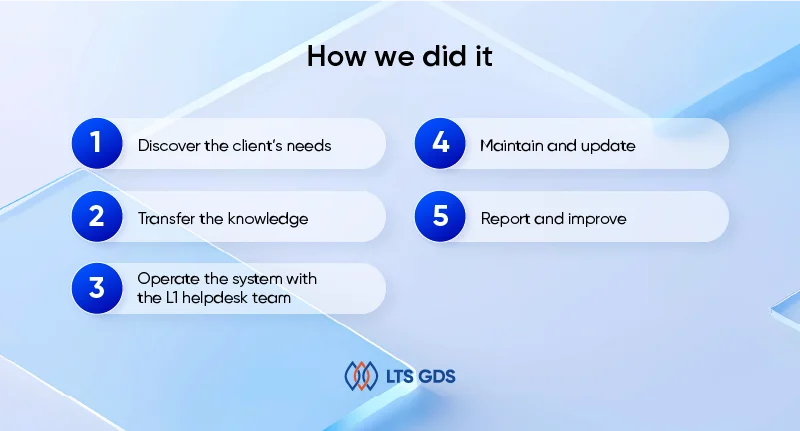
To deliver an advanced L1 IT helpdesk for a multi-client environment, LTS GDS followed a structured delivery process covering discovery, knowledge transfer, daily operations, maintenance, and reporting.
1. Discover the client’s needs
Based on the below, we defined clear Service Level Agreements before kick-off:
– Analyzed requirements for 24/7 L1 IT helpdesk support across five end clients
– Reviewed existing pain points, including L2/L3 overload, lack of night coverage, and rising support costs
– Identified required support channels: email, phone, and ticketing system
– Designed a customized L1 helpdesk model aligned with white-label delivery requirements
2. Transfer the knowledge
LTS GDS focused on a structured knowledge transfer to ensure smooth onboarding.
– Collected and reviewed existing documentation, support procedures, and escalation rules
– Understood current workflows, ticket categories, and dependencies with L2/L3 teams
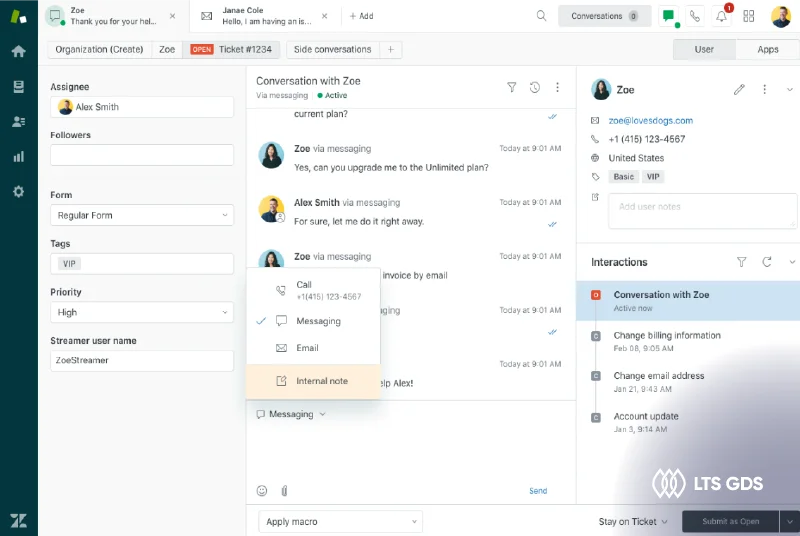
– Prepared the helpdesk team and configured tools, including Zendesk, Microsoft 365 Admin Center, and VoIP integration
– Selected the final operating model and shift structure
– Ran trial operations to validate ticket routing, escalation paths, and response time targets
3. Operate the system with the L1 helpdesk team
After the transition, the L1 helpdesk team began full-scale operations.
– Provided 24/7 monitoring and support for all five end clients
– Handled incoming service requests, incidents, and access issues via email, phone, and Zendesk
– Resolved standard issues at the L1 level, including password resets, account access, and basic application support
– Escalated complex or non-standard cases to L2 or L3 according to predefined rules
– Tracked performance KPIs such as first response time, ticket volume, resolution rate, and SLA compliance
4. Maintain and update
To keep operations efficient and scalable, LTS GDS:
– Regularly updated internal runbooks and client-facing knowledge articles
– Imported relevant procedures and configurations into centralized systems
– Conducted periodic reviews to verify the accuracy and relevance of support documentation
5. Report and improve
– Delivered monthly service reports covering SLA compliance and KPIs
– Held review meetings with the client to discuss feedback, trends, and operational optimizations.
– Updated SLAs and support scope as the client’s business and user base evolved
What the results have
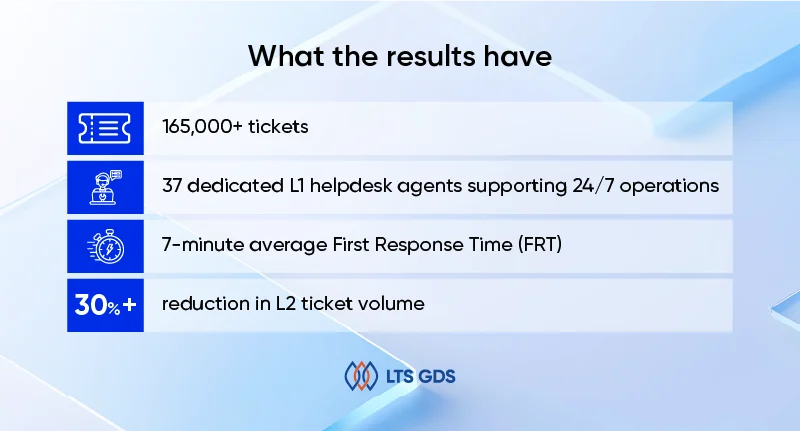
Over the 25-month, the project has delivered several key metrics:
– 165,000+ tickets handled across five end clients
– 37 dedicated L1 helpdesk agents supporting 24/7 operations
– 7-minute average First Response Time (FRT)
– 30%+ reduction in L2 ticket volume, freeing senior engineers for higher-value work
– Consistent SLA compliance across all priorities:
- Critical: ≤ 30 minutes
- High: ≤ 1 hour
- Medium: ≤ 2 hours
- Low: ≤ 4 hours
– Lower operating costs compared to building an internal L1 team
– White-label delivery maintained a seamless brand experience