


Client overview
The client is a Japanese company specializing in industrial waste sorting, processing, and recycling. They handle large volumes of mixed waste collected from factories, construction sites, and urban facilities. Typical items include scrap iron, steel, machinery parts, small tools, electric wires, and electrical products.
In their daily operations, efficiency depends on the ability to separate different categories of waste quickly and accurately. Manual sorting is both labor-intensive and error-prone. To reduce reliance on human workers and scale their operations, the client invested in an AI-based classification system.
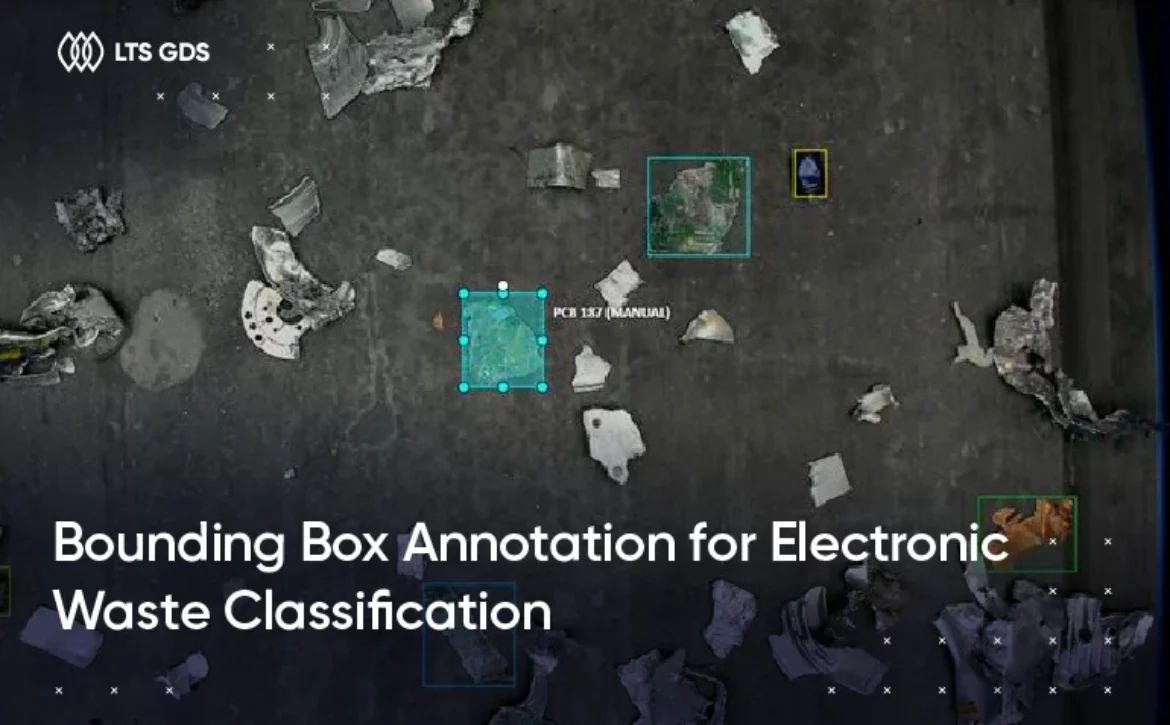
For this system to succeed, they needed a large dataset annotated with image segmentation so that the AI could recognize not just objects, but their precise boundaries. This was where we stepped in.
What the client needs
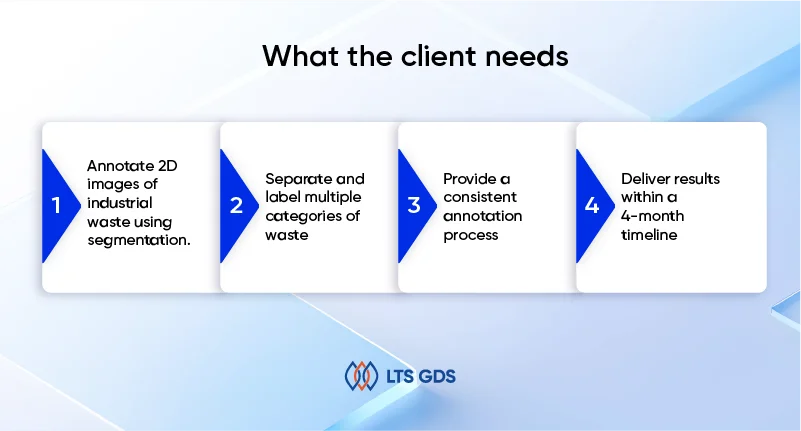
The client’s request was clear:
– Annotate 2D images of industrial waste using segmentation.
– Separate and label multiple categories of waste in each image, including scrap iron, steel, electrical wires, and household electrical panels.
– Provide a consistent annotation process across all images to ensure the AI could learn to recognize complex shapes and overlapping objects.
– Deliver results within a 4-month timeline, despite the large data volume.
How we did it
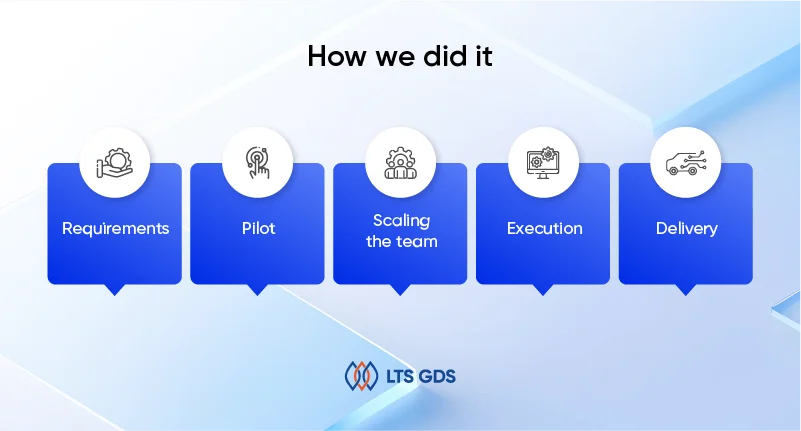
1. Requirement
We worked closely with the client’s engineers to understand their requirements. They shared examples of images and explained the segmentation rules:
-Each object type (iron, steel, wire, panel, etc.) needed its own class label.
-Segmentation had to capture the exact boundary of each object, not just a rough outline.
-Overlapping or tangled objects, like electrical wires, had to be carefully separated.
2. Pilot
We began with a pilot project using a small portion of the dataset. A group of 10 annotators segmented about 2,000 images while QA leads reviewed the results.
The pilot helped us identify:
-Scrap metal pieces had irregular, jagged shapes that required careful annotation.
-Electrical wires often overlapped, making them difficult to segment without errors.
-Some images contained multiple object types, demanding extra attention to class labels.
3. Scaling the team
After the pilot, we scaled up to a team of 50 members, organized as follows:
-2 PMs – handling schedules, client communication, and reporting.
-5 QA Leads – performing regular quality checks and retraining annotators if issues were found.
-43 Annotators – focusing on precise segmentation annotation.
4. Execution
Once the process was stable, the team ramped up to full operation. With 50 annotators, we processed thousands of images per week. Annotators rotated across different classes to avoid fatigue and maintain quality. QA and PMs always kept track to ensure the accuracy of the targets.
Finally, the team was able to segment over 1.5 million objects annotated within the 4-month deadline.
5. Delivery
We delivered annotated datasets every two weeks. Each delivery included segmentation files, a QA report with accuracy metrics, and some notes on how specific edge cases were handled.
What the results have
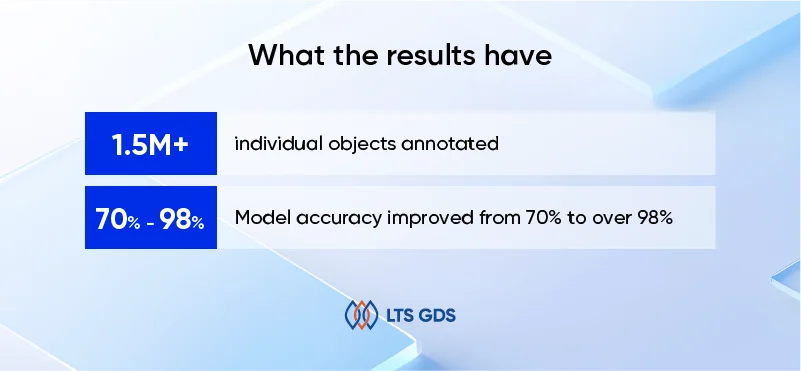
By the end of the project, we achieved:
– Over 1.5 million individual objects annotated across multiple waste categories.
– Model accuracy improved from 70% to over 98%.
– Faster sorting speeds and reduced manual labor in the client’s facilities.