


The conversation around artificial intelligence has been dominated by an arms race toward bigger, more powerful models. GPT-4, Claude, and other large language models have captured imaginations with their impressive capabilities, but they’ve also introduced significant challenges around cost and resource requirements. Enter small language models, which are a pragmatic alternative that’s reshaping how organizations think about AI implementation.
While tech giants battle over parameter counts in the billions, a quieter revolution is taking place. Small language models are proving that intelligence doesn’t always require massive scale. For enterprises and SMEs evaluating AI strategies, understanding when and how to leverage these efficient models has become increasingly critical. This isn’t just about choosing between big and small; it’s about matching the right tool to the right problem.
What is a Small Language Model?
A small language model (SLM) is an AI model that can understand and generate human language, but with far fewer resources than large language models (LLMs). Instead of hundreds of billions of parameters, SLMs usually range from a few million to several billion parameters, making them lighter, faster, and more efficient to run.
Because of their smaller size, SLMs require less computing power and memory. This allows them to run on laptops, mobile devices, edge systems, or even offline environments, without relying heavily on cloud infrastructure. As a result, they are often more cost-effective and easier to deploy in real applications.
Rather than trying to handle every possible task, small language models are designed for specific use cases. They perform especially well in domain-focused scenarios such as customer support, document processing, or industry-specific language tasks.
Examples of small language models
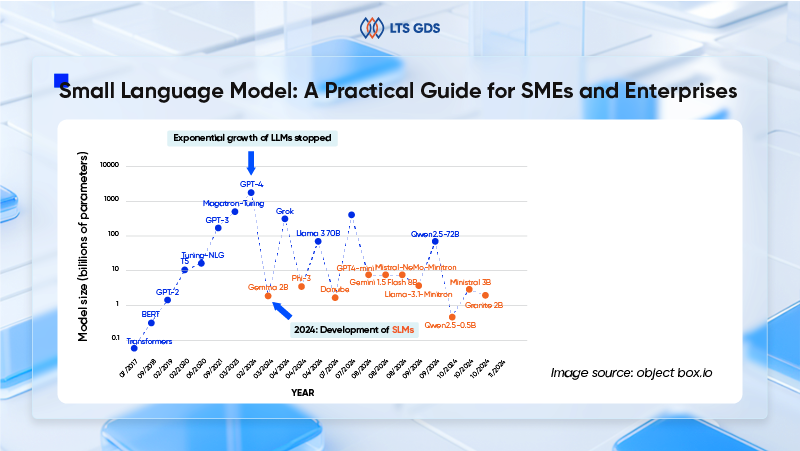
Small language models come in many forms, each optimized for different use cases, deployment environments, and performance goals.
- Gemma
Gemma is Google’s family of lightweight language models derived from the same technology as Gemini. Available in 2B, 7B, and 9B parameter versions, Gemma is designed for instruction following and conversational tasks. Its balance of performance and efficiency makes it suitable for developers who want strong results without large infrastructure costs. - GPT-4o mini
GPT-4o mini is OpenAI’s smaller, cost-efficient model within the GPT-4 family. It supports multimodal inputs, allowing it to process both text and images while generating text outputs. GPT-4o mini is commonly used in chatbots, assistants, and applications that require high-quality responses at a lower cost and latency than full-scale GPT-4 models. - Llama
Llama is Meta’s open-source language model family. Smaller variants, such as Llama 3.2 with 1B and 3B parameters, are designed for efficient inference and edge-friendly deployment. These models are often used for multilingual applications, research, and on-device AI scenarios. - Ministral
Ministral models from Mistral AI focus on fast inference and strong reasoning at smaller scales. Ministral 3B and 8B are optimized for tasks like question answering, summarization, and multilingual understanding, with architectural choices that improve efficiency without sacrificing accuracy. - Phi
Phi is Microsoft’s suite of small language models built with a strong emphasis on data quality and reasoning efficiency. Models like Phi-2 and Phi-3-mini deliver impressive performance for their size and are often used for reasoning-heavy tasks, educational tools, and scenarios where computing resources are limited.
How Small Language Models Work
Small language models may be smaller in size, but they are built on the same foundational principles as large language models. To understand how SLMs work, it’s important to look at their architecture, training strategies, and the optimization techniques that make them efficient.
At the architectural level, SLMs use the transformer model, which is the same neural network design behind modern LLMs. Transformers rely on encoders and decoders, along with self-attention mechanisms, to understand relationships between words and generate meaningful text. Self-attention allows the model to focus on the most relevant tokens in a sequence, regardless of their position, enabling effective language understanding even with fewer parameters.
The key difference lies in scale and configuration. Compared to large models with dozens of layers and hundreds of attention heads, SLMs use fewer transformer layers, smaller hidden dimensions, and leaner attention mechanisms. These design choices reduce computational overhead while preserving performance for targeted tasks.
Because SLMs have limited capacity, efficiency is achieved through careful model design and optimization rather than brute-force scaling. Developers intentionally prioritize certain capabilities such as reasoning, factual accuracy, or domain-specific language, depending on the intended use case. This specialization allows small models to perform competitively in focused applications, even when compared to much larger models.
Model compression plays a central role in building SLMs. Techniques such as pruning, quantization, low-rank factorization, and knowledge distillation are commonly used to reduce model size while maintaining accuracy.
- Pruning removes redundant or low-impact parameters from the network.
- Quantization lowers numerical precision (for example, from 32-bit floating point to 8-bit integers), reducing memory usage and speeding up inference.
- Low-rank factorization simplifies large weight matrices into smaller, more efficient representations.
- Knowledge distillation transfers the behavior and reasoning patterns of a large “teacher” model into a smaller “student” model, effectively compressing knowledge without copying the full parameter set.
Training strategies also differ from those used for large models. Instead of relying on massive amounts of unfiltered data, SLMs benefit from high-quality datasets that align closely with their target tasks.
Benefits of using SLMs
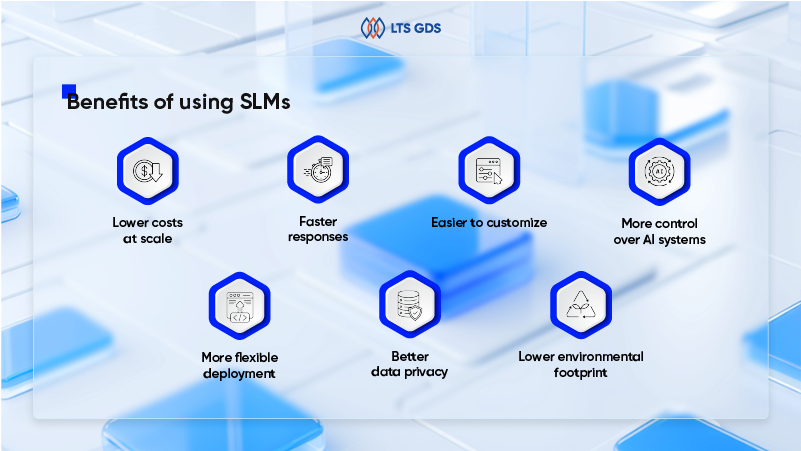
While large language models attract most of the attention, small language models often make more sense in practice because they address common challenges around cost, deployment, and privacy.
- Lower costs at scale: One of the biggest reasons teams turn to SLMs is cost. Smaller models are much cheaper to run, especially for products that handle large volumes of requests. Over time, the savings add up and can make the difference between experimenting with AI and actually deploying it in production.
- More flexible deployment: Unlike large models that depend heavily on cloud infrastructure, SLMs can run on standard servers, on-premise systems, or even edge devices. This opens the door to use cases where internet access is limited or data needs to stay local.
- Faster responses: With fewer parameters to process, SLMs respond more quickly. That speed matters in real-world applications like customer support tools, autocomplete features, or moderation systems where delays quickly frustrate users.
- Better data privacy: Running models locally means sensitive data doesn’t have to be sent to third-party APIs. For industries like finance, healthcare, or legal services, this makes it easier to meet internal security standards and regulatory requirements.
- Easier to customize: Fine-tuning a small language model is far more practical than adapting a massive one. Teams can train SLMs on their own documents, terminology, and workflows without needing specialized infrastructure or large AI budgets.
- Lower environmental footprint: Smaller models require less compute to train and run, which translates to lower energy use. For organizations paying closer attention to sustainability, this is an added benefit beyond performance and cost.
- More control over AI systems: Using SLMs reduces dependence on external providers. Teams aren’t exposed to sudden API pricing changes or service disruptions, which is especially important when AI becomes part of a core product or workflow.
Limitations of SLMs
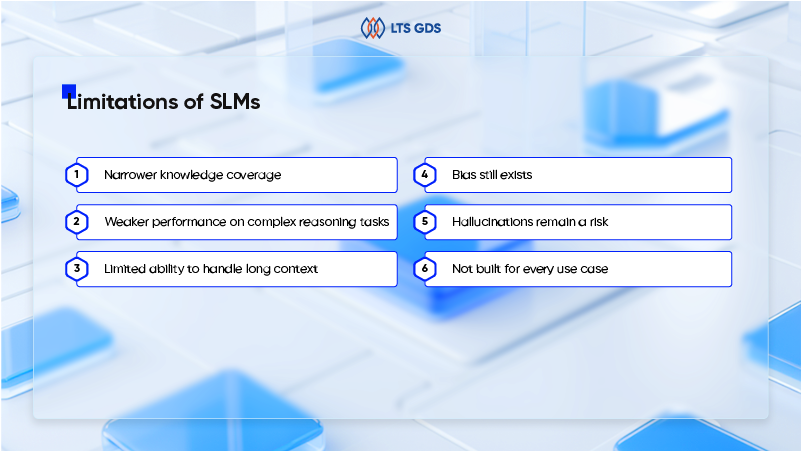
Despite their advantages, small language models have some challenges that organizations must understand and plan around:
- Narrower knowledge coverage: Compared to large language models, SLMs are trained on smaller and more focused datasets. This means they tend to perform well within their intended domain but may struggle with topics outside that scope, such as broad factual knowledge, niche scientific questions, or up-to-date information.
- Weaker performance on complex reasoning tasks: While some SLMs show surprisingly strong reasoning abilities, tasks that require multi-step logic, abstract thinking, or complex problem-solving are still challenging. In these cases, larger models usually have a clear advantage.
- Limited ability to handle long context: Many small language models can only process a few thousand tokens at a time. This limits their effectiveness for use cases like analyzing long documents, maintaining extended conversations, or reasoning across large volumes of text without additional chunking or preprocessing.
- Bias still exists: Like large models, SLMs can reflect biases present in their training data or inherited from larger teacher models during distillation. These biases can surface in outputs if not carefully monitored and mitigated.
- Hallucinations remain a risk: Small language models can generate confident but incorrect responses, especially when asked about topics beyond their training data. This makes validation and human oversight essential for production use cases.
- Not built for every use case: SLMs trade breadth and depth for efficiency. They work best for targeted tasks, but they are less suitable for applications that require a deep understanding across many domains or highly creative output.
Small language model vs Large language model
Although small and large language models are built on similar foundations, their different approaches make it important to compare them before choosing the right model.
| Criteria | Small language models (SLMs) | Large language models (LLMs) |
| Model size | A few million to several billion parameters | Tens to hundreds of billions (or more) parameters |
| Compute requirements | Low to moderate; can run on standard servers or edge devices | High; typically require powerful GPUs and cloud infrastructure |
| Inference cost | Significantly lower, suitable for high-volume use | High per request, especially at scale |
| Response speed | Fast, low-latency responses | Slower due to model size and compute overhead |
| Deployment options | On-device, on-premise, edge, or private cloud | Mostly cloud-based |
| Knowledge breadth | Narrower, domain-focused | Broad, general-purpose knowledge |
| Complex reasoning | Limited for multi-step or abstract tasks | Strong performance on complex reasoning and problem-solving |
| Customization | Easier and cheaper to fine-tune | Expensive and resource-intensive to customize |
| Best suited for | Task-specific, cost-sensitive, and resource-constrained applications | General-purpose assistants and complex AI tasks |
Explore more: What Are Vision Language Models?
Why Data Labeling Matters in Small Language Model Training
The quality of data labeling determines small language model effectiveness in ways that may be even more pronounced than with large models. When working with constrained parameter budgets, every training example must contribute maximum value, making data quality not just important but critical.
SLMs have less capacity to “learn around” noisy or incorrectly labeled data. A large model with hundreds of billions of parameters might encounter enough diverse examples to overcome occasional labeling errors through sheer volume and statistical averaging. This sensitivity means that organizations training SLMs must invest more in data quality than those training larger models.
The balance between breadth and depth in training data affects SLM performance differently from LLM performance. Large models benefit from exposure to vast domains even if individual examples receive shallow treatment. Small models often perform better with deeper, more thorough coverage of a narrower domain. This suggests labeling strategies should prioritize quality and completeness within the target domain rather than expanding to tangentially related areas.
Cutting corners on validation data labeling can create false confidence in a model that fails in production. Organizations should apply even higher labeling standards to evaluation data than training data, potentially having multiple expert labelers review each example to ensure gold-standard quality.
What Comes Next for Small Language Models
Rather than chasing scale, the future of small language models is defined by efficiency, specialization, and real-world deployability – where smarter design and better data matter more than sheer parameter count.
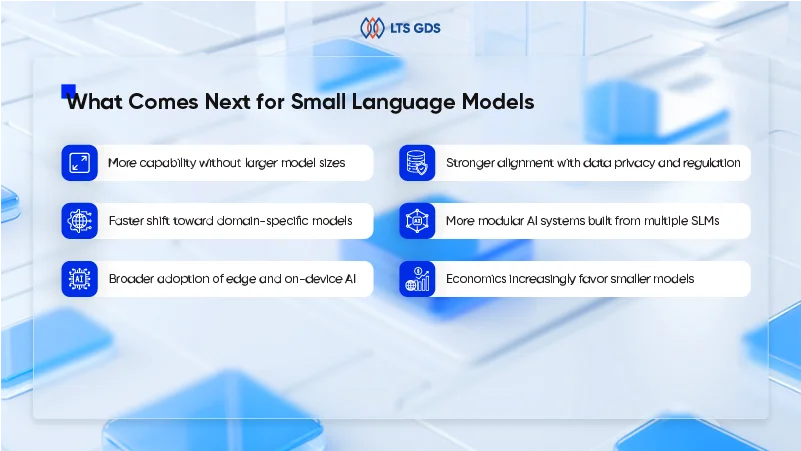
- More capability without larger model sizes: Architectural and training innovations are enabling SLMs to deliver stronger reasoning and task performance without increasing parameters or compute requirements.
- Faster shift toward domain-specific models: Organizations are increasingly prioritizing SLMs tailored to narrow, high-value use cases over general-purpose models that struggle to perform consistently in production.
- Broader adoption of edge and on-device AI: Hardware and model efficiency improve, SLMs are becoming practical for local deployment on mobile devices, embedded systems, and edge environments.
- Stronger alignment with data privacy and regulation: The ability to deploy, audit, and control SLMs internally is becoming a key advantage as AI governance and data protection requirements tighten.
- More modular AI systems built from multiple SLMs: Instead of one large model handling everything, future systems will route tasks to specialized SLMs optimized for specific functions.
- Economics increasingly favor smaller models: Rising large-model costs and improving SLM performance are shifting investment toward small, specialized models that deliver better ROI.
FAQs About Small Language Model
Can small language models match large models in performance?
On specialized tasks within their training domain, well-optimized SLMs often match or exceed large model performance. For broad general knowledge, complex reasoning across diverse domains, or tasks requiring sophisticated creativity, large models maintain advantages. The key is matching the model to the task; SLMs excel at focused applications, while LLMs excel at generalist applications.
What’s the best small language model for business applications?
The “best” model depends entirely on the specific use case. For general instruction-following tasks, Phi-3, Gemma, or similar instruction-tuned models perform well. For domain-specific applications, specialized models like FinBERT for finance or BioBERT for healthcare often outperform general models. Evaluate several candidates on your specific data and tasks before committing to one approach.
How do small language models handle languages other than English?
Language support varies significantly across SLMs. Many are primarily trained in English and perform poorly in other languages. However, multilingual SLMs trained on diverse language data handle multiple languages effectively, though typically with reduced capability compared to English. Organizations needing non-English support should specifically evaluate models in their target languages.
Are small language models more or less prone to generating harmful content?
Safety characteristics depend more on training methodology and safety tuning than on model size. Well-designed SLMs with appropriate safety training can be quite safe, while poorly designed models of any size can generate problematic content. Organizations deploying SLMs should implement appropriate content filtering and safety mechanisms regardless of model size.
Can small language models be fine-tuned on custom data?
Yes, fine-tuning SLMs is not only possible but often more practical than fine-tuning large models. The computational resources required for SLM fine-tuning are accessible to most organizations. This customization capability makes SLMs particularly valuable for specialized applications requiring domain expertise or company-specific knowledge.
Key Takeaways for Small Language Models Ahead
Small Language Models (SLMs) are redefining how organizations deploy AI – prioritizing efficiency, control, and domain focus over sheer scale. They are not simplified alternatives to large models, but purpose-built systems designed to solve real business problems effectively.
For most enterprise use cases like customer support, document processing, data analysis, or content moderation, well-trained SLMs deliver strong results at significantly lower cost and complexity. The real differentiator isn’t model size, but data quality. High-quality, domain-specific training data and precise labeling enable SLMs to outperform generic large models within specialized contexts.
Working with experienced data labeling teams that understand domain language and edge cases helps your small language models perform reliably in real production environments.