


Managed IT services are no longer a niche solution reserved for companies without internal IT. Over the past decade, they have become a core operating model for businesses that depend on technology to run stably.
Managed IT services involve outsourcing some or all IT operations to a third-party provider under a structured service agreement. Today, the model goes far beyond “outsourcing IT.” Modern managed IT services combine 24/7 proactive monitoring, operational discipline, security controls, and service accountability to keep business-critical systems running.
Many organizations already understand what managed IT services are. The more difficult question is when they are actually needed.
Adopting managed IT services too early can feel unnecessary, while adopting them too late can be costly. The real question, then, is how to recognize when managed IT services shift from a “nice to have” to a practical necessity for the business.
Explore more: Managed Services: What You Need to Know
Why Businesses Start Considering Managed IT Services
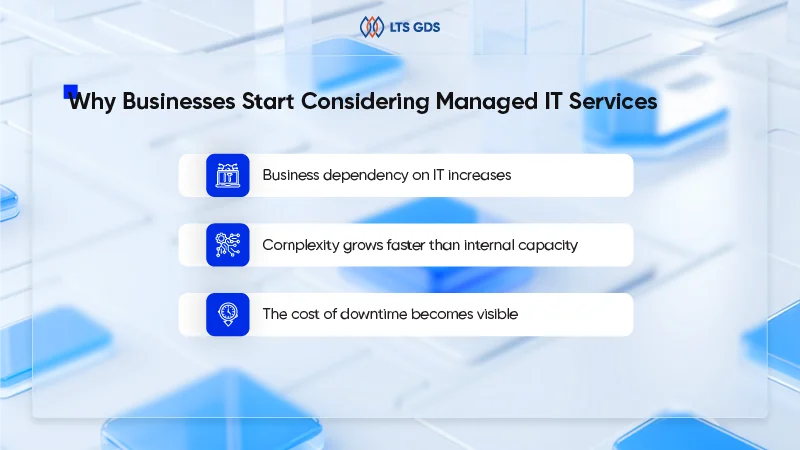
For many owners and executives, IT is still viewed primarily as a cost center. As long as systems are running and employees can work, spending more on IT feels unjustified. This mindset often leads to minimal investment, reactive support models, and deferred infrastructure decisions. Over time, however, three forces tend to change businesses.
Business dependency on IT increases. Systems that once supported operations become the operations. Sales, finance, customer support, supply chains, and product delivery all rely on technology working consistently.
Complexity grows faster than internal capacity. Cloud adoption, remote work, SaaS sprawl, cybersecurity requirements, and compliance obligations add layers of operational burden. Even capable internal teams spend more time keeping the lights on than improving systems.
The cost of downtime becomes visible. Lost revenue, missed SLAs, reputational damage, and recovery efforts expose the false economy of underinvesting in IT resilience. At this stage, many organizations realize that investing in uptime is cheaper than paying for downtime.
Key IT Risks That Indicate a Need for Managed IT Services
The strongest signal that a business needs managed IT services is not growth alone; it is unmanaged risk. Certain patterns appear repeatedly across organizations that eventually transition to an outsourced managed IT services model.
One of the most common is reactive incident handling. When IT teams spend their days responding to tickets, outages, and urgent requests, strategic work disappears. Issues are resolved, but root causes remain. Over time, the environment becomes fragile, and outages become more frequent.
Another major risk is a lack of continuous monitoring and response. Many internal teams operate within business hours, even though systems do not. Without 24/7 monitoring, incidents can go undetected for hours. By the time someone notices, the impact has already multiplied. This is often where 24/7 managed IT services deliver immediate value.
Moreover, when threats become more sophisticated, relying on basic tools and periodic checks is no longer sufficient. Businesses without security operations often discover gaps only after an incident through ransomware, data loss, or audit findings. At that stage, the question shifts from whether to outsource security operations to how quickly it can be done.
Backup and recovery risks are frequently misunderstood. Having documents in Google Drive or Dropbox is not a backup strategy. These tools are designed for collaboration, not for full system recovery. Organizations that have never tested restoration procedures often assume they are protected until they are not. Managed IT services typically formalize backup, disaster recovery, and business continuity as operational disciplines rather than assumptions.
Finally, there is the risk of knowledge concentration. When systems depend on one or two individuals who “know how things work,” the business becomes vulnerable to attrition, burnout, or simple unavailability. Managed IT services companies mitigate this risk by institutionalizing knowledge and processes across teams.
When these risks accumulate, managed IT services become less about optimization and more about crisis management.
Common Types of Managed IT Services
Managed IT services cover a wide range of service types, allowing businesses to outsource specific IT functions where operational strain or risk is highest while keeping control over areas they prefer to manage internally. Check it out!
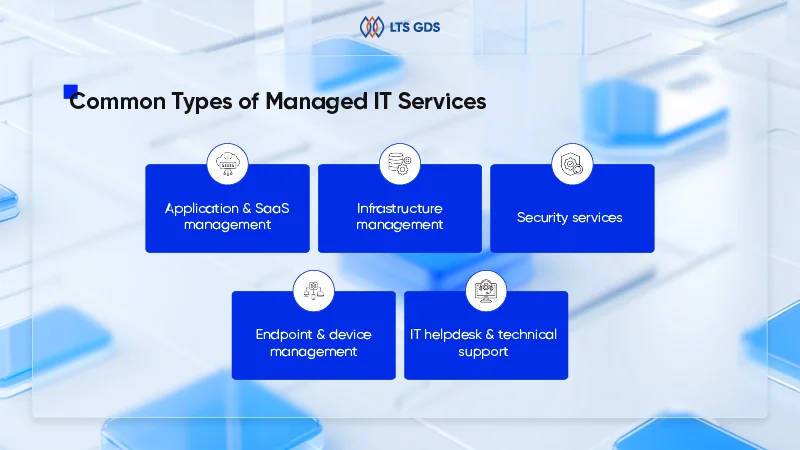
Application and SaaS management
Businesses adopt more SaaS platforms, and managing access, integrations, updates, and performance becomes increasingly complex. Application sprawl creates hidden inefficiencies and security risks, especially when ownership is unclear.
Managed IT services in this area typically cover application lifecycle management, license optimization, access controls, and incident response related to critical business software.
Infrastructure management
Managed IT infrastructure services remain a core component of most MSP engagements. This includes servers, networks, cloud environments, and hybrid architectures. Managed infrastructure services focus on proactive monitoring, patching, capacity planning, and incident prevention rather than reactive fixes.
Security services
Security is one of the fastest-growing segments of managed IT services. Internal teams often struggle to maintain round-the-clock vigilance while keeping up with evolving threats and compliance requirements. Managed security services typically include monitoring, vulnerability management, incident response, and policy enforcement.
Endpoint and device management
With remote and hybrid work now standard, endpoints have become a primary attack surface and operational challenge. Managing updates, configurations, and security across hundreds or thousands of devices is resource-intensive. Managed endpoint services bring consistency and control, reducing both support tickets and security exposure.
IT Helpdesk and technical support
For many businesses, IT helpdesk support is the most visible aspect of managed IT services. However, its value depends heavily on integration with underlying systems and processes.
When done well, outsourced IT managed services provide faster resolution, better user experience, and insights into recurring issues, freeing internal teams to focus on higher-value work.
Explore our IT managed services
Managed IT Services vs In-House IT: When Outsourcing Is the Better Option
Deciding between managed IT services and an in-house IT team is less about which model is “better” and more about which aligns with your business’s scale, risk profile, and strategic priorities. The comparison below highlights where each approach tends to deliver the most value and where trade-offs emerge.
| In-House IT Team | Managed IT Services | |
| Cost | Higher costs due to salaries and infrastructure | Cost-effective costs due to shared resources and lower overhead |
| Control | Higher level of control as the team belongs to the organization | Less control over physical distance |
| Expertise | Deep knowledge of the company’s specific environment, systems, and internal processes. | Access to a broad team of specialists across infrastructure, security, cloud, automation, and support. |
| Coverage and availability | Limited by staff availability, vacations, sick leave, and standard business hours. True 24/7 coverage requires multiple hires and overlapping roles. | Extended or 24/7 managed IT services are built into the delivery model. After-hours incidents are handled as part of standard service, not emergency exceptions. |
| Scalability | Scaling requires hiring, onboarding, and training, often be slow and costly. | Services scale up or down with specific business needs. |
| Risk management | Risk exposure increases when expertise is concentrated in a few individuals. Backup, disaster recovery, and security maturity vary widely. | Risk is distributed across teams, processes, and tools. Providers maintain tested backup, disaster recovery, and incident response frameworks. |
| Security | Building and maintaining security operations and compliance frameworks internally requires significant investment in tools, certifications, and staff. | Managed services companies already operate certified security processes, compliance controls, and audit-ready documentation across multiple clients. |
| Strategic focus | Internal teams often spend significant time firefighting, leaving limited capacity for improvement or innovation. | Managed services free internal teams to focus on strategic initiatives rather than operational maintenance. |
| Best for | Technology-driven organizations where in-house IT expertise directly underpins the core product or service. | Businesses are looking for 24/7 expert support and predictable costs without the overhead of full-time salaries. |
Read more: Top Managed Service Providers – Evaluation and How to Pick?
FAQs about IT Managed Services
What are managed IT services, in simple terms?
Managed IT services mean outsourcing part or all of your IT operations to a third-party provider. Instead of reacting only when issues arise, the provider proactively manages systems such as infrastructure, applications, security, endpoints, and user support under a predefined Service Level Agreement (SLA). This helps ensure consistent performance, faster issue resolution, and predictable IT operations.
Are managed IT services only for small businesses?
No. Managed IT services are used by small, mid-sized, and enterprise organizations alike. While SMEs often rely on MSPs due to limited internal resources, larger enterprises also use them to support infrastructure, security operations, and service delivery at scale. MSPs are designed to handle a wide range of issues, from routine support to complex, high-impact incidents across different business sizes.
How much do managed IT services cost?
Managed IT services pricing varies based on service scope, complexity, and support levels. Common pricing models include per-user, per-device, or flat monthly fees. Rather than comparing costs in isolation, businesses should evaluate managed services against the financial impact of downtime, security incidents, and internal staffing overhead.
Can firms still have some internal IT staff while using managed services?
Absolutely. A hybrid model is increasingly common. Many organizations keep an internal IT team focused on business-specific systems, user training, technology planning, and vendor coordination, while outsourcing infrastructure management, security monitoring, and help desk support to an MSP. This approach often delivers the best balance between internal business knowledge and external technical depth with 24/7 coverage.
Will a managed service provider understand each specific industry and business need?
Many MSPs specialize in specific industries such as healthcare, financial services, legal, or manufacturing. They need to understand industry-specific applications, compliance requirements, and operational challenges. During evaluation, it’s important to ask about relevant projects, industry experience, and how the provider approaches business discovery.
What happens to the internal IT team if we start using managed IT services?
This depends on business goals and current IT maturity. Some organizations reposition internal IT staff into more strategic roles focused on applications, innovation, and process improvement. Others use managed services to support an overextended internal team by adding backup and specialized expertise. In some cases, roles may be reduced, but many businesses find that maintaining internal IT capability in a different capacity delivers greater long-term value.
Knowing the Right Time to Move to Managed IT Services
The right time to adopt managed IT services is rarely defined by headcount or revenue alone. It is defined by exposure. When IT outages disrupt operations, when security risks outpace internal capabilities, when systems grow more complex than teams can sustainably manage, and when uptime becomes non-negotiable, managed IT services shift from optional to essential.
Organizations that make the move early enough do so on their own terms. They choose providers carefully, define service expectations clearly, and integrate managed services into a broader IT strategy.
Those who wait often adopt managed IT services in response to crises. This is a reason why the focus shifts from optimization to recovery.
In an environment where technology underpins nearly every business function, the question is no longer whether managed IT services are valuable. The real question is whether the business can afford to operate without them for much longer.
LTS Global Digital Services specializes in end-to-end managed IT services, supporting infrastructure, security, and day-to-day operations with a flexible delivery model. If you’re assessing managed IT services as part of your IT strategy, contact us to explore a tailored model.