


As enterprises race to harness the power of AI, the demand for high-quality labeled data has skyrocketed, transforming data labeling from a niche service into a multi-billion-dollar industry. But with hundreds of vendors claiming expertise, businesses may struggle to choose one of the best data labeling companies for their next projects.
In this 2026 updated guide, we cut through the noise to spotlight the top players that are truly setting the benchmark for accuracy, scalability, security, and domain specialization. Whether you’re building next-gen computer vision systems, fine-tuning LLMs, or deploying multimodal AI at scale, these industry leaders represent the gold standards shaping the future of AI development.
In this blog, we’ll break down the top data labeling companies you should know in 2026 and beyond, what sets them apart, and how they compare across key evaluation criteria – helping you choose the right partner for your AI roadmap with confidence.
Overview: Selection Method for Leading Data Labeling Companies in 2026
The companies featured in this list were identified through a set of clear, industry-standard evaluation criteria designed to reflect the capabilities that matter most in data labeling today. The assessment framework includes:
- Market presence and regional leadership: Recognition as strong performers within major geographies or specialists in high-demand domains.
- Independent reputation signals: Verified reviews, consistent client feedback, and publicly documented success cases.
- Quality assurance maturity: Robust annotation workflows, layered QA mechanisms, and proven accuracy across large-scale projects.
- Operational scalability: Demonstrated capacity to deliver high-volume, multi-format datasets with stable, predictable throughput.
Pricing competitiveness: Transparent cost structures aligned with global market norms. - Security and compliance standards: Up-to-date certifications and rigorous data governance practices.
This methodology highlights vendors that stand out for their reliability, scalability, and overall execution strength in 2026.
Top 10 Data Labeling Service Providers in 2026
1. LTS GDS
General information
LTS Global Digital Services (LTS GDS), part of the LTS Group‘s technology ecosystem, specializes in digital BPO services, including AI data annotation, LLM training and IT managed services. LTS GDS is renowned for its four-layer QA process and a team of 500+ vetted data annotators and LLM training specialists in various industries. Throughout 8 years of operations, LTS GDS has accomplished more than 200 AI and LLM projects, processing 50+ million data points. Its high quality is also reflected by a number of certificates and awards. Quality, ISO 27001 security, and long-term partnerships drive its scalable support for business growth across various industries, including automotive, construction, manufacturing, finance, and more.
Website: gdsonline.tech
Headquarters: Hanoi, Vietnam
Key strengths
- Exceptional annotation accuracy, consistently achieving 99%+ across various data types, including images and video, text, audio, and multimodal datasets.
- Robust four-layer quality assurance process: self-check by annotators, peer reviews, vertical QA by leads, and final inspection by project managers or client reviewers.
- Scalable, multilingual workforce enabling rapid deployment for projects of any size, with flexible integration to client platforms like CVAT, Label Studio, and Supervisely.
- Strong security and compliance framework with ISO 27001, ISO 9001:2015, and GDPR certifications, plus DEKRA Certificate of Conformity for Data Labeling.
- Competitive, transparent pricing optimized through Vietnam’s cost advantages and favorable tax policies.

For a closer look at how LTS GDS delivers 99%+ annotation accuracy across different data types and industries, explore our featured case studies covering computer vision, NLP, and multimodal AI projects.
Explore some of our featured case studies here:
LiDAR Annotation for Autonomous Driving (Automotive)
Bounding box annotation for electronic waste classification (Waste management, environmental tech)
Architectural drawings labeling for a 4D digital twin platform (Construction)
Key clients:
Global enterprises and innovative startups in autonomous driving, retail, construction, coding LLM, and agriculture sectors.
Customer feedback / Clutch review:
- Holds a 4.8/5 rating on Clutch based on verified client reviews.
- Praised for professionalism, accuracy, transparent communication, and timely delivery.
- Clients highlight LTS GDS’s ability to adapt quickly, maintain quality under tight deadlines, and provide consistent project management excellence.
Certifications & recognition:
- ISO 27001 (Information Security Management)
- ISO 9001:2015 (Quality Management)
- DEKRA Certificate of Conformity for Data Labeling
- Winner of the Sao Khue Award 2021 for Data Annotation Excellence.
- Recognized among Vietnam’s Top ICT Companies by VINASA as a leading labeling outsourcing provider in 3 executive years 2023, 2024, and 2025.
Pricing:
Flexible project-based or hourly pricing models tailored to client needs, maximizing ROI without compromising quality.
Best for:
Enterprises and research labs seeking a trusted, scalable, and secure annotation partner with deep domain expertise in autonomous driving, construction, agriculture, retail, manufacturing, BFSI, and AI-driven industries.
2. Shaip

General information
Shaip is a well-established global provider of high-quality training data and annotation services, supporting enterprises across various sectors, including healthcare, finance, retail, and conversational AI. With capabilities spanning data collection, annotation, and de-identification, the company delivers structured, production-ready datasets that meet the requirements of complex AI development pipelines.
Website: shaip.com
Headquarters:
Louisville, Kentucky, USA
Key strengths:
- End-to-end human-powered data labeling, data sourcing, and synthetic data generation
- Specialization in healthcare, finance, automotive, and eCommerce
- Advanced quality control and data anonymization for regulatory compliance
Key clients:
Major healthcare, technology, and automotive enterprises – including Google, Microsoft, Amazon, and leading global providers in digital health, insurance, autonomous driving, and conversational AI.
Customer feedback / Clutch review:
- Clutch rating not publicly listed
- Clients praise Shaip for reliability, flexibility, and ability to handle complex, regulated data projects
- Positive feedback highlights professionalism and adaptability to changing requirements
Certifications & recognition:
- ISO 27001,
- GDPR,
- CCPA,
- HIPAA;
- Recognized as a Challenger in Everest Group’s DAL Solutions PEAK Matrix
Pricing:
Custom, project-based; flexible based on data type and volume
Best for:
Organizations with sensitive, regulated data needs in the healthcare and financial sectors
3. Mindy Support
General information
Mindy Support is a global provider of data annotation, data preparation, and customer support services, delivering solutions for enterprises, including Fortune 500 and major tech clients. With a diverse and multilingual workforce of over 2,000 professionals spread across more than 25 countries, the company handles large-scale annotation, data collection, QA, and outsourced support projects.
Website: mindy-support.com
Headquarter:
Limassol, Cyprus
Key strengths:
- Large-scale multilingual annotation for text, image, audio, and video
- Specialized in Generative AI, customer care, and AI/ML consultancy
- Dedicated project managers and rapid scaling for high-volume projects
Key clients:
Fortune 500, GAFAM, and leading tech enterprises, including Anyline, Atlatec, Sweatcoin, Kili Technology, Superb AI, Viu More, YieldSystems, and OnRecruit, in automotive, AI, retail, geospatial, and customer service sectors.
Customer feedback / Clutch review:
- Holds a 4.8/5 rating on Clutch based on verified client reviews.
- High client retention (80%), praised for quality, affordability, and professional management
Certifications & recognition:
- ISO 27001,
- ISO 9001, SOC 2 Type 1, GDPR, CCPA, HIPAA
Pricing:
Flexible; tailored to project size and complexity
Best for:
Enterprises requiring large, multilingual teams and robust quality assurance for complex datasets
4. Encord
General information
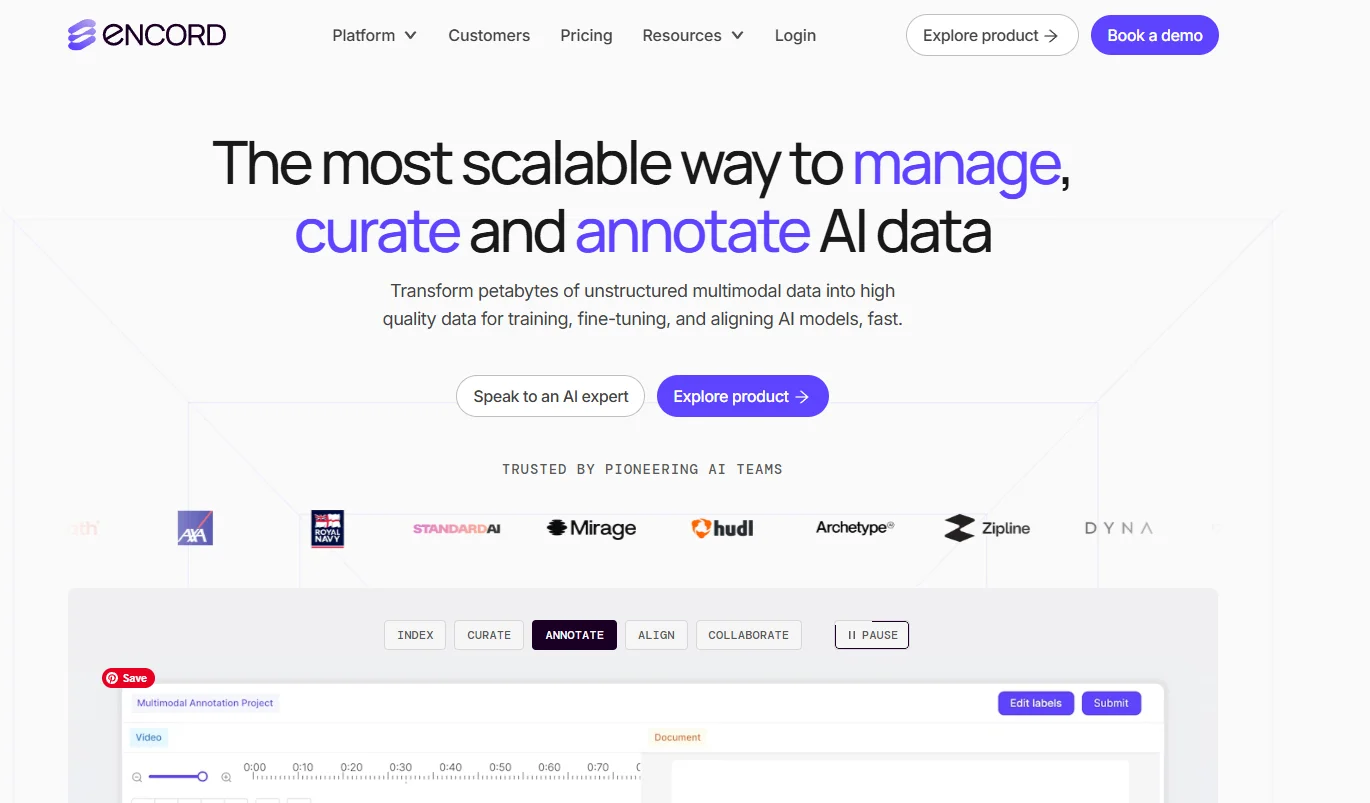
Encord is a leading AI-data management and annotation platform that enables organizations worldwide to handle, curate, and annotate large-scale multimodal datasets – including images, video, audio, documents, LiDAR/point-cloud, medical imaging, and more. The company provides a unified environment for data ingestion, annotation, curation, quality control, and model evaluation, designed to support end-to-end data workflows from raw data to production-ready datasets.
Website: encord.com
Headquarter:
London, UK
Key strengths:
- AI-assisted multimodal annotation platform (images, video, LiDAR, DICOM)
- Human-in-the-loop workflows, active learning
- Integrated quality control and model feedback
Key clients:
Major AI, robotics, healthcare, and automotive leaders, including Viz.ai, Pickle Robot, Automotus, Toyota, Zipline, Synthesia, Stanford Medicine, King’s College London, and AXA Financial.
Customer feedback / Clutch review:
- No public Clutch rating
- Valued for automation, transparency, and accelerating model deployment
Certifications & recognition:
SOC2 compliant
Pricing:
Custom, based on requirements; private offers available
Best for:
AI teams needing scalable, automated annotation and integrated quality analytics
5. Sama
General information
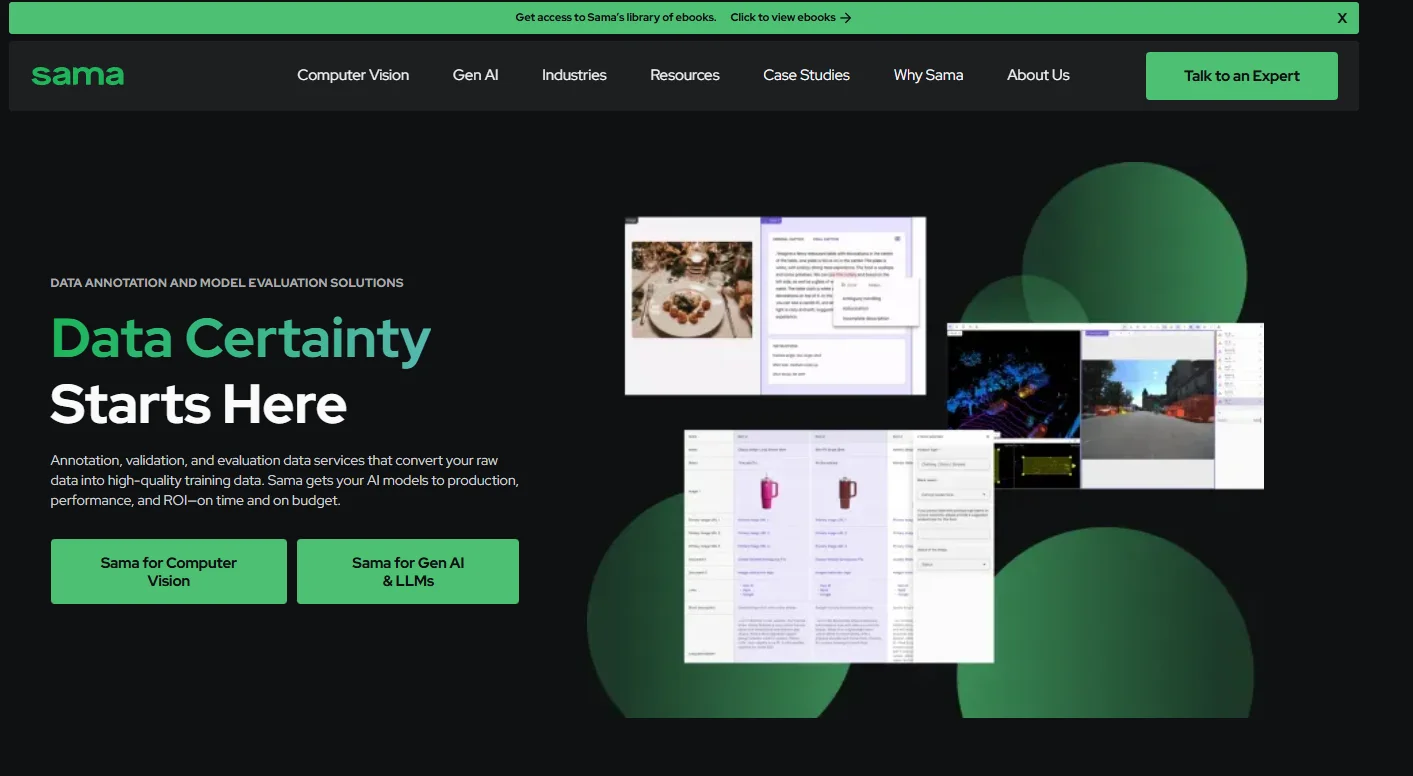
Sama is a globally recognized provider of high-quality data annotation and model evaluation services, serving enterprise clients across multiple industries. The company offers a full-cycle data annotation and validation platform designed to convert raw data into production-ready, annotated datasets, supporting both computer vision and generative AI / LLM workloads.
Website: sama.com
Headquarter:
San Francisco, USA (delivery centers: Nairobi, Kampala, India)
Key strengths:
- Social impact model, B corporation certified
- High-quality annotation for computer vision, NLP
- Diverse, global workforce; ethical employment focus
Key clients:
40% of FAANG companies and Fortune 50 enterprises, including Google, Microsoft, NVIDIA, General Motors, Ford, Bosch, Walmart, and Peloton, are in autonomous vehicles, computer vision, generative AI, medtech, retail, and robotics.
Customer feedback / Clutch review:
- No public Clutch rating
- Trusted for ethical standards, quality, and social responsibility;
Certifications & recognition:
- ISO 9001;
- ISO 27001;
- Featured in Deloitte’s Tech for Good
- Certified B Corporation, industry social impact awards
Pricing:
- Custom project-based pricing with detailed SLA agreements
- Competitive, fair labor emphasis
Best for:
Enterprises valuing ethical sourcing, social impact, and high-quality labeling
6. Cogito Tech
General information
Cogito Tech is a well-established AI data services company with roots since 2011, delivering high-quality annotation, data processing, and AI-ready dataset solutions to clients worldwide. The company supports a wide spectrum of data services spanning computer vision, NLP, audio/video, multimodal data, and generative-AI/LLM workflows, combining human-in-the-loop expertise with scalable operational capacity.
Website: cogitotech.com
Headquarter:
Levittown, New York, USA
Key strengths:
- AI-assisted and human-powered annotation for computer vision, NLP, and LLMs
- Specialization in RLHF, ADAS, healthcare, and content moderation
- DataSum certification for ethical sourcing and data governance
Key clients:
Fortune 100, Fortune 500, and leading enterprises, including Humana, Medtronic, Siemens, Verizon, Amazon, and major players in healthcare, finance, insurance, autonomous tech, and retail.
Customer feedback / Clutch review:
- Cogito Tech maintains a 5.0/5 rating on Clutch
- Praised for expertise, quality, and reliable communication
Certifications & recognition:
- ISO 27001;
- ISO 9001;
- SOC 2 Type II;
- HIPAA;
- GDPR;
- CCPA;
- DataSum
Pricing:
Volume-based pricing with flat rates for enterprise accounts
Best for:
Mid-size to large AI firms requiring scalable and flexible annotation services.
7. Alegion
General information
Alegion is a leading provider of managed data annotation and data preparation services for machine learning and AI initiatives, delivering production-ready, high-quality training datasets to enterprises worldwide. The company combines a powerful annotation platform with a global workforce and strong process discipline, enabling clients to outsource data labeling, collection, transformation, and quality control at scale.
Website: alegion.com
Headquarter:
Austin, Texas, USA; global operations
Key strengths:
- End-to-end managed labeling for video, image, text, and audio
- Advanced platform with ML-assisted tools and rich ontologies
- Dedicated client services and global support
Key clients:
Fortune 500 and global enterprises, including Airbnb, Walmart, and leading companies in retail, finance, technology, and AI/ML sectors.
Customer feedback / Clutch review:
Noted for collaborative project design, quality, and flexibility
Certifications & recognition:
SOC 2 Type 1, additional certifications as needed
Pricing:
Custom, based on data type and project complexity
Best for:
Large enterprises with complex, high-volume annotation requirements
8. Ossisto
General information
Ossisto is a global outsourcing and virtual assistance provider, offering a wide range of services, from data entry and data-processing support, virtual administrative and customer-service assistance, to digital marketing, web development, and full back-office outsourcing. The company primarily serves small and mid-sized businesses (SMEs) and entrepreneurs, helping them offload routine or specialized tasks so they can focus on core operations.
Website: https://ossisto.com/
Headquarters: New Jersey, USA (operations in India)
Key strengths:
- Flexible workforce model combining virtual assistants and technical staff
- Cost-effective packages tailored for smaller annotation budgets
- Emphasis on client support and fast turnaround
Key clients:
Leading enterprises and SMBs, including e-commerce brands like Shopify merchants, real estate firms such as Keller Williams affiliates, digital agencies like WebFX partners, and tech startups in SaaS and marketing automation.
Customer feedback:
Ossisto holds a 5.0/5 rating on Clutch, praised for professionalism, accuracy, and timely delivery.
Certifications & recognition:
- GDPR compliant;
- Recognized as a leader in virtual assistance in emerging markets
Pricing model:
Hourly and task-based pricing suited for startups and SMEs
Best for:
Small to midsize businesses seeking affordable, scalable annotation services.
9. Clickworker
General information
Clickworker is a leading crowdsourcing-based data and micro-task services provider, leveraging a globally distributed workforce to deliver flexible, scalable data solutions. The company transforms large or complex data-oriented projects into micro-tasks, enabling businesses to outsource data collection, annotation, validation, and content-related work efficiently. With a community of millions of registered contributors (“Clickworkers”) across dozens of countries, Clickworker serves clients globally, from small tasks to enterprise-scale jobs, using a platform optimized for speed, flexibility, and wide language/cultural coverage.
Website: https://www.clickworker.com/
Headquarters: Essen, Germany
Key strengths:
- Large global crowdsourcing network for fast annotation
- Embedded QA and multilingual capabilities
- Cost-effective solutions for high-volume, lower-complexity tasks
Key clients:
Global enterprises, Fortune 500, and top technology leaders, including OTTO, Bosch, Tennis-Point, Axzo, and over 500 enterprise clients in e-commerce, automotive, AI, and retail sectors.
Certifications & recognition:
- GDPR compliant;
- ISO-certified infrastructure
Pricing model:
Per-task pricing with upfront cost estimates
Best for:
Cost-conscious clients handling bulk, non-sensitive data annotation.
While this list highlights top performers in 2025, choosing the right partner depends on your specific use case, budget, and data needs. Read more on how to choose the best data annotation outsourcing company to make an informed, strategic decision.
What’s the Cost of Outsourcing Data Labeling
Determining the exact cost of outsourcing data labeling can be complex, as it depends on multiple factors such as data type, annotation complexity, project scale, and quality requirements. Pricing models vary widely, from per-label, per-hour, to project-based fees, and each has implications for budget and project management. Additionally, hidden costs such as quality control, revisions, and annotator training can impact the final expense.
For a detailed breakdown of these factors, common pricing structures, and strategies to optimize costs without compromising quality, please refer to our comprehensive guide on data annotation pricing.
Best Practices When Partnering with a Data Labeling Company
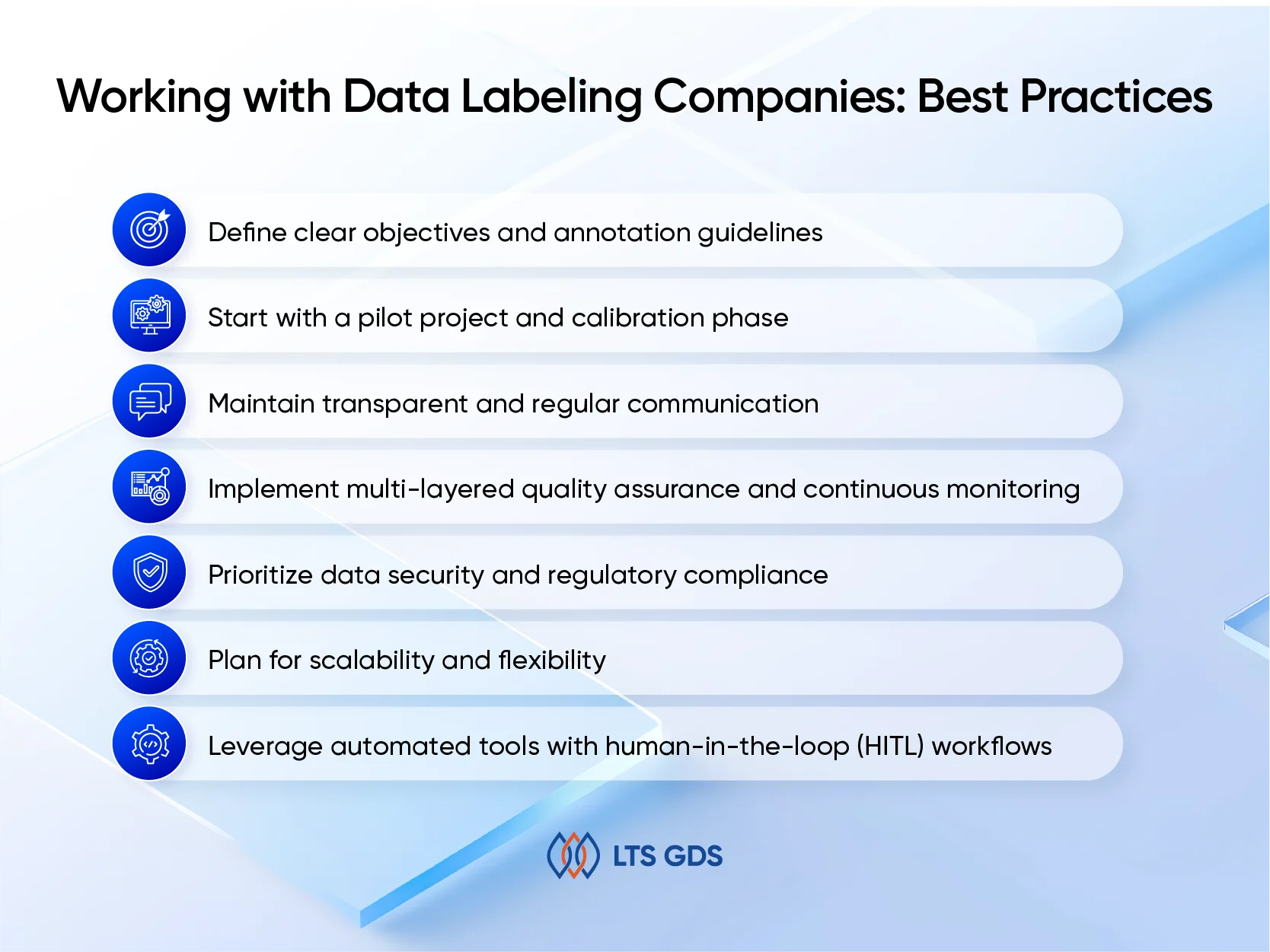
1. Define clear objectives and annotation guidelines
Clear objectives and detailed annotation guidelines form the foundation of any successful data labeling project. They ensure that all stakeholders share a unified understanding of what the AI model requires and how data should be labeled.
Action points
- Collaborate with domain experts to draft precise annotation instructions.
- Include examples, edge cases, and definitions of ambiguous scenarios.
- Document guidelines in an accessible format for annotators and reviewers.
- Regularly update guidelines based on feedback and model performance.
Why it matters
Ambiguous or incomplete guidelines lead to inconsistent labels, increasing error rates, and requiring costly rework. Clear objectives align the labeling team with business goals, accelerating model training and improving AI accuracy.
2. Start with a pilot project and calibration phase
Launching a pilot project allows you to validate annotation quality, test workflows, and calibrate the labeling team before full-scale deployment.
Action points
- Select a representative subset of data for the pilot.
- Set clear quality benchmarks and review cycles.
- Use pilot results to refine guidelines and processes.
- Engage in active feedback loops with annotators and project managers.
Why it matters
Pilots reduce risk by identifying issues early, preventing large-scale errors. Calibration ensures the team understands expectations, leading to higher quality and smoother scaling.
3. Maintain transparent and regular communication
Effective communication between your internal team and the labeling partner is critical for project success and adaptability.
Action points
- Establish regular status meetings and reporting cadence.
- Use collaborative tools for real-time updates and issue tracking.
- Encourage open dialogue about challenges and changes.
- Share model performance feedback to inform annotation adjustments.
Why it matters
Transparency fosters trust and agility, enabling quick resolution of problems and alignment with evolving project needs. It prevents miscommunication that can derail timelines or quality.
4. Implement multi-layered quality assurance and continuous monitoring
A robust quality assurance framework combining automated and human review ensures annotation accuracy and consistency.
Action points
- Deploy automated validation scripts to catch obvious errors.
- Use peer reviews and expert spot checks for nuanced quality control.
- Monitor key quality metrics continuously and report regularly.
- Adapt QA protocols based on error trends and client feedback.
Why it matters:
Multi-layered QA minimizes annotation errors, which directly impact AI model performance. Continuous monitoring allows proactive quality management and sustained excellence.
5. Prioritize data security and regulatory compliance
Protecting sensitive data and complying with legal regulations is non-negotiable, especially in healthcare, finance, and other regulated sectors.
Action points
- Verify the partner’s certifications (ISO 27001, GDPR, HIPAA, CCPA).
- Ensure data encryption in transit and at rest.
- Implement strict access controls and audit trails.
- Conduct regular compliance audits and risk assessments.
Why it matters:
Data breaches or regulatory violations can cause severe legal and financial consequences. Prioritizing security safeguards your organization’s reputation and client trust.
6. Plan for scalability and flexibility
AI projects often evolve rapidly, requiring annotation volume and complexity adjustments. Your partner must scale efficiently without compromising quality.
Action points
- Choose providers with proven ability to scale annotation teams quickly.
- Negotiate flexible contracts accommodating volume fluctuations.
- Ensure technology platforms support seamless onboarding and workflow changes.
- Prepare contingency plans for peak demand periods.
Why it matters:
Scalability ensures your AI development remains uninterrupted despite changing data needs, while flexibility allows cost optimization and responsiveness to market dynamics.
7. Leverage automated tools with human-in-the-loop (HITL) workflows
Combining AI-assisted annotation tools with expert human review balances speed and precision.
Action points
- Integrate AI pre-labeling to accelerate routine annotations.
- Use HITL workflows for complex or ambiguous data requiring human judgment.
- Continuously retrain AI models using human feedback to improve automation.
- Monitor HITL effectiveness through quality metrics.
Why it matters:
HITL workflows optimize resource use, reduce costs, and maintain annotation quality, enabling faster iteration cycles and improved AI model accuracy.
Summary table: Best practices for partnering with data labeling companies
| Step | Key actions | Business impact |
| Define clear objectives & guidelines | Draft detailed instructions; update regularly | Ensures consistent, high-quality labels |
| Start with pilot & calibration | Run small tests; refine processes | Early issue detection; smoother scaling |
| Maintain transparent communication | Regular updates; open feedback | Builds trust; agile problem-solving |
| Multi-layered QA & continuous monitoring | Automated + human reviews; track metrics | Sustains annotation accuracy |
| Prioritize security & compliance | Verify certifications; enforce controls | Protects data; mitigates legal risk |
| Plan scalability & flexibility | Scale teams; flexible contracts | Supports growth; cost-effective |
| Leverage automated + HITL workflows | AI pre-labeling + human review | Balances speed and precision |
For a detailed, step-by-step guide on collaborating with image annotation providers and implementing these best practices effectively, please refer to our guide on best practices for collaborating with an image annotation provider.
What to Consider When Choosing AI Data Labeling Companies?
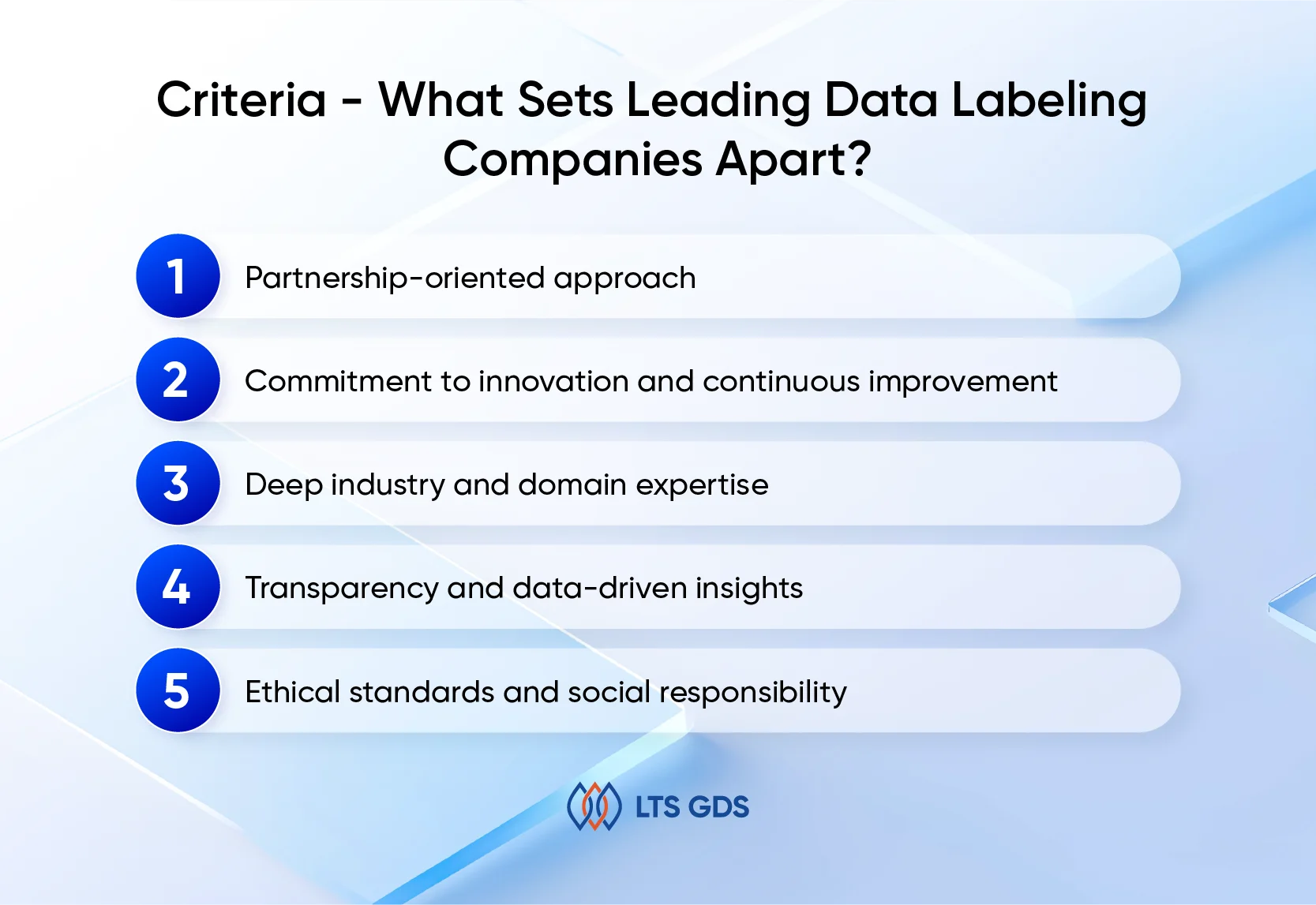
Building on the rapid growth and increasing complexity of the data labeling industry outlined above, enterprises today face a critical challenge: selecting a partner capable of delivering not only volume but also precision, security, and strategic alignment. As data annotation demands evolve, the criteria for choosing a leading data labeling company have become more nuanced and multifaceted.
In 2026, the most successful providers distinguish themselves through a combination of collaborative partnership models, relentless innovation, deep domain expertise, transparent operations, and strong ethical commitments. These factors collectively ensure that annotation projects not only meet technical requirements but also drive long-term AI success and business value.
1. Partnership-oriented approach
- Strategic alignment: Leading data labeling companies engage deeply to understand the enterprise’s AI objectives, data challenges, and business priorities. This ensures annotation workflows are tailored to deliver maximum value.
- Customized processes: They design flexible annotation guidelines and workflows that adapt as project requirements evolve, minimizing delays and rework.
- Open communication: Continuous, transparent dialogue fosters trust and quick resolution of issues, positioning the provider as an extension of the client’s AI team.
- Scalability and agility: Providers can rapidly scale resources and pivot focus to meet fluctuating data volumes and shifting priorities without compromising quality or deadlines.
2. Commitment to innovation and continuous improvement
- Advanced technology integration: Utilization of AI-assisted pre-labeling, active learning, and human-in-the-loop (HITL) frameworks accelerates annotation while maintaining accuracy.
- Iterative quality enhancement: Continuous feedback loops and performance monitoring enable ongoing process refinement, reducing errors and annotator fatigue.
- Workflow automation: Seamless automation of data ingestion, annotation, quality checks, and delivery optimizes operational efficiency.
- Adoption of emerging techniques: Early adoption of cutting-edge annotation methods, such as semantic segmentation and 3D point cloud labeling, keeps providers ahead of evolving client needs.
3. Deep industry and domain expertise
- Industry-specific knowledge: Annotation teams possess deep expertise in sectors like autonomous vehicles, healthcare, finance, retail, and NLP, ensuring contextual accuracy.
- Regulatory compliance: Providers understand and adhere to industry-specific regulations, reducing legal and operational risks for clients.
- Reduced rework: Domain proficiency minimizes annotation errors and ambiguities, accelerating dataset readiness and model training.
- Enhanced model performance: Precise, context-aware labeling improves AI model reliability and effectiveness in real-world applications.
4. Transparency and data-driven insights
- Real-time visibility: Clients gain access to live dashboards showing annotation progress, quality metrics, and throughput.
- Detailed analytics: Comprehensive reporting on error rates, turnaround times, and annotator performance identifies bottlenecks and drives continuous improvement.
- Process transparency: Clear insight into workflows and quality controls builds client confidence and accountability.
- Informed decision-making: Data-driven insights empower enterprises to optimize annotation strategies and resource allocation proactively.
5. Ethical standards and social responsibility
- Robust data security: Compliance with standards such as ISO 27001 and GDPR ensures stringent protection of sensitive data.
- Fair labor practices: Commitment to safe working conditions, fair compensation, and workforce diversity fosters ethical labor environments.
- Sustainability and governance: Providers integrate environmental and social governance (ESG) principles into operations, aligning with client corporate responsibility goals.
- Risk mitigation: Ethical standards reduce reputational and legal risks for both providers and their enterprise clients.
FAQ about Best Data Labeling Companies
1. What is a data labeling service company?
A data labeling service company specializes in annotating raw data, such as text, images, videos, or audio, to make it understandable and usable for machine learning models. These companies employ trained professionals and sophisticated tools to apply accurate tags, bounding boxes, segmentation masks, transcription, or classifications depending on the data type and AI use case.
2. How big is the data labeling industry?
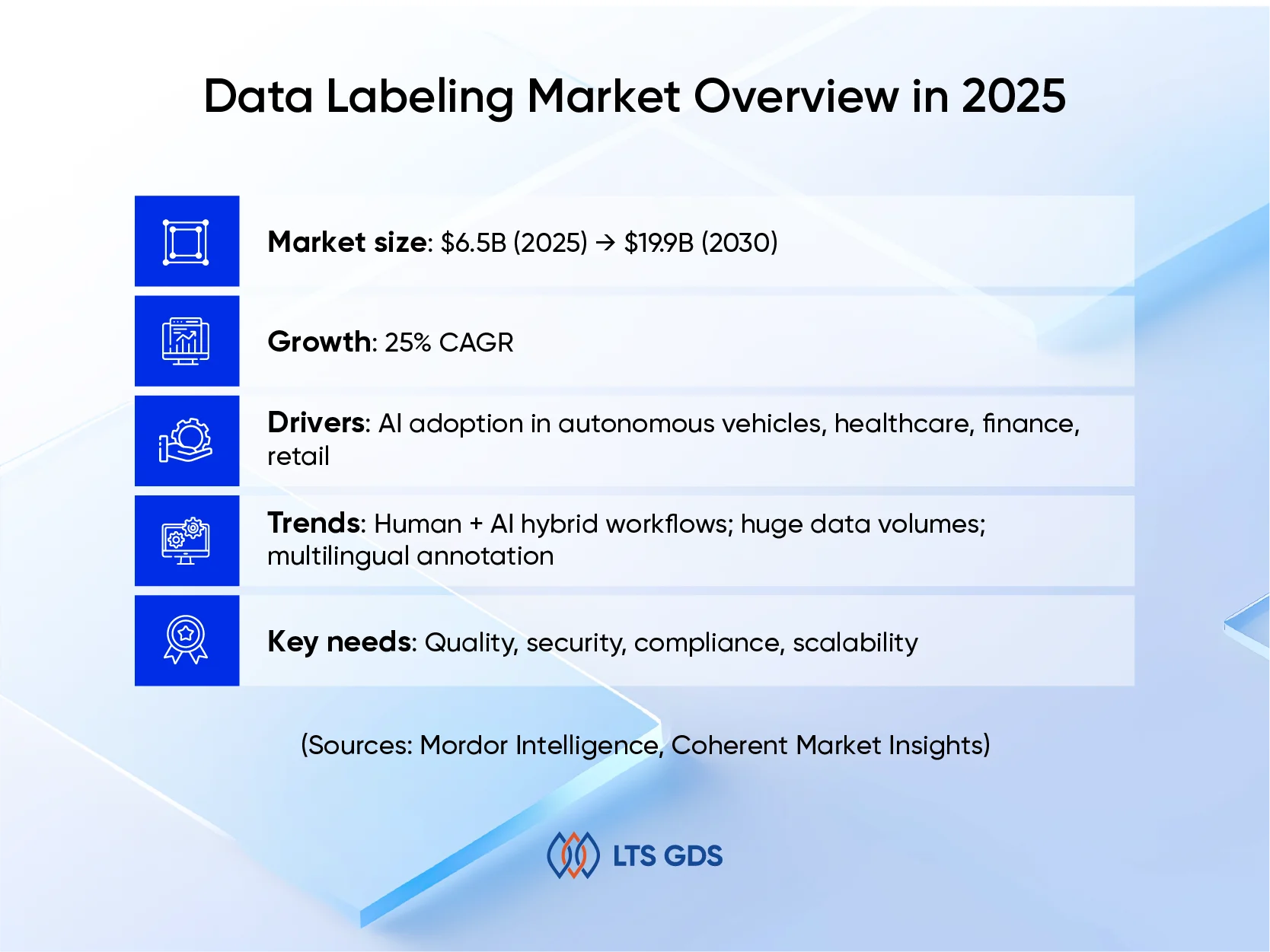
The global data labeling market is experiencing rapid growth, driven by the exponential demand for AI and machine learning applications across industries. According to market research, the industry was valued at over $3.77 billion USD in 2024 and is projected to surpass $10 billion USD by 2030.
3. What are the benefits of hiring a data labeling company?
Hiring a data labeling company offers several advantages:
- Scalability: Outsourcing allows businesses to handle large volumes of data quickly without straining internal resources.
- Expertise: Specialized labeling teams are trained for domain-specific annotations, ensuring accuracy and consistency.
- Efficiency: Experienced vendors use custom pipelines and QA processes to accelerate delivery timelines.
- Cost-effectiveness: Outsourcing to offshore locations with competitive labor markets (e.g., Vietnam, India) can significantly reduce costs.
- Focus on core tasks: Partnering with a vendor frees internal teams to concentrate on model development and strategic initiatives.
4. What are the key considerations when choosing a data labeling company?
When evaluating a data labeling company, key factors to consider include:
- Data security & compliance: Ensure the provider adheres to industry standards (e.g., ISO 27001, GDPR).
- Quality control mechanisms: Look for multi-stage QA workflows, gold standard benchmarks, and annotator training.
- Tooling & integration: Choose vendors that offer flexible tool compatibility or support custom platforms.
- Domain expertise: Some vendors specialize in healthcare, legal, automotive, or financial data. Hence, consider choosing one that aligns with your needs.
- Scalability & turnaround time: A company’s ability to scale quickly without sacrificing quality is essential for enterprise projects.
5. What are the benefits of partnering with a Vietnamese data labeling company?
Vietnam is emerging as a competitive hub for high-quality, cost-efficient data labeling services. Key benefits include:
- Skilled workforce: A young, tech-savvy population with strong STEM education provides a solid talent base.
- Cost advantage: Labor costs in Vietnam are significantly lower than in Western markets, allowing for competitive pricing without compromising quality.
- Time zone compatibility: Favorable overlap with both U.S. and Asia-Pacific time zones ensures smoother communication cycles.
- English proficiency: Many Vietnamese professionals are proficient in English, facilitating collaboration with global clients.
- Government support for tech sector: Vietnam’s national strategy for digital transformation fosters innovation and investments in AI-related industries.
Choosing Trusted Enterprise’s Ideal Data Labeling Partner
Choosing the right data labeling partner is a critical strategic decision for the success of any enterprise project. The quality, accuracy, and security of your enterprise’s labeled data directly impact the performance and reliability of your AI and machine learning models.
By following best practices such as establishing clear communication channels, providing detailed project guidelines, and ensuring robust quality assurance processes are in place, your enterprise can maximize the success of its collaboration.
At LTS Global Digital Services – the no.1 LLM training company in Vietnam, we specialize in providing high-quality, efficient, and secure data labeling services tailored to meet your unique business needs. Whether your team requires a comprehensive quote, wishes to initiate a pilot project to validate our capabilities, or seeks further information on how we can help streamline your enterprise data annotation pipeline, contact us today.
Let us help your enterprise achieve its AI goals with precision, security, and scale!