


Scale AI built its name as the go-to data partner for frontier labs, autonomous vehicle programs, and government AI projects. For years, its workforce and infrastructure made it the default choice.
That changed with Meta’s $14 billion investment for a 49% stake in Scale AI and CEO Alexandr Wang’s move to lead Meta’s own AI lab. For competing labs like OpenAI and Google, Scale is no longer a neutral vendor. Many have already started shifting their data programs elsewhere.
This guide covers the leading competitors to Scale AI for AI data projects, from autonomous driving to generative AI. It focuses on quality frameworks, domain expertise, infrastructure, and flexibility, not just company size.
If you’re evaluating Scale AI alternatives for your next AI data project, this guide will help you find the right partner.
Top 9 Scale AI Competitors & Alternatives
Not all Scale AI competitors follow the same business model. Some provide end-to-end managed AI data services, while others offer annotation platforms for organizations with internal data teams. Identifying the right delivery model is an important first step in narrowing the shortlist.
LTS GDS
Overview: LTS Global Digital Services (LTS GDS) is a data services company and a core member of LTS Group, a Vietnam-based technology ecosystem. The company delivers data solutions for AI and ML models, covering Computer Vision, NLP, and end-to-end data pipelines for Generative AI, including LLMs, diffusion models, and multimodal systems, along with specialized domains such as STEM, Physical AI, and coding LLMs. LTS GDS has delivered 500+ projects and processed more than 50 million data points at a 99% accuracy rate, with particularly deep experience in automotive and ADAS annotation, where it manages multi-year partnerships involving millions of high-precision labeled data points.
Website: https://www.gdsonline.tech/
Headquarters: Hanoi, Vietnam
Why LTS GDS?
Diverse market: LTS GDS works with a broad global client base spanning the US, EU, Japan, South Korea, and other markets across APAC.
Quality: With over 10 years of experience annotating data for autonomous driving and transportation projects, LTS GDS runs a 4-layer QA framework designed to hit up to 100% accuracy across LiDAR, 2D/3D object detection, and semantic segmentation. LTS GDS is also among the first providers to receive the Data Labeling Assessment from DEKRA Testing and Certification S.A.U, which validates its processes specifically for AI and ADAS systems.
Security: LTS GDS operates under strict NDAs and maintains compliance with ISO 27001 and GDPR standards.
Talent pool: LTS GDS can recruit and train hundreds of specialized experts within one week, and offers flexible engagement models, including project-based, time & materials (T&M), and build-operate-transfer (BOT).
Best for: AI startups, coding LLM teams, Physical AI and robotics companies, and automotive AI programs looking for a cost-efficient, neutral data partner that combines domain expertise with fast team ramp-up and flexible contract structures.
Snorkel AI
Overview: Snorkel AI grew out of research at the Stanford AI Lab and built its name on “programmatic data development”, which uses rules, heuristics, and model-assisted workflows (rather than pure manual labeling) to generate and curate training data at speed. Its Snorkel Flow platform is used across regulated industries like banking, insurance, and healthcare, and the company has more recently positioned itself as a “data layer for specialized AI,” working with frontier labs, enterprises, and government agencies on expert-authored data with full audit trails. Snorkel has raised roughly $238 million and was valued at $1.3 billion as of its most recent funding round.
Website: https://snorkel.ai/
Headquarters: California, United States
Why Snorkel AI?
Snorkel has repositioned itself less as a data vendor and more as a “Frontier AI Data Lab,” built for difficulty rather than volume. Where Scale AI has historically optimized for labeling as much data as possible, Snorkel targets the edge cases and distributional gaps that actually break frontier models.
That shows up in how it pairs programmatic scaling with a vetted expert community across software engineering, medicine, law, and finance. Besides, Snorkel has also pushed deep into agentic and reinforcement learning data, building reasoning traces and multi-step, computer-use datasets in sandboxed environments, often co-developing benchmarks like OSWorld 2.0 and SWE-Bench+ with academic teams. It reads as a lab built for hard AI data work, not a general-purpose labeling vendor.
Best for: Enterprises in regulated industries including banking, insurance, healthcare, and legal that need programmatic, expert-driven data development rather than large-scale outsourced human labeling.
Appen

Overview: Appen has been a data provider since 1996, before “data labeling” was a category anyone talked about. The company built its scale through a global network of more than a million contributors across 170+ countries and 80+ languages, and today organizes its work into six data product pillars: frontier model alignment, multimodal perception, agentic workflow data, model evaluation, physical/embodied AI data, and speech and audio collection.
Website: https://www.appen.com/
Headquarters: Australia and United States
Why Appen?
Appen’s global crowd spans more than a million contributors across 200+ countries, which is hard for most vendors to match when you’re training multilingual LLMs, building localization products, or tuning global search relevance. That scale, paired with 25+ years of experience, also means Appen has quality infrastructure built for large projects, not just small pilots.
Appen’s coverage goes beyond basic labeling too. It supports the full model development cycle, supervised fine-tuning, RLHF, model evaluation, and bias mitigation, across generative AI, LLMs, computer vision, and speech. Combined with its AI-assisted annotation platform, that gives Appen a full-stack offering rather than a single-service one.
Best for: Enterprises needing large-scale multilingual data collection, search relevance tuning, speech data, and frontier model evaluation across dozens of languages and regions.
Encord
Overview: Encord offers a data layer for AI models, with a strong focus on Physical AI and robotics, autonomous vehicles (AV) and ADAS, and industrial and manufacturing use cases. The company’s platform handles multimodal data including images, video, audio, text, DICOM medical imaging, LiDAR, and point clouds. It’s used by teams like Toyota, Skydio, AXA, and Maxar to curate, manage, annotate, and align the data behind robotics, autonomous vehicles, and other embodied AI systems. Encord has raised approximately $110 million, including a $60 million Series C in early 2026.
Website: https://encord.com/
Headquarters: California, United States
Why Encord?
The clearest way to think about Encord versus Scale AI is control versus outsourcing. Scale is primarily a managed service, which hands off labeling work, and Scale’s workforce executes it. Encord is a software platform that your own ML and data teams operate directly, giving clients more control over curation logic, active learning loops, and dataset governance. For physical AI teams dealing with petabyte-scale sensor data and constant iteration, that in-house control often matters more than raw labeling throughput.
Best for: Robotics, autonomous vehicle, and physical AI teams that want a self-operated platform for curating and governing large multimodal datasets rather than fully outsourcing the labeling function.
TELUS Digital

Overview: TELUS Digital (formerly TELUS International) is the digital customer experience and AI data services arm of TELUS Corporation, one of Canada’s largest telecom groups. Beyond its well-known CX business, TELUS Digital runs a substantial AI data annotation practice covering image, video, text, and multi-sensor datasets, supported by a global delivery network spanning 70+ centers and dozens of languages.
Website: https://www.telusdigital.com/
Headquarters: Vancouver, Canada
Why TELUS Digital?
Scale is enormous, but TELUS Digital brings something Scale doesn’t have in the same way: the operational maturity of a public telecom parent company. That means structured governance, mature security practices, and consistent processes across markets, which matters a lot for enterprises with strict compliance requirements or multi-region rollouts. TELUS Digital also supports data annotation in hundreds of languages, making it a practical fit for global automotive, retail, or finance programs that need consistent labeling quality across many regions at once.
Best for: Global enterprises that need multilingual data annotation delivered under enterprise-grade compliance and governance frameworks.
SuperAnnotate
Overview: Established in 2018, SuperAnnotate is a US-headquartered firm specializing in an end-to-end data platform for enterprise AI training and model deployment. The company provides a comprehensive suite of solutions spanning dataset creation, curation, model evaluation, and reinforcement learning from human feedback (RLHF) workflows. Supported by leading investors like NVIDIA and Databricks Ventures, they are recognized for their top-rated data labeling platform and their strategic partnerships with global technology leaders such as IBM, ServiceNow, and Databricks.
Website: https://www.superannotate.com/
Headquarters: California, United States
Why SuperAnnotate?
SuperAnnotate has emerged as one of the most recognized alternatives to Scale AI by combining an enterprise annotation platform with managed AI data services. This dual offering appeals to organizations seeking both workflow flexibility and operational support from a single provider.
Beyond its platform capabilities, SuperAnnotate places a strong emphasis on enterprise security, with compliance including SOC 2 Type II, ISO/IEC 27001:2022, GDPR, CCPA, and HIPAA, as well as security features such as SSO and 2FA. The company also offers an LLM Expert Workforce that provides access to vetted specialists for RLHF, model evaluation, and other GenAI data workflows, supporting organizations developing foundation models and AI applications.
Best for: AI teams that want a hybrid of self-serve software and managed data operations for RLHF, model evaluation, and fine-tuning datasets; especially teams diversifying away from Scale AI.
iMerit
Overview: Established in 2011, iMerit is a US-headquartered enterprise data platform and service provider specializing in high-quality data solution pipelines for global AI deployment. Operating through a secure network of over 5,500 dedicated, full-time domain experts globally, the company serves an international client base across North America, Europe, and the Asia-Pacific region, including many Fortune 500 enterprises.
Website: https://imerit.ai/
Headquarters: California, United States
Why iMerit?
iMerit delivers end-to-end and high-quality data annotation, dataset curation, and reinforcement learning from human feedback (RLHF) solutions across industries such as Autonomous Vehicles (ADAS), Medical AI, Geospatial Tech, and Generative AI. The company is recognized for its consultative, high-compliance approach, offering SOC 2 Type II, HIPAA, and TISAX certifications alongside its Ango Hub platform to provide clients with unmatched data security, multi-layered quality assurance, and real-time project observability at scale.
Best for: Healthcare AI, geospatial intelligence, and autonomous mobility companies that need subject-matter-expert-level accuracy on highly technical data.
Label Your Data
Overview: Founded in 2020, Label Your Data not only offers a professional annotation service but also a data labeling platform, aimed at helping data scientists and ML engineers move faster through dataset preparation. With headquarters in Delaware and delivery teams spread across North America, the EU, and Asia, the company positions itself around transparent, flexible pricing models, plus a free pilot for prospective clients.
Website: https://labelyourdata.com/
Headquarters: Delaware, United States
Why Label Your Data?
Label Your Data runs a team of 1,000+ annotators across Europe, LATAM, and Africa, supporting 55 languages worldwide. The team can work with whatever annotation setup a client already uses, and the company offers 24/7 support across more than 20 industries, from automotive to healthcare to fintech. Label Your Data also runs its own data annotation platform built for computer vision datasets. The tradeoff is that its experience leans more toward established computer vision annotation work than newer generative AI data types.
Best for: Startups and mid-size ML teams that want transparent pricing and a low-risk way to pilot a data partner before scaling up.
V7
Overview: V7 built its reputation on V7 Darwin, a self-serve annotation platform for computer vision and generative AI training data, supporting more than 50 data formats including medical imaging standards like DICOM and NIfTI. The platform uses SAM-based auto-segmentation, automatic object tracking across video frames, and model-in-the-loop workflows that let a client’s own models pre-label new data. V7 has since expanded into V7 Go, a document and workflow automation product, but its core annotation business still serves around 350 customers, including Genentech, Mars, and Kion.
Website: https://www.v7labs.com/
Headquarters: London, United Kingdom
Why V7?
V7 has shifted its focus toward enterprise workflow automation for private markets, using AI agents to structure data rooms, CRMs, and research documents rather than just labeling training data. That’s a different business than only annotation, so teams evaluating V7 mainly for computer vision or medical imaging work should confirm its current roadmap still prioritizes that use case. And since V7 doesn’t run a large managed workforce the way Scale AI or iMerit do, teams without in-house annotation capacity may need to pair it with contract annotators.
Best for: Computer vision and medical imaging teams that want a self-serve, AI-assisted annotation platform rather than a fully managed labeling workforce.
How to Choose Among the Most Reliable Scale AI Competitors
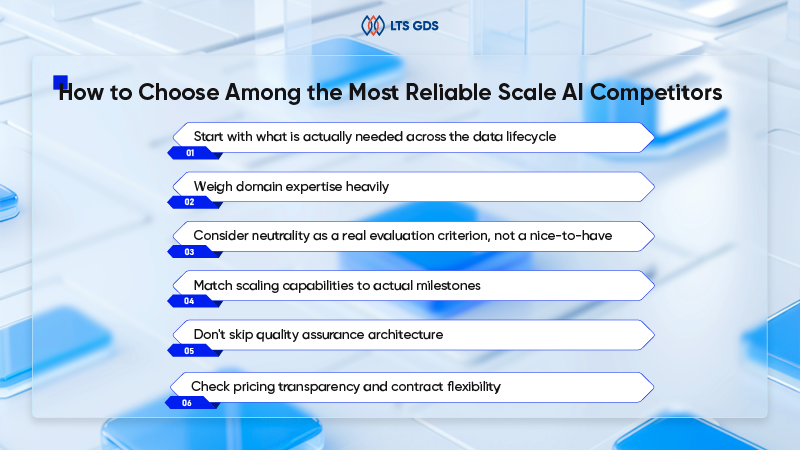
With these different options on the list, picking the right one comes down to matching a vendor’s model to your actual project constraints, not just its brand recognition.
Start with what is actually needed across the data lifecycle. Some of the most reliable Scale AI competitors offer full-service coverage from data collection through annotation and validation. Others are platforms your team operates directly. Neither model is inherently better; it depends on whether your organization has in-house capacity to run annotation workflows or whether businesses need a partner to own execution end-to-end.
Weigh domain expertise heavily. A vendor excellent at generic image classification is not automatically proficient in LiDAR sensor fusion for autonomous driving or in correctly reading a chest CT scan. Prioritizing evidence of actual industry experience, such as DEKRA’s automotive data labeling assessment certification or HIPAA compliance for healthcare, is always worth more than a generic capabilities list.
Consider neutrality as a real evaluation criterion, not a nice-to-have. This is new relative to how buyers evaluated data vendors even years ago, but it’s become material. If your company competes with a major AI lab, or if you simply don’t want your training data pipeline financially entangled with one player’s outcomes, a vendor’s ownership structure and investor base deserve a line item in your vendor review.
Match scaling capabilities to actual milestones. Some vendors can ramp a specialized team in a week; others need months to properly train experts for a new domain. Be honest with yourself about how quickly your project actually needs to scale, and pressure-test whether a vendor’s stated ramp-up capability holds up under a real pilot.
Don’t skip quality assurance architecture. Ask specifically how a vendor structures QA like multi-layer review, consensus labeling, and gold-set calibration, rather than accepting a stated accuracy percentage at face value. In any training project, the QA process is usually a better predictor of real-world performance than the marketing number.
Check pricing transparency and contract flexibility. Vendors offering free pilots, transparent tiered pricing, or flexible engagement models tend to be a better fit for teams that need to prove value before committing to a large contract.
Why Companies Look for Scale AI Alternatives
The most immediate reason has nothing to do with data quality and everything to do with structure. Meta’s roughly $14 billion investment for a 49% stake in Scale AI, paired with founder Alexandr Wang’s move into Meta’s own AI research team, changed how rival labs view the company. For labs like OpenAI or Google DeepMind, sending sensitive training data or evaluation workloads to a provider tied directly to a chief competitor is an impossible internal sell, regardless of labeling quality. Several major customers have already started redirecting volume elsewhere, and that shift is a big part of why “Scale AI competitors” and “Scale AI alternative” are trending in search right now.
In addition, AI development has grown more complex, moving well past basic bounding boxes and text classification into supervised fine-tuning, RLHF, safety alignment, red teaming, and ongoing model evaluation. Not every company built for high-volume labeling has kept pace with that shift, which pushes buyers toward more specialized partners for specific stages of the pipeline.
Cost plays a role too. Scale AI’s pricing reflects its enterprise positioning, which can be hard to justify for an early-stage startup or a smaller AI agent company working with a tighter budget. A few of the options in this guide offer more flexible pricing and engagement terms.
Depending on one company for a mission-critical pipeline creates real exposure if priorities shift, prices climb, or leadership changes reshuffle the business, which is roughly what happened at Scale over the past year. Spreading work across two or three partners, or choosing a smaller, more responsive one for a given project, meaningfully reduces that exposure.
And finally, fit matters more than it used to. Physical AI, autonomous driving, coding agents, and healthcare all require data requirements that a generalist can struggle to handle well. Thus, it is necessary for firms to choose specialized companies on the wishlist to solve their business issues.
FAQs About Scale AI Competitors
1. Who are Scale AI’s competitors?
The most commonly cited Scale AI competitors include LTS GDS, Snorkel AI, Appen, Encord, TELUS Digital, SuperAnnotate, iMerit, Label Your Data, and V7. Each serves a slightly different niche, from managed annotation services to self-serve data platforms, so the right one depends on your specific AI or LLM use case rather than overall market size.
2. What are the top Scale AI competitors and alternatives in 2026?
Heading into 2026, the top Scale AI competitors and alternatives span a mix of established players and newer specialists: Appen and TELUS Digital for scale and multilingual reach, Snorkel AI and SuperAnnotate for programmatic and RLHF-focused workflows, Encord and V7 for physical AI and computer vision platforms, iMerit for domain-expert annotation in healthcare and geospatial work, and LTS GDS and Label Your Data for cost-efficient, flexible engagement models.
3. Is there a reliable Scale AI competitors list for autonomous driving or Physical AI projects?
Yes. For automotive and Physical AI use cases specifically, LTS GDS and Encord stand out on this Scale AI competitors list, given their focus on LiDAR annotation, sensor fusion, and multimodal robotics data. iMerit is also a strong option where autonomous mobility overlaps with geospatial or agricultural AI data needs.
4. Who are the most reliable Scale AI competitors for LLM and generative AI data?
For LLM and generative AI work, Snorkel AI, SuperAnnotate, and Appen are among the most reliable Scale AI competitors, each offering dedicated tooling or services for RLHF, model evaluation, and frontier alignment data. LTS GDS is also a strong option for coding LLM data specifically, given its developer-led evaluation teams.
5. Why are companies moving away from Scale AI toward alternatives?
The most immediate driver is Meta’s investment in and close ties to Scale AI, which has made some competing AI labs treat the company as a less neutral vendor. Beyond that, companies are also looking for more specialized domain expertise, more transparent pricing, and more flexible contract terms than Scale AI’s enterprise-first model typically offers.
Wrapping Up: Finding the Right Scale AI Alternative for Your Team
There’s no shortage of vendors claiming they can handle training data projects, but not many of them are actually built for what your project needs. That’s the real test, not brand recognition, but fit. Quality, domain depth, security, and how fast a vendor can scale with you all shape model performance far more than headcount alone.
The market has also shifted in a way that’s hard to ignore. Since Meta’s stake in Scale AI, neutrality has become part of the evaluation criteria too, not just a nice-to-have. Teams are now considering vendor independence alongside the usual factors: pricing, turnaround time, and proven experience in their specific domain.
LTS Global Digital Services is one of the strongest emerging Scale AI alternatives, delivering high-quality, cost-effective data solutions for AI and LLM projects. With a team of specialized experts, a rigorous QA process, and flexible engagement models, LTS GDS helps businesses build reliable datasets tailored to their specific needs. Talk to our team to see how we can support your next project.