

Elevate Pre-trained Models with Precision Fine-tuning Data!
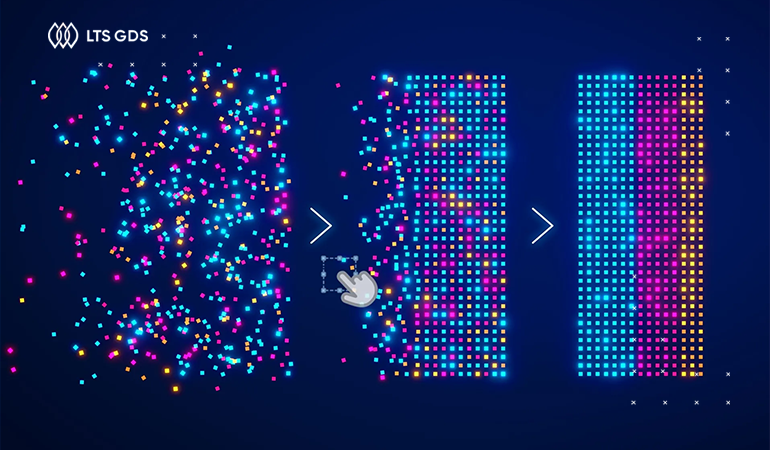
Deliver end-to-end LLM fine-tuning solutions to adapt pre-trained models into high-performing, domain-specific systems.
Trusted by Industry Leaders Worldwide


Our Capabilities
Optimize post-training LLM performance with our end-to-end data solutions.
LTS GDS delivers high-quality supervised datasets to adapt pre-trained LLMs into domain-specific, task-oriented systems across various industries.
Our offerings include:
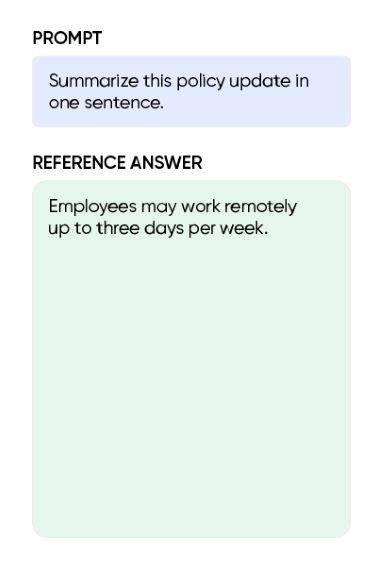
- Prompt generation and validation
- Response generation with quality scoring
- Multi-turn dialogue creation and evaluation
- Domain-specific context adaptation
- Error detection and response refinement
- Localization and multilingual adaptation
We design structured instruction datasets that improve model reasoning, task understanding, and output consistency across complex scenarios.
Several tasks we focus on:
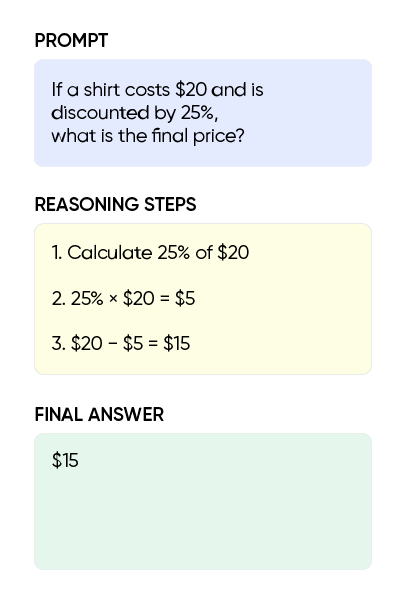
- Instruction-response pair creation
- Chain-of-thought and reasoning path annotation
- Task decomposition and step-by-step guidance generation
- Complex query and edge-case scenario design
Our experts evaluate model-generated responses in different contexts using reinforcement learning with human feedback (RLHF) and Direct Preference Optimization (DPO).
Key features:
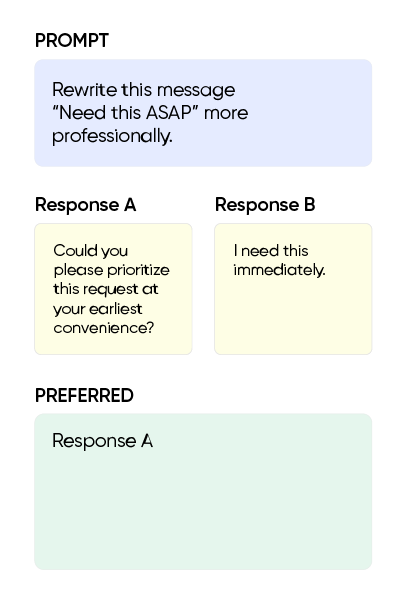
- Real-time human interactions to guide model behavior
- Evaluation of single- or multi-turn conversations
- Customizable evaluation criteria: semantic accuracy, clarity, tone, and compliance
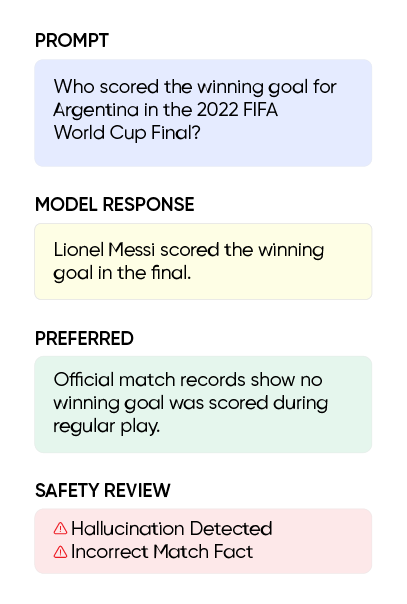
We improve model safety and compliance through targeted datasets that reduce hallucinations, bias, and deployment risks.
What we deliver:
- Toxicity and harmful content detection
- Bias identification and mitigation
- Hallucination-trigger dataset creation
- Policy and compliance alignment (e.g., GDPR-ready data)
- Red-teaming and adversarial prompt design
Our 500+ AI Trainers Pool
Train LLMs with deep industry expertise, powered by multilingual, multi-level experts.
Vietnamese
English
Russian
Mandarin Chinese
Cantonese
Japanese
Korean
Malay
Indonesian
Thai
Lao
Hindi
Arabic
French
German
Spanish
Portuguese
Italian
Bulgarian
Hungarian
Engineering
Civil Engineering
Law
Finance
Accounting
Economics
Mathematics
Computer Science
Medicine
Psychology
Physics
Healthcare
Chemistry
Biology
Astronomy
Biotechnology
Bioinformatics
Teaching
Linguistics
Religion
Language Arts
Music
Philosophy
History
Performing Arts
Robotics Engineers
Computer Scientists
Software Engineers
Systems Architects
Data Engineers
AI/ML Researchers
Financial Analysts
Accountants
Auditors
Economists
Investment Bankers
Risk Managers
Psychologists
Sociologists
Political Scientists
Administrators
Scientists
Mathematicians
Photographers
Screenwriters
VFX Supervisors
Cinematographers
Art Directors
Creative Directors
Animation Directors
3D Modelers
Sound Designers
Audio Engineers
Music Composers
Voice Directors
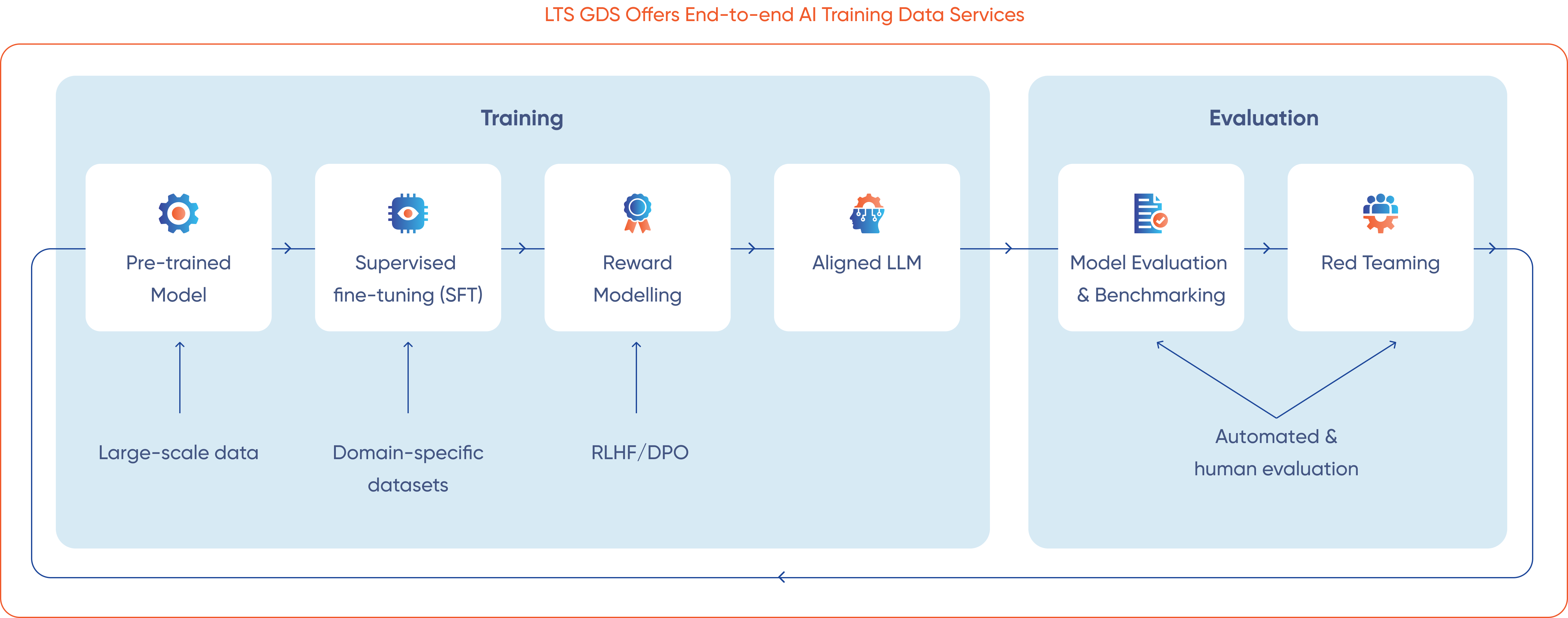
How to Train an LLM at LTS GDS
Train your model by combining large-scale pre-training, expert-guided post-training, and domain-specific fine-tuned data for industry-ready performance.
Our Model Alignment and Evaluation Services Workflow
We follow a structured LLM fine-tuning method to achieve excellent outcomes.
A dedicated project manager works closely with the client to understand business objectives, data sources, and LLM fine-tuning needs. We assess model scope, domain requirements, training methods, compliance considerations, expected outcomes, and cost factors. Based on this, we propose a customized LLM fine-tuning strategy to ensure alignment before project initiation.
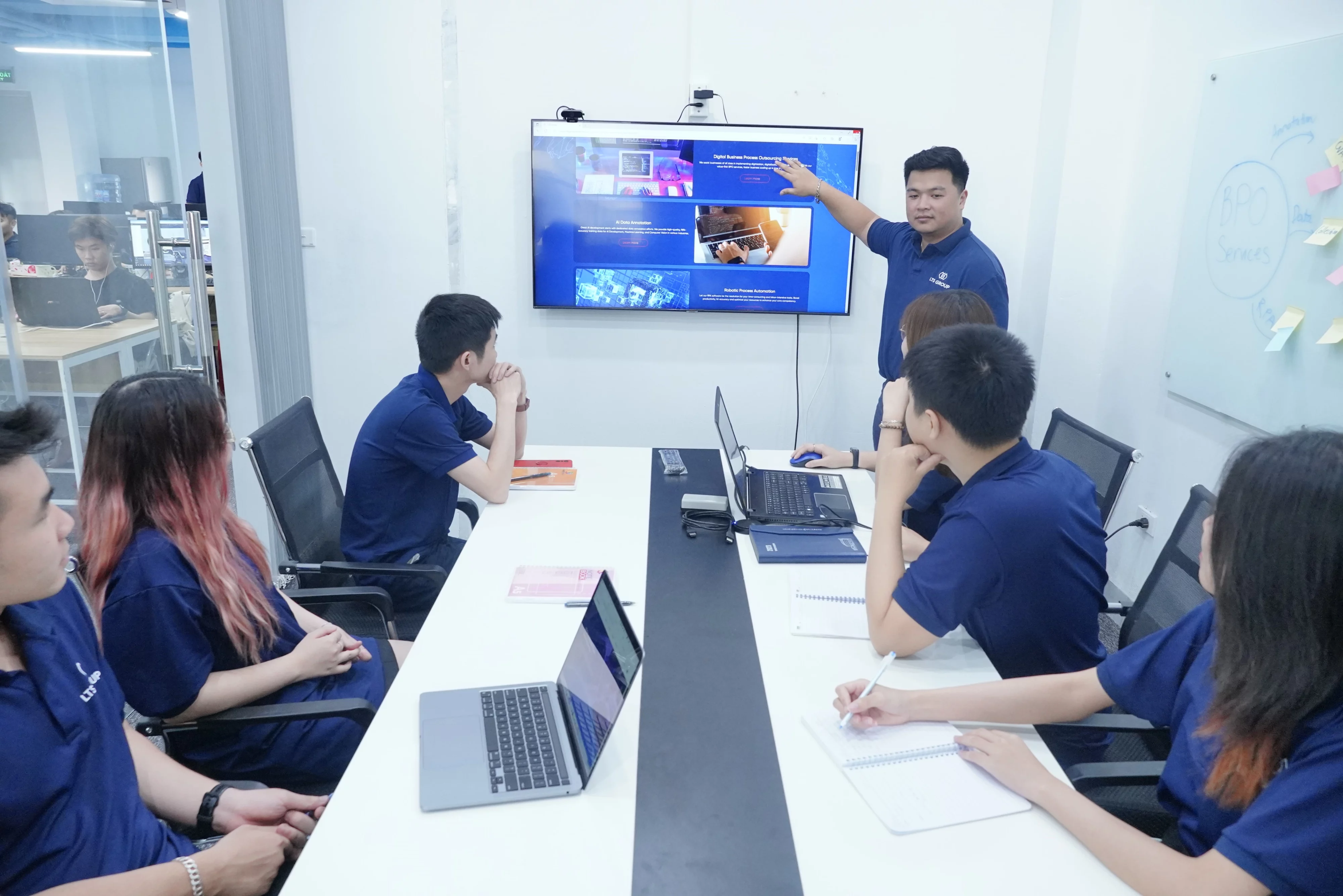
LTS GDS will assemble a dedicated delivery team, including both internal experts and vendor partners from different regions worldwide when needed. Training sessions are conducted to align all team members on project goals, annotation or data preparation quality standards, and execution methodology. This ensures every contributor understands the LLM fine-tuning workflow from day one.
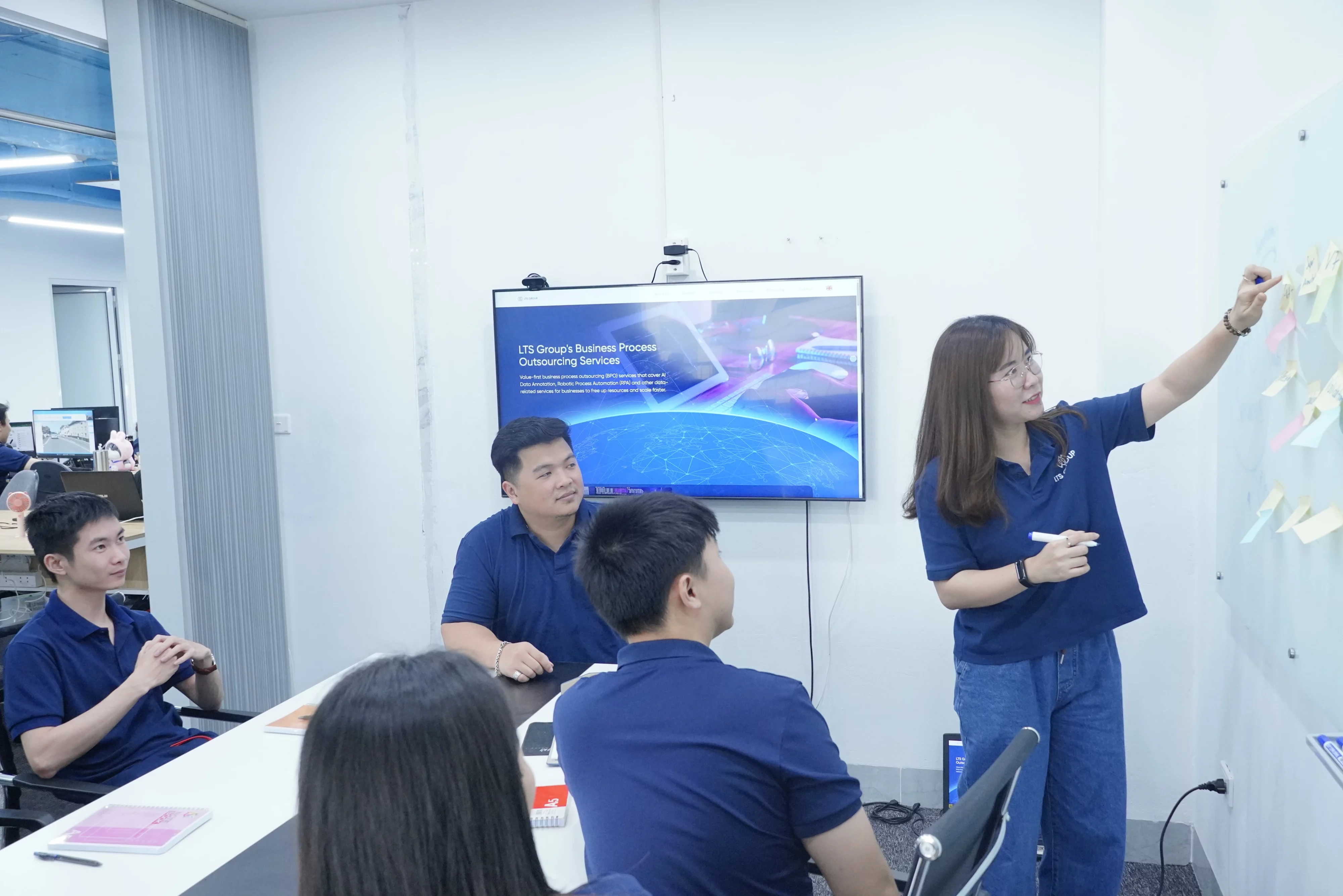
Before scaling, our team executes trial tasks to validate the process. Outputs are shared with the client for review, and feedback is integrated into updated guidelines. This step helps refine edge cases, improve consistency, and ensure the LLM fine-tuning process matches business objectives.

LTS GDS manages large-scale LLM fine-tuning with strict deadlines and regular quality checks. Specialized teams handle different tasks, while ongoing meetings ensure the training process adapts to client feedback. Together with our clients, LTS GDS defines clear evaluation criteria to measure output quality and refine results until they meet expectations.
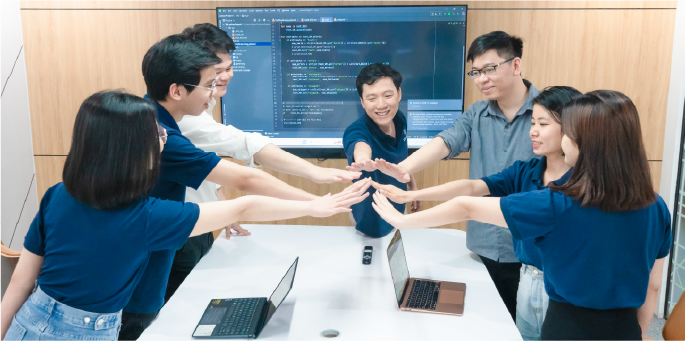
We proactively track and report issues, such as unclear requirements or hidden scenarios, to the client. Our internal team meets regularly to resolve errors, update workflows, and strengthen the LLM fine-tuning outcomes over time.

Our Experts
Why LTS GDS?
Build smarter, more reliable and more capable models with top-tier quality data provided by SMEs.
Quality-first Approach
We deliver reliable LLM fine-tuning outcomes with high accuracy. Our multi-layered review process ensures that models are refined with critical thinking and contextual understanding.
Domain-specific Expertise
Our AI trainers bring deep knowledge across industries to create domain-specific LLMs that understand specialized terminology and meet real model needs.
Global Competence
With huge teams in many regional markets and cultures, our experts train LLMs that adapt naturally to multilingual use cases and cultural nuances.
Cost-effective
Leverage Vietnam’s competitive labor costs, favorable business environment, and flexible pricing models to optimize your LLM projects.
Wall of Achievement
99%
Accuracy
50M+
Lines of Code
11
Countries
500+
Projects
Our Case Studies
See how enterprises have leveraged our LLM fine-tuning services to scale AI adoption.
Our Tools and Technologies
LTS GDS leverages cutting-edge tools and frameworks to implement LLM guardrails


FAQs about LLM Fine-tuning Services
How does LLM fine-tuning work?
LLM development typically involves two stages: pre-training and post-training.
Pre-training builds general language understanding using large-scale datasets. Fine-tuning (post-training) then adapts the model to specific tasks or domains using high-quality, curated data.
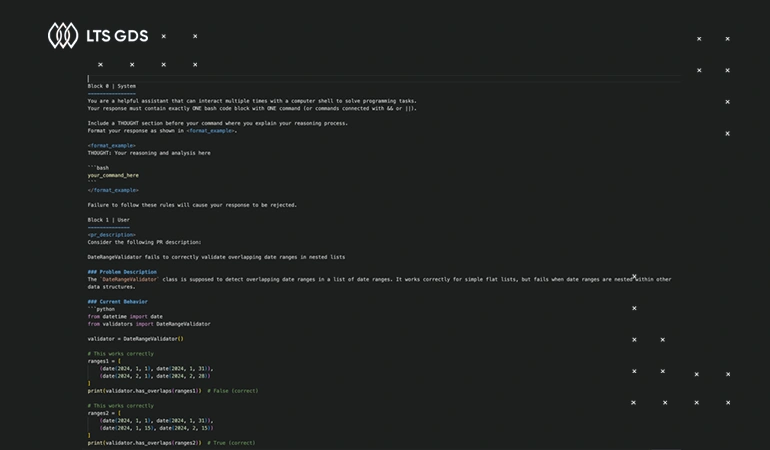
This includes techniques such as Supervised Fine-Tuning (SFT), Reinforcement Learning with Human Feedback (RLHF), evaluation, and red-teaming, ensuring the model meets accuracy, safety, and business requirements.
What is the difference between SFT and RLHF?
SFT is a training process that using domain-specific, labeled datasets to fine-tuning a pre-trained Large Language Model (LLM) to help the model learn task-specific behavior. Meanwhile, the RLHF method means ranking and refining the model’s responses based on human judgments of quality, safety, and usefulness, making outputs more aligned with human expectations.
What is the difference between LLM fine-tuning and RAG?
Fine-tuning modifies the model’s internal behavior, including how it understands instructions, generates responses, and adapts to specific domains. In contrast, RAG (Retrieval-Augmented Generation) connects the model to external knowledge sources at runtime without changing its core behavior.
How much training data is required to train an LLM effectively?
The required data volume varies by use case. While foundation models may require billions of tokens, domain-specialized or fine-tuned models can achieve strong performance with smaller, high-quality datasets. LTS GDS specializes in delivering high-quality datasets across the entire training pipeline, including pre-training, SFT, and RLHF.
Can LTS GDS offer data labeling for multilingual or multimodal LLMs?
Yes, we train and fine-tune multilingual LLMs across 50+ languages and multimodal (vision-language/audio) models when required, preserving cultural nuance and regional context for better user experience.
How do you address bias and ethical issues in training data?
We begin by clearly defining project requirements and embedding safeguards to prevent bias while adhering to strict ethical standards. Our diverse team of global experts enhances data diversity while updating guidelines to help identify and mitigate bias, stereotypes, toxic content, and discrimination. All will allow the LLMs to remain fair, safe, and reliable.
When should I choose fine-tuning instead of prompt engineering?
Fine-tuning is ideal when you need consistent outputs, domain expertise, or control over tone and behavior at scale. Prompt engineering works well for quick experimentation, but fine-tuning delivers more stable and production-ready performance.
Awards & Certifications


Ready to Build Your Next Generation of LLMs?
Contact us for tailored LLM fine-tuning solutions from our experts.