


Ask an AI chatbot what happens if you push a glass off a table, and it can describe the answer in perfect sentences. Ask a robot to actually catch that glass before it shatters, and most AI systems built on language alone will fail. That gap, between describing the physical world and understanding it, is what AI world models are built to close.
The term “world model” has moved from academic papers to real AI development. Google DeepMind shipped Genie 3. Nvidia scaled its Cosmos platform. Fei-Fei Li raised over a billion dollars for World Labs. Waymo rebuilt its simulation stack around a world model trained on real driving data. Large language models are excellent with words, but they don’t have a working model of physics, space, or cause and effect. Robots, autonomous vehicles, and industrial machines need exactly that.
This guide covers what an AI world model is, how one gets built, how it works, and where it’s already running in robotics, self-driving cars, and factories. If you’re evaluating physical AI vendors, planning a data strategy for embodied AI, or just want to know why every major AI lab is suddenly talking about world models, start here.
What Is an AI World Model?
An AI world model is a system that learns an internal representation of how the physical world behaves, then uses that representation to predict what happens next. Give it a scene and an action, and it forecasts the resulting state: where objects will move, how a scene will change, what a robot arm’s next observation will look like after it applies a certain force.
That’s the short answer to “what is a world model in AI.” The longer answer is that a world model is trying to solve a different problem than the AI systems most people already know.
Large language models predict text. They’re trained on enormous volumes of writing and learn to predict the next word in a sequence. That makes them excellent at reasoning in language, but they have no grounded sense of gravity, friction, or object permanence unless it happens to show up in the text they were trained on.
Image and video generators predict pixels. Tools like diffusion-based video models can produce a visually convincing clip, but a clip is a closed loop. It doesn’t respond to a new action, and it doesn’t carry a persistent, queryable state of the world forward in time.
World models predict state. They take in an observation and an action, and they output what the world looks like next, in a way that can be queried, replayed, and acted on again. This is often described using three capabilities:
- Predictive simulation. Given a current state and a hypothetical action, the model forecasts what happens, effectively answering “if I do X, what happens next?”
- Action conditioning. The prediction changes based on a specific intervention, not just a general continuation of a scene.
- Physical and spatial grounding. The model has learned constraints like gravity, occlusion, materials, and object permanence from the data it was trained on, rather than being explicitly programmed with them.
Read more: What Is a VLA Model? How Vision-Language-Action Models Enable Physical AI
How Are World Models Built?
Building a world model looks less like training a typical LLM and more like building a small, specialized simulation engine. It generally happens in five stages.
1. Collecting raw sensory data
World models learn from observation, so they need large volumes of the kind of data an agent actually experiences: video, depth, lidar, robot telemetry, and sometimes audio. This can come from web-scale video, egocentric footage of humans performing tasks, simulated environments, or real robots and vehicles operating in the field.
2. Curating and filtering that data
Raw footage is noisy. Data pipelines deduplicate near-identical clips, remove low-quality or corrupted segments, and filter out footage that doesn’t add useful signal (a static camera pointed at a wall teaches a model nothing).
3. Tokenizing the data
Before a model can learn from video, that video needs to be compressed into a representation the model can actually process. Video tokenizers convert raw frames into compact tokens, similar in spirit to how a language model converts words into tokens, except the “vocabulary” here is visual and temporal rather than linguistic. Efficient tokenization is a major factor in how much video a world model can realistically be trained and run on.
4. Pretraining, then post-training for a specific use case
A general-purpose model, often called a world foundation model, is trained first on the broad dataset. That base model is then fine-tuned for a narrower application: a warehouse robot, a delivery vehicle, a specific factory line. This mirrors how a foundation LLM gets fine-tuned for a specific domain, except the fine-tuning data here is action and video, not text.
5. Evaluating model performance
Today’s benchmarks focus on whether the model improves planning, decision-making, and performance in real-world tasks. A visually convincing simulation has little value if it fails to reflect real-world physics. Safety is also essential. Most world model pipelines include guardrails to prevent harmful or unrealistic outputs from affecting downstream AI systems. NVIDIA Cosmos is a leading example, providing pretrained world models, data tools, and safety features in a single platform, helping robotics teams accelerate development without building everything from scratch.
Applications of AI World Models
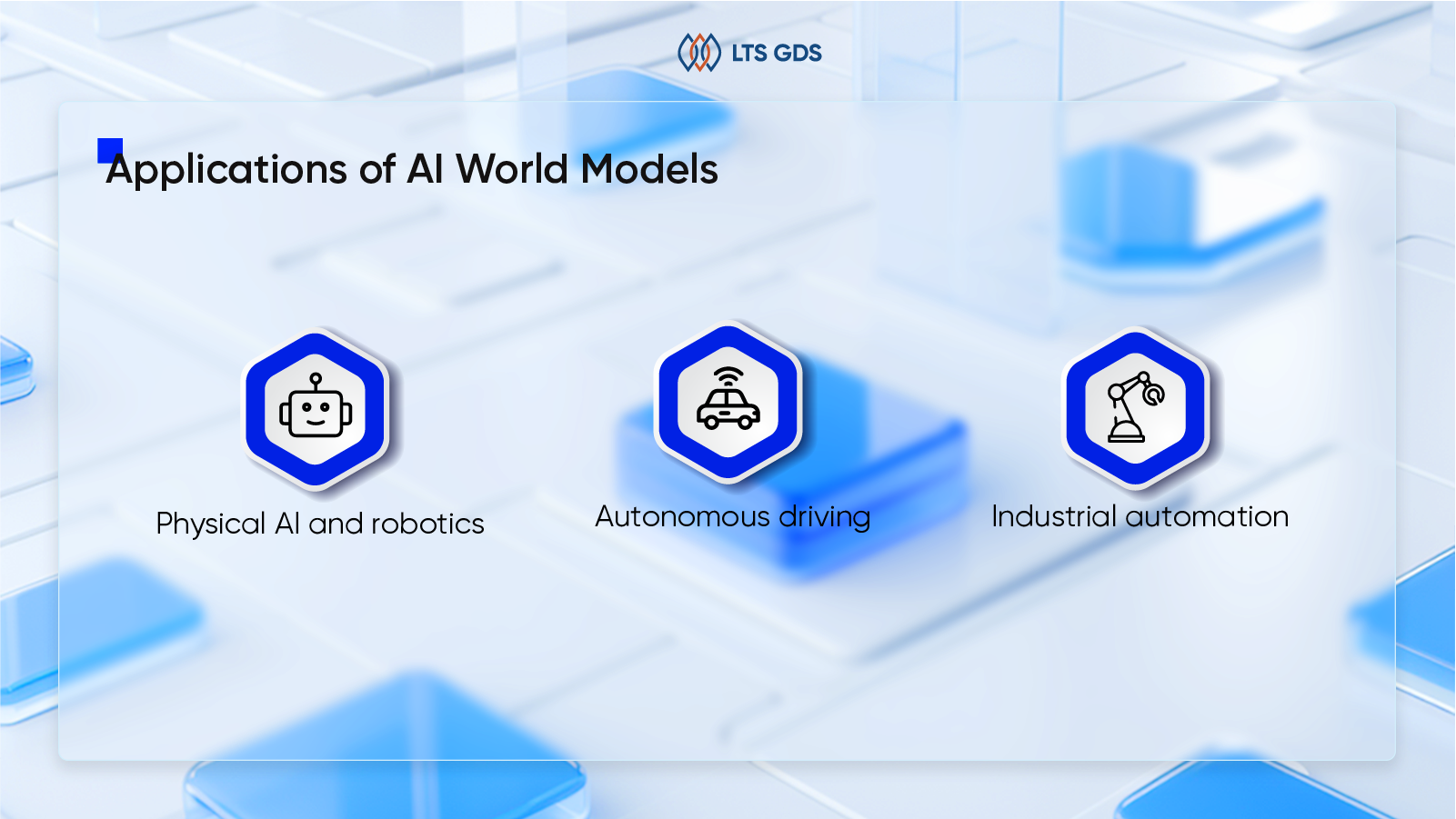
World models have officially moved out of the lab. They’re becoming essential infrastructure for three industries facing the exact same challenge: real-world testing is slow, expensive, and risky; and a solid simulator completely changes the game.
Physical AI and robotics
Robotics is where the “physical AI world model” is most literal. Training a robot through real trial and error is slow and can damage expensive hardware, and collecting enough demonstration data the traditional way often takes tens of thousands of hours. A world model changes that math: a team can test thousands of variations of a task, different lighting, object placement, starting positions, inside a learned simulator, far faster and cheaper than physical trial and error allows, though the simulator is only as good as the real video and sensor data it was trained on.
Humanoid robotics companies have leaned into this hardest. 1X built an internal world model lab on the belief that robotics “is not a fine-tuning problem,” and that generalized humanoid behavior needs pretraining on video, egocentric human footage, and simulation from the start, not a world model bolted on later. Its policy predicts what a task should look like on video, then derives the robot’s actions from that prediction.
Nvidia’s GR00T and Cosmos platforms offer the same foundation for other builders: pretrained world models, trained on layered data (web video, simulation, then real robot data) that companies fine-tune rather than train from zero. Figure AI and Physical Intelligence take a related path, pairing a world model or simulator with a separate action policy, with Figure piloting the setup in real BMW factories and Physical Intelligence building policies meant to transfer across robot types. The goal across all of them is the same: cut how much real-world trial and error a humanoid or industrial robot needs before it’s reliable enough to deploy.
Autonomous driving
Self-driving is the most mature proving ground for world models, since driving companies have spent years collecting exactly the kind of sequential, action-conditioned data these models need. Waymo is the clearest example: its fleet has logged an enormous number of real autonomous miles, yet the company says its cars have driven far more distance in simulation than on public roads. It has since built its own dedicated world model, using the same underlying approach as Google DeepMind’s Genie line, to generate realistic, controllable driving scenarios, including rare, dangerous edge cases too unsafe or too rare to capture naturally, and it can turn existing dashcam or phone footage into a fully explorable simulation. Wayve took an early lead here with GAIA-1, one of the first generative world models built for driving, and Nvidia’s Cosmos platform is now being evaluated by other autonomous vehicle toolchains for the same kind of scenario generation and validation work.
Industrial automation
Factories are a quieter but fast-growing use case, since the payoff is easy to measure: fewer defects, less downtime, and safer operation in environments where mistakes are costly. Vendors use world models to simulate machine behavior, predict equipment wear before it causes a failure, and train inspection and bin-picking systems on synthetic scenarios that would be impractical to stage physically at scale. Established players like Fanuc and ABB layer predictive maintenance and automated visual inspection onto their existing platforms, using simulated defect types and failure modes that are too rare in real production data to train on directly.
Newer entrants are pushing the same idea into less structured settings, using world models to help autonomous equipment in construction, energy, and mining handle unpredictable terrain where a single wrong action carries real cost. The logic is the same across every industrial case: simulate the failure in a world model first, so it doesn’t have to happen on the actual factory floor or job site.
The Role of Data in Training AI World Models
Every capability described above rests on one essential requirement: enormous volumes of high-quality, well-labeled data. This is arguably the single biggest bottleneck in building a serious world model today, more than model architecture or compute. A few things make world model data uniquely demanding compared to training a standard LLM or a computer vision classifier.
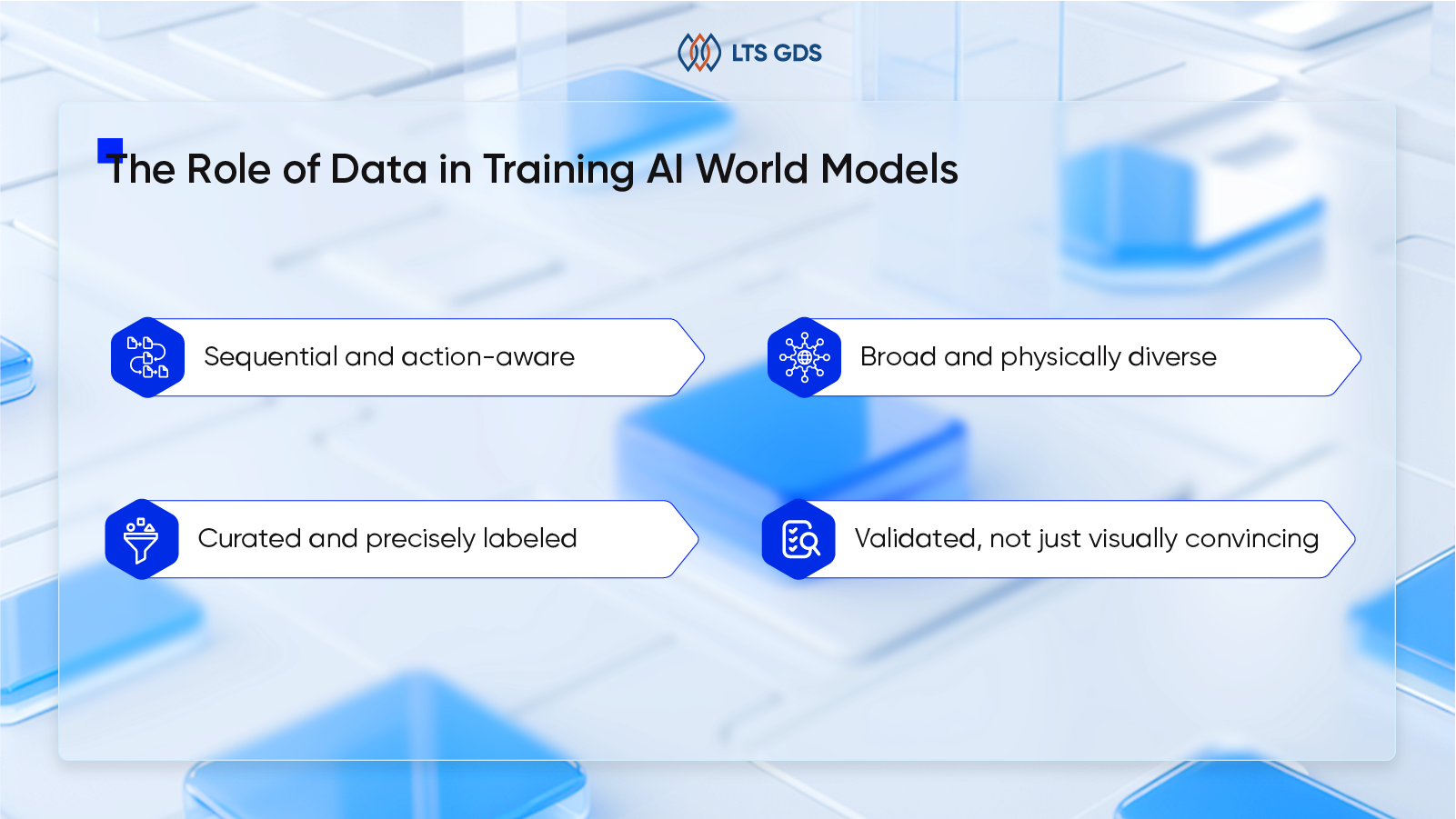
Sequential and action-aware. A world model doesn’t just need to know what a scene looks like. It needs paired sequences: this state, this action, this resulting state. That means data collection and annotation have to preserve temporal order and, ideally, tag exactly what action or intervention caused each observed change.
Broad and physically diverse. A model that’s only seen on a warehouse floor won’t generalize to a hospital hallway or a highway on-ramp. Teams building general-purpose world foundation models deliberately blend web-scale video, egocentric human footage, simulated data, and real robot or vehicle data specifically because each source covers different physical situations the others miss.
Curated and precisely labeled. Raw video is cheap to collect but expensive to make useful. Deduplication, quality filtering, and structured annotation (object masks, depth estimates, action labels, scene descriptions) are what turn petabytes of raw footage into something a world model can actually learn from. Poorly annotated video, mislabeled actions, or inconsistent temporal ordering can quietly degrade a model’s ability to reason about cause and effect, which is the entire point of building a world model in the first place.
Validated, not just visually convincing. As covered earlier, the bar for a useful world model has moved past convincing video toward whether its predictions actually improve a downstream policy’s decisions. That shift puts more pressure on data quality upstream: a model trained on shallow annotations can still generate plausible rollouts while failing the harder test of predicting physically accurate outcomes. Annotation errors that are a minor nuisance in a text or image dataset can compound across a sequence of predicted frames, since each predicted state feeds into the next.
All is exactly the kind of problem specialized data partners exist to solve. These companies are able to source and curate multimodal video and sensor data, building the structured, action-aware annotations world models need. If you’re looking for a specialized data partner for a physical AI or robotics project, don’t miss companies offering high-quality multimodal datasets like LTS GDS.

FAQs about AI World Model
What’s the difference between a world model and a large language model?
A large language model predicts the next token in a sequence of text. A world model predicts the next state of an environment given a current state and an action. LLMs reason in language; world models reason in space, time, and physical cause and effect. The two are increasingly combined in physical AI systems, where a language model handles high-level reasoning and a world model handles physical prediction.
What is Nvidia Cosmos, and how does it relate to world models?
Nvidia Cosmos is a platform, not a single model. It bundles pretrained world foundation models, video tokenizers, a data curation pipeline, and guardrails into one open toolkit aimed at robotics and autonomous vehicle developers. Instead of building a world model from scratch, teams can fine-tune Cosmos’s pretrained models for their specific hardware and use case, which is why it’s become one of the most widely referenced platforms in the physical AI space.
Is an embodied AI world model the same thing as a robot?
No. An embodied AI world model is the internal simulator a robot or agent uses to predict outcomes and plan actions. The robot itself is the hardware and the policy that decides what to do. Many robotics systems pair a world model with a separate decision-making policy (sometimes called a vision-language-action model), where the world model predicts what will happen and the policy decides what action to take.
What is the most powerful AI model in the world in 2026?
This depends entirely on what “powerful” means for your use case, and general-purpose leaderboards change frequently. For language and reasoning tasks, frontier LLMs from labs like OpenAI, Anthropic, and Google currently top most public benchmarks. For understanding and simulating the physical world specifically, the frontier looks different: platforms like Nvidia Cosmos, Google DeepMind’s Genie line, and Waymo’s driving-specific world model currently represent the most capable systems for physical prediction and simulation, which is a different kind of “powerful” than a chatbot’s reasoning score.
Do you need a physical robot to build or use a world model?
No. World models can be trained purely on video, simulation, and web-scale data without ever touching physical hardware, and many are. That’s actually one of their biggest advantages: teams can develop and test a world model extensively in simulation before it ever needs to interact with a real robot, vehicle, or industrial system.
How much data does it take to train a useful world model?
There’s no fixed number, since it depends heavily on the task and how narrow or general the model needs to be. As a rough guide, general-purpose world foundation models are typically trained on petabyte-scale video datasets curated from thousands of hours of footage, while a narrower, task-specific model fine-tuned for one robot or one factory line can sometimes get useful results from a much smaller, carefully curated and annotated dataset. In almost every case, data quality and diversity end up mattering more than raw volume.
Building the Future with AI World Models
AI world models are moving beyond research and becoming a core technology for Physical AI, robotics, and autonomous systems. By enabling machines to predict how the world changes over time, they unlock more capable planning, safer decision-making, and more adaptive behavior in complex environments.
But a powerful architecture alone isn’t enough. The performance of an AI world model ultimately depends on the quality, diversity, and scale of the multimodal data used to train it. From robot demonstrations and egocentric videos to sensor fusion and interaction data, building the right dataset is fundamental to creating models that generalize beyond controlled environments.
LTS GDS helps AI teams build the data foundation behind AI world models. Our end-to-end services cover multimodal data collection, annotation, validation, and quality assurance for robotics, autonomous driving, and other Physical AI applications, helping accelerate the development of reliable, production-ready AI systems.