



Every robot that folds laundry, picks a part off a conveyor belt, or walks through a warehouse aisle is trying to solve the same problem a toddler solves in its first year of life: understanding the world from its own point of view. That is the core idea behind egocentric data: information captured from a first-person perspective rather than by a fixed camera watching from across the room.
For teams building embodied AI, humanoid robots, and autonomous systems, egocentric data collection has become one of the most important pieces of the training pipeline. It shows a model of what hands do while grasping an object, how a scene shifts as a body turns, where eyes look right before a reach, and how a person moves through a cluttered kitchen or a busy loading dock.
This guide covers what egocentric data actually is, why it matters for AI and robotics teams, the main types of egocentric data you will run into, how to collect it well, where it gets used, and how to decide whether to build a collection pipeline in-house or bring in a specialized partner.
What is Egocentric Data?
Egocentric data is any sensor data captured from a first-person viewpoint, meaning the camera or sensor moves with the person or robot performing the task rather than observing it from a fixed, external position. In AI and robotics, it refers to data recorded from a body-worn or robot-mounted device: a head-mounted camera, smart glasses, a chest rig, or a camera built into a robot’s wrist or gripper.
Compare that to exocentric data, the more familiar third-person view. A security camera mounted in a store corner, a drone shot of a warehouse floor, or a static tripod recording a cooking demonstration are all exocentric. They show what is happening to a person or object from the outside. Egocentric data shows what the person or robot sees and experiences while doing it: the hand entering the frame before it touches a mug, the shift in gaze toward a door handle, the sway of the camera as the body turns a corner.
Egocentric data collection is the practice of systematically capturing this first-person information, along with the metadata, annotations, and sensor readings needed to make it useful for training AI models. A single egocentric data collection session might combine several data types at once:
- Video from a head-mounted or chest-mounted camera
- Depth or point cloud data from a stereo or LiDAR sensor
- Hand and body pose tracked in 3D
- Gaze direction from eye-tracking hardware
- Audio from a built-in microphone
- Inertial measurement unit (IMU) data describing head or body motion
The output is a rich, synchronized record of a task performed from the inside, which is exactly the vantage point a robot or an AI agent needs if it is going to act in the world rather than just describe it.
Why Is Egocentric Data Collection Important for Physical AI and Robotics?
Robots and embodied AI agents do not operate from a bird’s-eye view. A humanoid robot’s camera sits on its head, its hands carry their own sensors, and its understanding of a scene has to be built from that same first-person vantage point. If a model is trained almost entirely on third-person internet video, it learns to recognize what actions look like from the outside, but it has never seen what those actions look like from the position it will actually occupy. That mismatch is often called a viewpoint gap, and it is one of the reasons models that perform well on exocentric benchmarks can still fail when deployed on a real robot.
This is not a small or theoretical problem. Teams that have trained perception systems solely on third-person footage routinely find that accuracy drops the moment the same model is applied to footage from an actual robot camera, even when the objects and environment look nearly identical to a human observer. The model has effectively learned a different visual language than the one it needs to operate in. Egocentric data collection closes that gap in several concrete ways.
Matching the robot’s actual sensor input
A camera mounted on a robot’s head or gripper produces footage that looks far closer to human egocentric video than to a static overhead shot. Training on egocentric data robotics teams have collected themselves, or licensed from a specialized source, gives a model examples that resemble its deployment conditions from day one, rather than forcing it to bridge a large viewpoint gap at inference time.
Capturing fine detail in hand-object interaction
Manipulation tasks live or die on small details: finger placement before a grasp, wrist rotation while pouring, the exact moment contact is made with an object, how grip pressure changes as an object shifts weight. A first-person camera close to the hands captures this at a resolution and angle that a room-level camera simply cannot, which is exactly the signal manipulation policies need most.
Adapt to VLA model
Modern embodied AI systems, including vision-language-action (VLA) models, need training examples that connect what is seen, what is said or intended, and what physical action follows. Egocentric footage pairs perception with action because the camera is present at the exact moment a task unfolds, giving these models a coherent, first-person thread from instruction to outcome.
Supporting embodiment-specific training
Different robot forms- a wheeled arm, a quadruped, a two-armed humanoid- each need viewpoint data that matches their own geometry. Egocentric data collection can be tailored to the height, reach, and field of view of a specific platform rather than forcing a generic third-person dataset to fit, which shortens the gap between what a model learns and what a specific robot can actually do.
Improving Sim-to-Real transfer
Simulation is fast and cheap, but simulated environments still fall short of the texture, lighting, and physical unpredictability of the real world. Real egocentric footage, layered on top of simulation-trained policies, gives teams a way to close that remaining gap without having to run every training scenario on physical hardware.
Common Types of Egocentric Data
Most egocentric data collection projects often combine several of the following data types, synchronized in time, to build a complete picture of a task.
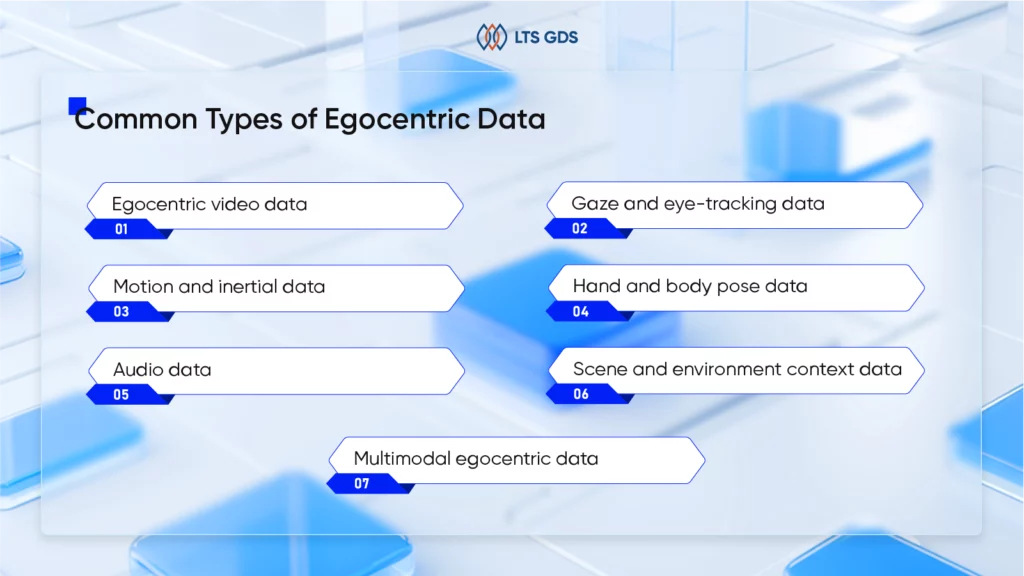
Egocentric video data
This is the foundation of most egocentric datasets: continuous first-person footage from a head-mounted, chest-mounted, or wrist-mounted camera. Egocentric video data collection typically prioritizes a wide field of view, since the goal is to capture as much of what the operator sees as possible, including peripheral objects and hands entering and leaving the frame. Resolution, frame rate, and lens distortion correction all matter here, since downstream models are sensitive to blur and warped geometry near the edges of the frame. Stabilization also matters more than it does in third-person video, since a moving head or body naturally introduces shake that can degrade model performance if left uncorrected.
Gaze and eye-tracking data
Where a person looks right before they reach for something is a strong predictor of intent. Eye-tracking hardware embedded in smart glasses records gaze direction and fixation points, which can be used to teach models to anticipate an action before it happens, or to weight attention toward task-relevant objects in a cluttered scene. Gaze data is also useful for building attention maps that highlight which regions of a frame actually mattered to the person performing the task, filtering out visual noise that is irrelevant to the action at hand.
Motion and inertial data
IMU sensors track the acceleration and rotation of the head, chest, or hands over time. This data helps reconstruct camera trajectory, stabilize footage, and give models a sense of body movement that pure video cannot provide on its own, especially useful for tasks involving walking, reaching, or turning. Combined with visual data, IMU readings also support visual-inertial odometry, which helps a model or robot estimate its own position and movement through space.
Hand and body pose data
Precise 3D tracking of finger joints, wrist position, and overall body pose turns raw video into structured, model-ready signals. This is especially critical for manipulation-focused datasets, where the exact configuration of a hand around an object is often the single most useful piece of training signal available. Pose data is typically derived through a combination of computer vision models and marker-based or markerless motion capture, depending on how much precision a project needs.
Audio data
Built-in microphones capture ambient sound, verbal instructions, and task-relevant audio cues, such as the click of a latch or the hiss of a valve. Audio is frequently paired with video in multimodal training pipelines, particularly for tasks involving human speech commands, and it can also help models learn to recognize task boundaries, since many physical actions produce a distinct, recognizable sound at the moment of contact.
Scene and environment context data
Depth maps, point clouds, and lightweight SLAM (simultaneous localization and mapping) data describe the 3D structure of the surrounding environment. This context helps a model understand not just what the hands are doing, but where that action is happening relative to walls, furniture, shelving, or other obstacles, which matters heavily for navigation and for manipulation in tight or cluttered spaces.
Multimodal egocentric data
Increasingly, egocentric data collection combines video, depth, pose, gaze, audio, and IMU streams into a single synchronized dataset. This multimodal approach is what powers many current embodied AI and humanoid robot training pipelines, since no single sensor stream fully captures the richness of a real-world task. Synchronization across these streams, so that a frame of video, a gaze reading, and a hand pose estimate all line up to the same instant in time, is one of the more technically demanding parts of building a usable multimodal dataset.
Different sensors also tend to run at different sample rates by default: a camera at 30 or 60 frames per second, an IMU at several hundred readings per second, an eye tracker somewhere in between, which means raw data rarely arrives pre-aligned. Building a reliable timestamping and alignment process early in a project saves significant rework later, since misaligned multimodal data is difficult to fully fix after collection is complete.
How to Collect Egocentric Data
Collecting egocentric data well is less about any single piece of hardware and more about designing a repeatable pipeline. Deep dive into how teams typically build an AI egocentric dataset.
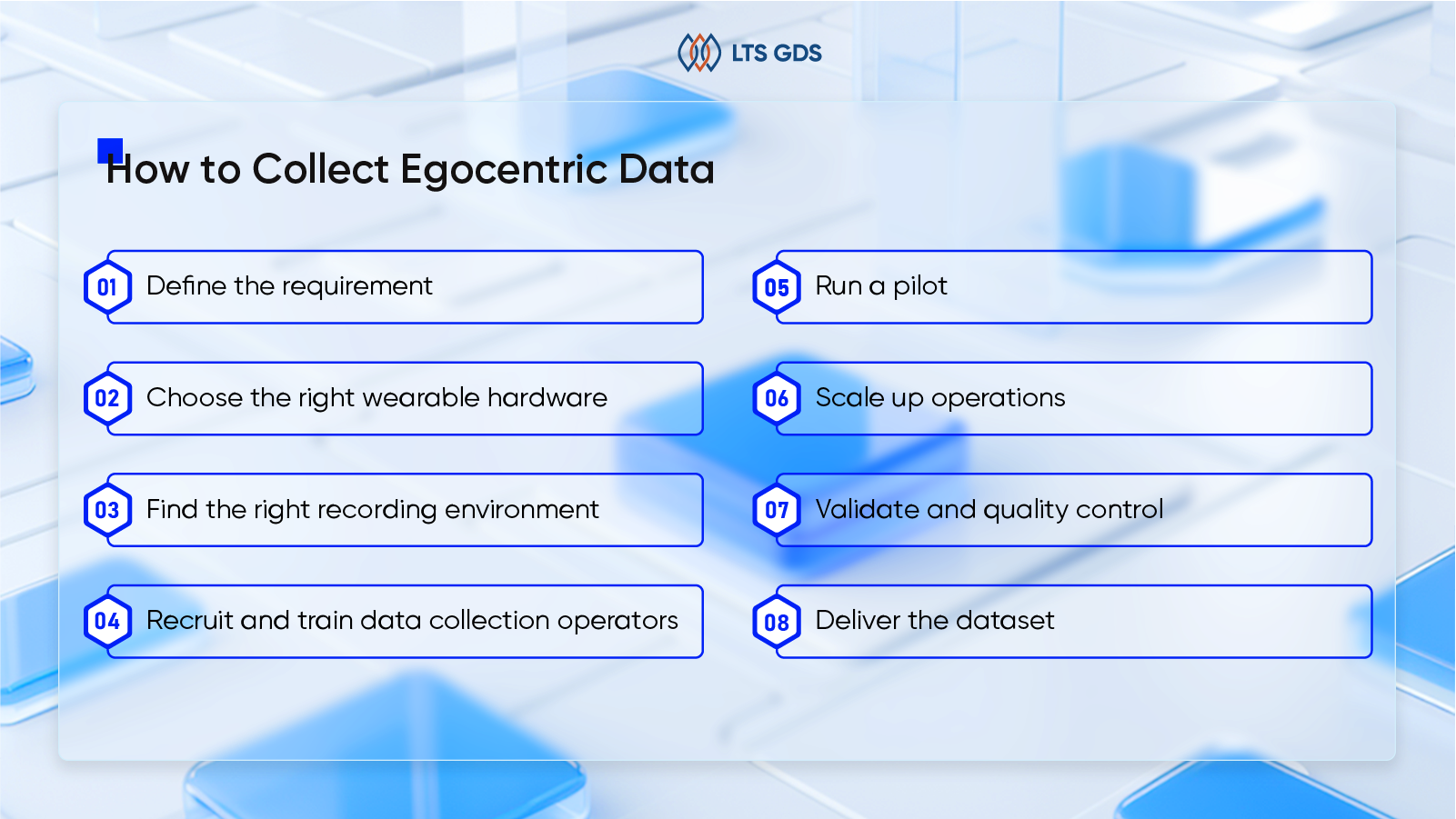
1. Define the requirement
Before any hardware goes on, define the specific behaviors the dataset needs to support: picking and placing small objects, navigating cluttered indoor spaces, following verbal instructions, opening containers, and so on. This shapes every downstream decision, from which sensors to use to how many hours of footage are actually needed.
2. Choose the right wearable hardware
Common options include head-mounted smart glasses with built-in cameras and eye tracking, chest-mounted rigs for a more stable, lower field of view, action cameras like GoPro-style devices for cost-effective video capture, and robot-mounted cameras when the goal is to collect data directly from the platform’s own sensors. Depth cameras and LiDAR units are often added when spatial accuracy matters, such as for navigation or precise manipulation tasks. Hardware choice should follow directly from the requirement, not the other way around. A project focused on fine hand manipulation, for example, benefits far more from a chest- or wrist-mounted camera with a close, stable view of the hands than from head-mounted glasses alone.
Field of view, weight, and battery life matter more in practice than most teams expect going in. A rig that is too heavy or too warm to wear comfortably for a full session changes how operators move, which quietly distorts the naturalism the dataset is supposed to capture.
3. Find the right recording environment
The environment needs to reflect real-world deployment conditions, not just studio convenience. A home-assistance robot needs lived-in homes with genuine clutter, not a sterile studio. Industrial robotics projects need authentic settings such as factories, warehouses, production facilities, resorts, and spas, not empty demo spaces. Scouting diverse layouts, lighting, and acoustic backgrounds is essential to prevent a model from overfitting to a single, artificial environment.
Logistics and privacy carry just as much weight as the setting itself. Clear filming permissions and scheduling agreements need to be secured before a single session is booked. Egocentric footage often captures sensitive, incidental data, faces, proprietary documents, private equipment, so every location needs a thorough privacy review before recording starts. Ensuring compliance with data protection standards from day one is the best way to avoid operational and legal bottlenecks later.
4. Recruit and train data collection operators
The right operator profile depends on the project, not a fixed formula. Some tasks need a varied pool, different heights, dominant hands, movement styles, and levels of task familiarity, so the dataset captures real hesitation and variation. Others need a more consistent profile that matches a specific deployment context, such as a target user group’s age or physical ability. Defining which one a project actually needs, before recruiting starts, matters more than defaulting to diversity by default.
Building the team is rarely simple either way. Recruiting and training enough operators for hundreds or thousands of hours of footage takes real infrastructure, covering how to wear and calibrate the rig, keep a natural pace, and recognize when a take needs a redo.
Consent needs more than a signature. Operators need a clear explanation of what is being recorded, how it will be used, who it is shared with, how long it is kept, and a genuine option to withdraw before their data is used in training. The same standard applies to anyone else who ends up on camera, family members or coworkers included. Getting this wrong can make an otherwise well-collected dataset unusable.
5. Run a pilot
Before committing to full-scale collection, run a small pilot batch with the chosen equipment, environments, and operators. A pilot surfaces problems while they are still cheap to fix: a rig that fogs up after an hour, a protocol that is too scripted or too loose, sensor streams that drift out of sync, or an environment that turns out to be less representative than it looked during scouting. Reviewing pilot footage against the original requirement, not just checking that recording worked, is what makes this step worth the extra time.
6. Scale up operations
Once the pilot validates the protocol, scale up recruiting, environments, and session volume in a controlled way rather than all at once. This is also the point to lock in storage and versioning infrastructure, since multimodal datasets grow fast once depth, pose, and high-resolution video are all stacked together, and raw footage, processed data, and annotations need to stay correctly linked as volume increases. Rolling out in stages, rather than jumping straight to full volume, keeps any remaining protocol issues contained to a small batch instead of the entire dataset.
7. Validate and quality control
Every batch of collected footage needs a real check before it moves forward, not just a scan to confirm recording happened. This means verifying sensor synchronization across every stream, checking camera calibration, confirming file integrity, and reviewing each session for issues such as blur, dropped frames, incomplete coverage, or content that should have been excluded for privacy reasons.
Sessions that fail this check, whether from a bad take, a sync error, a corrupted file, or a privacy issue missed during recording, get cleaned up or re-shot rather than passed downstream as is. Catching problems at this stage is far cheaper than catching them later, once a flawed session has already made its way into a delivered dataset.
8. Deliver the dataset
The final step packages validated, cleaned footage and sensor streams into a format the training team can actually use: consistent file structures, clear documentation of what each session contains, metadata on operators and environments, and defined splits for training, validation, and testing. If annotation is part of the project scope, labels and task graphs get delivered as a structured layer on top of the cleaned footage, not folded into it, so the training team can see exactly what came from collection and what was added afterward.
Data access rights need to travel with the dataset, not get sorted out afterward. That means spelling out who is authorized to access raw footage versus any labeled or processed version, what license terms cover downstream use, how long the data can be retained, and what happens to it once a project ends or a contract expires. For datasets built from real people’s homes, workplaces, or faces, these terms are not paperwork, they determine whether the dataset can legally be used at all. A dataset delivered without this structure, and without clear access terms, creates work, and real risk, for whoever receives it, which defeats much of the point of a careful collection process in the first place.
Best Egocentric Data Companies: Build In-House or Partner Up
Choosing between an in-house team and a specialized vendor depends on your project’s priorities. If you need full control over hardware, data protocols, and have the time and resources to build internal capabilities, an in-house approach can make sense. On the other hand, if speed, scalability, or recurring data collection are critical, working with an experienced vendor is often the more practical choice.
In-house teams are typically best suited for organizations that already have mature data operations and a focused, well-defined collection task. Outsourcing is a better fit when projects require large-scale data collection, multimodal workflows, or continuous execution without expanding internal headcount.
LTS GDS has hands-on experience delivering egocentric data collection projects for Physical AI, from hardware setup and operator recruitment to multimodal data capture and quality-controlled delivery. Contact us to learn how we can support your next project.

Applications of Egocentric Data Collection
Humanoid robots and manipulation
Humanoid robots share a rough approximation of the human body, which makes human egocentric data an unusually good training signal. Egocentric footage of people grasping, stacking, pouring, and assembling objects helps teach humanoid platforms fine manipulation skills that are extremely hard to hand-code or simulate convincingly. This is one of the fastest-growing use cases for egocentric data collection today, as humanoid robotics teams race to build foundation models that generalize across many manipulation tasks rather than narrow, single-purpose ones.
Household chores are a common early target for this kind of data, folding clothes, loading a dishwasher, wiping a counter, precisely because these tasks are simple for a person and stubbornly difficult for a machine. Egocentric footage of ordinary people doing ordinary chores, recorded across many different homes and routines, gives humanoid teams a realistic base of examples to train and evaluate against, well before a robot is ever tested in a real household.
Autonomous navigation and mobile robots
Warehouse robots, delivery robots, and other mobile platforms rely on egocentric data to learn how to move through real, cluttered, and unpredictable spaces. First-person footage of people walking through aisles, around obstacles, and through doorways gives navigation models a sense of realistic obstacle avoidance and path planning that overhead maps alone cannot provide. Combined with depth and IMU data, this footage also helps models learn to handle tight corners, uneven flooring, and the kind of everyday clutter that rarely shows up in clean, simulated environments.
For logistics and fulfillment operations specifically, egocentric footage of workers navigating aisles while carrying items, checking labels, and reacting to other people in the space captures a level of situational complexity that scripted robot test runs rarely include. That complexity, other moving people, temporary obstructions, inconsistent lighting between aisles, is often exactly what separates a navigation model that performs well in a controlled pilot from one that holds up in a live, fully operational facility.
AR/VR and wearable devices
Augmented and virtual reality systems increasingly rely on egocentric data to understand a user’s hands, gaze, and surroundings in real time. Smart glasses and mixed reality headsets use the same first-person sensor stack described earlier in this guide, making egocentric data collection directly relevant to consumer wearable products as well as robotics. Hand tracking, scene understanding, and gaze-based interaction in these devices all depend on training data collected from exactly this kind of first-person viewpoint.
Industrial and manufacturing training data
Manufacturing and industrial teams use egocentric footage of skilled workers performing assembly, inspection, and maintenance tasks to train both robotic systems and AI-based training tools for new human employees. Capturing an experienced technician’s exact hand movements and gaze pattern during a repair, for instance, creates a dataset that is useful both for robot learning and for human workforce training programs.
Driver and in-cabin monitoring
Automotive systems use head- and body-facing egocentric data to monitor driver attention, gaze direction, and fatigue signals. While this application sits closer to the vehicle than to general robotics, it draws on the same core techniques described throughout this guide: gaze tracking, pose estimation, and synchronized multimodal capture.
FAQs about Egocentric Data Collection
What is the difference between egocentric and exocentric data?
Egocentric data is captured from a first-person viewpoint that moves with the person or robot performing a task. Exocentric data is captured from a fixed, external, third-person viewpoint, such as a security camera or a tripod-mounted shot. Robots and embodied AI systems generally need egocentric data because it matches their actual sensor perspective.
What hardware is used for egocentric data collection?
Common hardware includes head-mounted smart glasses with cameras and eye tracking, chest-mounted camera rigs, action cameras, depth and LiDAR sensors, and cameras built directly into robot grippers or heads. IMUs are frequently added to capture motion alongside video.
How much egocentric data do you need to train a robot foundation model?
There is no single number, since it depends heavily on task complexity, how many environments and operators are represented, and how the data will be used, for pretraining, fine-tuning, or evaluation. Most teams find that data diversity across environments, lighting, and operators matters more than raw hour count once a reasonable baseline volume is reached.
Is egocentric data collection expensive?
Costs vary with hardware, operator recruitment, environment setup, and annotation complexity. Multimodal collection with pose, depth, and gaze tracking costs more than simple video capture. Partnering with a specialized vendor can reduce total cost compared to building an in-house pipeline from scratch, particularly for teams that need this data on an ongoing basis rather than as a one-time project.
How is egocentric data different from teleoperation data?
Teleoperation data is recorded while a human directly controls a robot’s arms or body remotely, so the action is performed by the robot itself, guided by a human operator. Egocentric human data is recorded from a person performing the task with their own body, wearing a camera and sensors. Both are useful for training embodied AI, and many teams combine the two: human egocentric footage for broad skill coverage, teleoperation data for precise, embodiment-specific fine-tuning.
How does egocentric data support vision-language-action (VLA) models?
VLA models need training examples that tie together what is seen, what instruction is given, and what physical action follows. Egocentric footage naturally provides all three in a single, continuous stream, since the camera is present at the exact moment perception turns into action, making it a practical data source for this class of models.
Turning First-Person Data Into Robots That Learn
Egocentric data collection is what lets AI systems learn the way people actually experience the world: through hands that grasp, eyes that anticipate, and bodies that move through real, imperfect spaces. For teams building humanoid robots, manipulation systems, autonomous navigation, or embodied AI models more broadly, first-person data is quickly becoming as important as the models trained on it.
Getting there requires more than strapping a camera to a headset. It takes a clear task definition, the right hardware, realistic collection protocols, careful attention to consent and privacy, thorough rigorous quality control, all before a single frame reaches a training pipeline. Whether a team builds this pipeline in-house, draws on open research datasets, or partners with a specialized vendor, the same fundamentals apply: match the data to the task, and never let volume substitute for quality.
If your team is scoping an egocentric data collection project and weighing whether to build in-house or bring in a specialized partner, LTS GDS works with AI and robotics teams on exactly this kind of multimodal, physical AI-focused data collection. Reach out to talk through what your specific task and platform actually need.