



Managed IT services place the ongoing management of IT systems, such as infrastructure, applications, security, and user support, under a structured service agreement. While this model offers stability and access to specialized expertise, it often raises concerns around managed IT services pricing.
Costs can vary significantly based on service scope, SLA requirements, and support levels, making pricing difficult to assess without a clear understanding of what’s included.
In this article, we will be walking businesses through what drives the cost of managed IT services and how to select the right service model to avoid unexpected expenses. Let’s get cracking!
How Much Do Managed IT Services Cost?
In 2026, managed IT services pricing varies widely from one organization to another, affected by differences in service scope, delivery models, and operational models. As a result, no single price point can exactly reflect the true cost of managed services, since a range of less visible factors shape what a client pays. The following section outlines how managed IT services pricing is often viewed in 2026.
For most organizations, pricing falls into the following general ranges:
- Small businesses (10-50 users): USD 100-175 per user per month
- Mid-sized businesses (50-250 users): USD 150-250 per user per month
- Larger organizations (250+ users): USD 150-300+ per user per month
For device-based pricing, typical costs include:
- Workstations: USD 50-120 per device per month
- Servers: USD 150-400 per server per month
- Network devices such as firewalls and switches: USD 75-250 per device per month
It is important to note what these numbers actually include.
In most cases, the quoted monthly fee covers ongoing operational support, including monitoring, patching, routine maintenance, and access to a service desk.
What it does not always include are one-off projects, large-scale cloud migrations, hardware procurement, or advanced security services such as continuous threat hunting or compliance audits. These items are often priced separately unless they are explicitly bundled into an all-inclusive agreement.
Managed IT services pricing should always be evaluated in context. Clients need to consider what is covered, what is excluded, and how pricing aligns with actual business risk. This is far more important than simply chasing the lowest possible monthly rate.

Factors that Affect IT Managed Services Cost
Managed IT services pricing is shaped by business reality rather than a fixed formula. What an organization pays demonstrates scale, risk, and technical complexity, all of which can shift costs up or down in meaningful ways. Understanding these factors makes it easier to evaluate pricing instead of reacting to headline numbers.
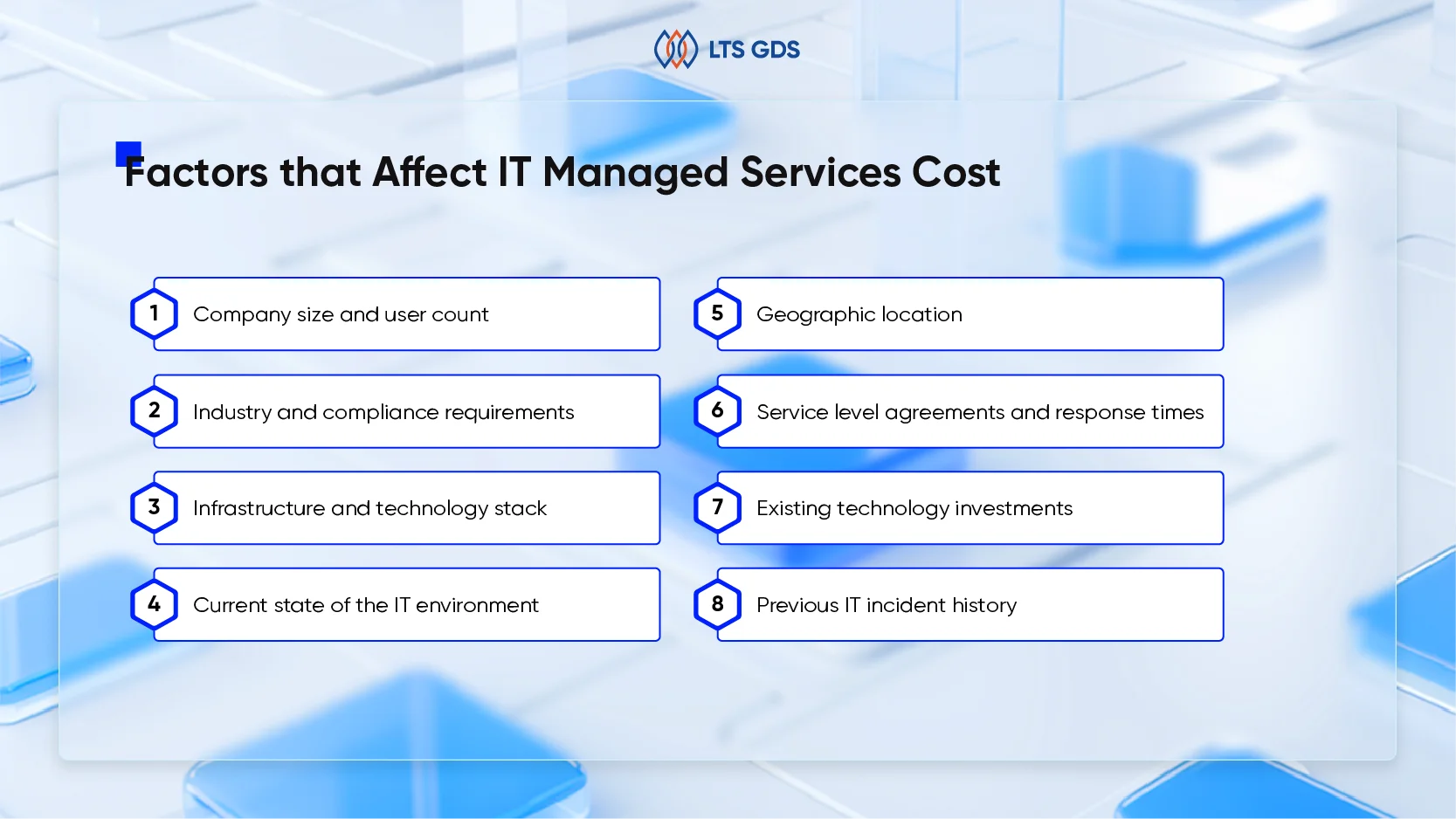
Company size and user count
More users mean more devices, more support tickets, and more security endpoints to monitor.
However, a provider might charge $200 per user for a 10-person company but only $120 per user for a 100-person company due to economies of scale. At its core, their fixed costs, such as monitoring tools and documentation systems, are spread across a larger user base.
Industry and compliance requirements
A retail business with PCI compliance needs pays far less than a healthcare provider dealing with HIPAA, or a financial services firm navigating SEC regulations and SOC 2 requirements. This compliance requires specialized security measures, extensive documentation, and regular audits.
Consequently, prices typically increase by 20-30% when serious regulatory requirements enter the picture.
Infrastructure and technology stack
The makeup of the technology environment plays a decisive role.
Standardized environments built around common operating systems and a single cloud platform are easier to manage and, as a result, less expensive. Costs rise as diversity increases. Supporting multiple operating systems, several cloud providers, specialized applications, and complex integrations requires broader expertise and more tooling.
Complexity does not always create visible problems, but it does increase the effort required to keep systems stable and secure.
Current state of the IT environment
The condition of the existing environment often determines how smooth or painful the transition will be. Organizations with well-maintained systems, current software, and clear documentation are easy to onboard. Others are not so fortunate.
Outdated infrastructure, inconsistent security controls, and missing documentation create risk from day one. Providers must spend additional time stabilizing the environment before they can deliver proactive services, and that work is reflected in pricing.
Geographic location
Geography still plays a role, although less than it used to be.
Providers based in major technology hubs tend to charge more than those operating in smaller markets. However, remote delivery models and distributed service teams have reduced these differences. Many organizations are no longer limited to local providers, which has increased competition and brought pricing closer together across regions.
For example, a mid-sized logistics company in Singapore, which partnered with LTS GDS, moved away from several expensive, locally licensed IT tools. By using GDS’s existing monitoring, service desk, and security platforms, our client reduced its IT operating costs by up to 25% annually.
Service level agreements and response times
Service level agreements materially influence managed IT services pricing. Coverage limited to standard business hours is typically priced at a lower baseline, while 24/7 support introduces a different cost structure. Tighter response commitments for critical incidents and rapid on-site availability further increase costs, reflecting the additional operational capacity required to sustain those guarantees.
Existing technology investments
If your business has already invested in quality monitoring tools, security platforms, or backup solutions, some providers will leverage those rather than requiring the client to switch to their preferred tools.
Others have standardized on specific platforms and won’t work with your existing investments, forcing you to replace devices or platforms that work fine. The decision-maker or person in charge may inquire about this during evaluation, since it can mean thousands in avoided costs.
Previous IT incident history
Past incidents also affect how providers assess risk. Organizations with a history of ransomware attacks, frequent outages, or repeated security failures may be viewed as higher risk engagements. Some providers adjust pricing to account for that exposure. Whether it feels fair or not, this consideration is part of how managed service contracts are priced in practice.
Managed IT Services Pricing Models Explained
Managed service providers have developed several different pricing approaches over the years. Each model has advantages and drawbacks depending on each business’s needs. Let’s zoom in on the most common managed IT services pricing structures firms will encounter.
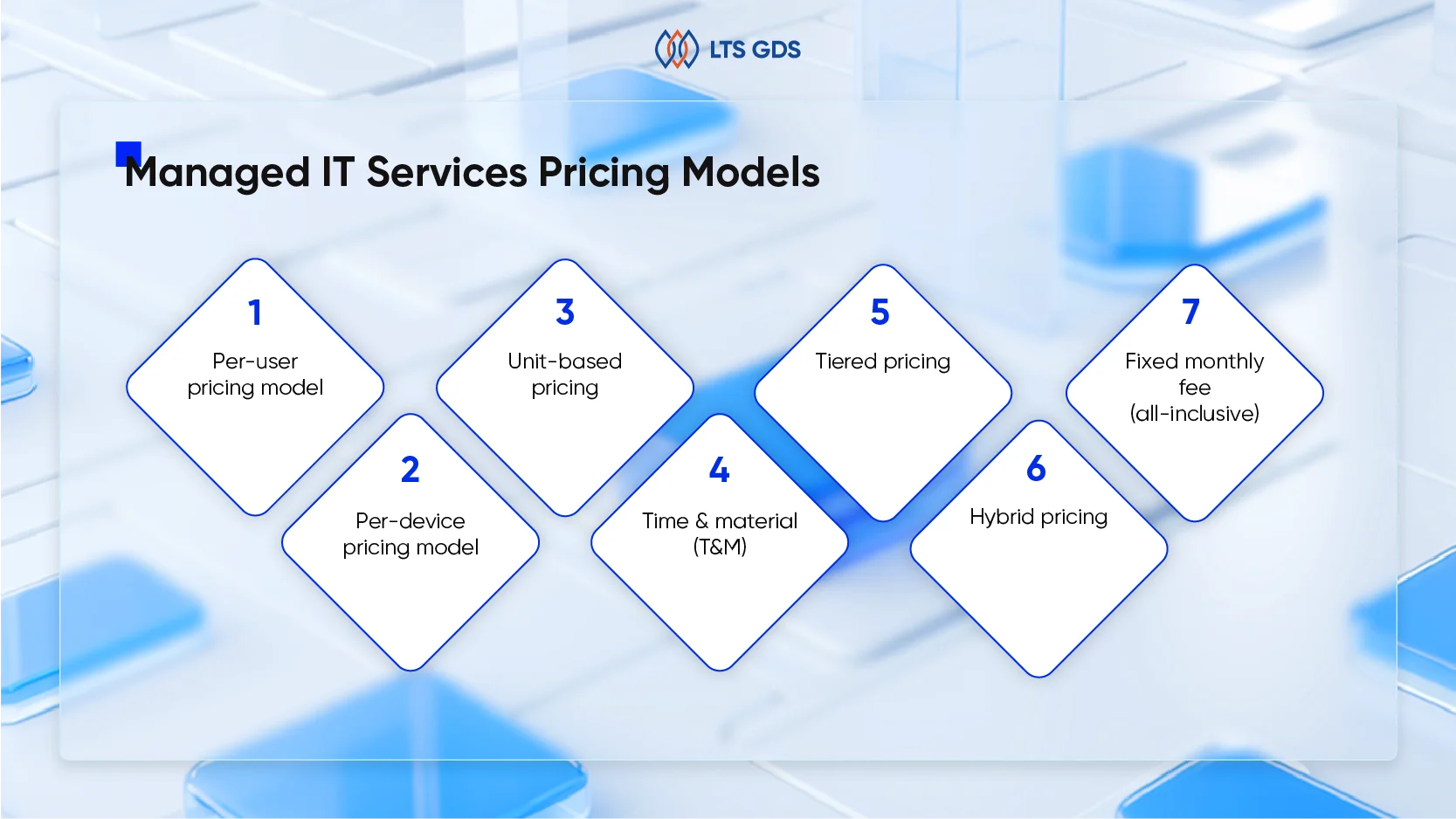
| Pricing models | Definition | Pros | Cons | Typical cost range | Best for |
| Per-user | Flat monthly fee per employee | Simple, predictable, and easy to scale. | Cost inefficiency when user needs vary; user definition disputes | ~$100-300 per user/month, depending on service level and included features. | Organizations where employees have relatively standard technology needs. |
| Per-device | Charges by device type and quantity | High transparency by asset type | Requires strict asset tracking; BYOD complexity |
|
Shared or device-heavy environments |
| Unit-based | Charges based on defined, measurable service units | Clear link between cost and usage | Monthly spend fluctuates; harder forecasting | Varies by unit and volume | Usage-driven or transaction-heavy businesses |
| Time & material | Charges an hourly rate (typically $100-$250 per hour) for actual work performed. | Flexible, pay-as-you-go | Unpredictable costs; reactive by nature | ~$100-250 per hour | Irregular or low support demand |
| Tiered pricing | Offers multiple service packages at different price levels, labeled Bronze, Silver, Gold, and Platinum. | Clarity and flexibility | Risk of under- or over-buying | Entry to premium tiers varies widely | Businesses want structured options |
| Hybrid pricing | Combines multiple pricing models into a single structure. | Balanced accuracy and predictability | More complex billing and forecasting | Blended based on scope | Complex or mixed IT environments |
| Fixed monthly fee (all-inclusive) | Charges a single flat monthly fee that covers all IT services within an agreed scope. | Maximum cost certainty | Difficult to scope; limited scalability | Custom, environment-specific | Small, stable environments |
How to Choose the Right Managed IT Services Pricing Model
Selecting the right managed IT services pricing model matters almost as much as choosing the right MSP. The wrong model can lead to billing disputes, budget overruns, and long-term frustration, even when technical service delivery is strong. To avoid that, here’s how to think through.
| Situation | Key factors | Suitable pricing model | Why it fits |
| Standard office workforce | Similar laptops, common applications, consistent user setup | Per-user pricing | Simple to manage, scales with headcount, and aligns well with workforce-based budgeting |
| Uneven user-to-device ratio | Shared workstations, multiple devices per employee, or device-heavy roles | Per-device pricing | Better reflects actual support effort when device count matters more than user count |
| Need for predictable monthly IT spend | Tight financial planning, fixed operating budgets | Per-user or fixed monthly fee | Reduces cost volatility and simplifies forecasting |
| Variable or project-heavy IT demand | Infrequent support needs, changing workloads | Time and material | Costs align with actual usage rather than fixed commitments |
| Standardized IT environment | Windows endpoints, Microsoft 365, limited customization | Per-user or tiered pricing | Captures support effort accurately without unnecessary complexity |
| Complex environment | Multiple cloud platforms, legacy systems, specialized applications | Hybrid pricing | Balances predictable costs with flexibility for higher-effort components |
| Partial in-house IT team | Internal staff handles certain functions | Hybrid pricing | Allows selective outsourcing without paying for overlapping services |
| Full IT outsourcing required | No internal IT team, end-to-end responsibility | Fixed monthly (all-inclusive) | Clear accountability and simplified vendor management |
If your business is about to leapfrog with optimized IT operations, check out Top Managed Service Providers – Thorough Evaluation and How to Pick?

Types of Managed IT Services
The term “managed IT services” includes numerous specific service categories. There exist common managed IT services types:
- Application & SaaS management
- Infrastructure management
- Security services
- Endpoint & device management
- IT helpdesk & technical support
Learn more about our managed IT services.
FAQs about Managed IT Services Pricing
What’s the average cost of IT support services for small businesses?
Small businesses with 10-50 employees typically spend between $1,500 and $7,500 monthly on managed IT services. Businesses at the lower end of this range typically have simple environments and minimal compliance needs. Those at the higher end often deal with greater complexity, stricter security requirements, or industry-specific compliance obligations.
Are managed IT services more cost-effective than hiring in-house IT staff?
For most businesses with under 100 employees, managed services cost significantly less than equivalent in-house staffing. However, at larger scales (200+ employees) or with highly specialized needs, hybrid models combining in-house staff with managed services often deliver the best value.
What are the most common managed IT services pricing models?
The most common managed IT services pricing models include per-user pricing, per-device pricing, tiered service packages, all-inclusive flat-rate pricing, à la carte pricing, and pay-as-you-go (break-fix). Each model varies in cost predictability, flexibility, and service scope, depending on business needs and IT complexity.
What factors increase managed IT services costs?
Managed IT services costs tend to rise as the scope of responsibility expands. Higher service levels, such as 24/7 coverage, stricter response commitments, or multi-region support, all require additional operational capacity. Pricing also increases in environments that are complex, heavily customized, reliant on legacy systems, or subject to elevated security and compliance requirements. In addition, the level of expertise required and the scale of users and devices under management have a direct impact on overall cost.
What’s the difference between outsourced IT support costs and managed services pricing?
Outsourced IT support often refers to break-fix arrangements charging hourly rates ($100-$250 per hour) when problems occur. Managed services pricing covers proactive, ongoing support for a predictable monthly fee regardless of issues encountered. Managed services include monitoring, prevention, and regular maintenance that break-fix arrangements lack. While break-fix might seem cheaper initially, unpredictable costs during emergencies and lack of prevention usually make it more expensive over time for businesses beyond minimal technology usage.
Managed IT Services Pricing: Key Takeaway
Managed IT services pricing varies since business environments, risk profiles, and service expectations are not the same. Choosing the right model requires looking beyond headline costs and understanding how pricing aligns with operational needs, scalability, and long-term value.
LTS GDS provides managed IT services with flexible pricing options designed to balance cost efficiency and service reliability. To explore an MSP model that fits your organization’s requirements, contact us for a tailored solution.