

5-level Physical AI Data Readiness Assessment Framework
Discover how prepared your organization is to support Physical AI development with high-quality training data. This eBook introduces a 5-level maturity framework to assess data readiness, identify capability gaps, and build scalable data pipelines for robotics, autonomous systems, and Physical AI applications.
Discover how prepared your organization is to support Physical AI development with high-quality training data.
Understand Your Physical AI
Data Readiness Before You Scale
Assess Your Physical AI Data Readiness Before Scaling
Building high-quality Physical AI datasets requires more than collecting sensor data or recording robot interactions. It takes the right infrastructure, tools, and expertise to transform raw data into training-ready assets.
Organizations must also establish scalable workflows for annotation, validation, quality assurance, and data operations. Without a clear understanding of these capabilities, critical gaps often remain hidden until model training or deployment.
The 5-level Physical AI Data Readiness Framework helps organizations
- Determine organization’s current Physical AI data maturity level
- Identify gaps across collection, annotation, validation, and operations
- Understand the capabilities required at each stage of readiness
- Benchmark data practices against Physical AI requirements
- Prioritize investments and improvements that drive the greatest impact
- Build a roadmap toward scalable, deployment-ready data operations
Whether organization is just beginning to collect data or looking to optimize mature operations, this framework helps prioritize the capabilities that matter most.
Key Takeaways from This eBook
Define better QA criteria, align with benchmarks, and apply them at scale to build high-quality LLM datasets.

Clear framework for QA criteria
Understand how to define QA standards across quality, knowledge, security, and safety dimensions.

Datasets and evaluation benchmarks alignment
Discover how benchmark thinking facilitates more effective dataset preparation without directly impacting training data.

Practical approach to implementation
Follow step-by-step guidance to apply and scale QA criteria in the LLM training and fine-tuning processes.
Key Takeaways from This eBook
Learn the essential principles and practical steps for evaluating and advancing your organization’s Physical AI data readiness.

Assess data readiness
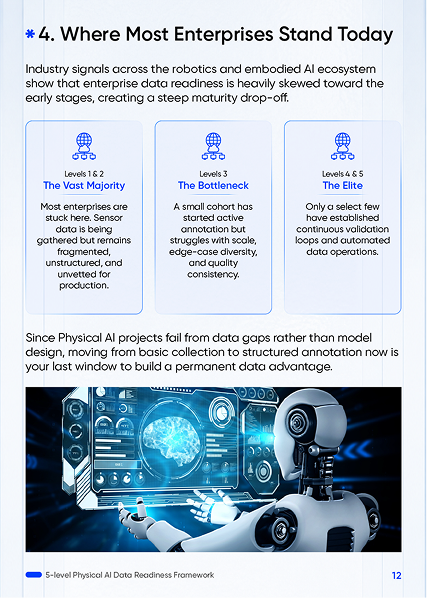
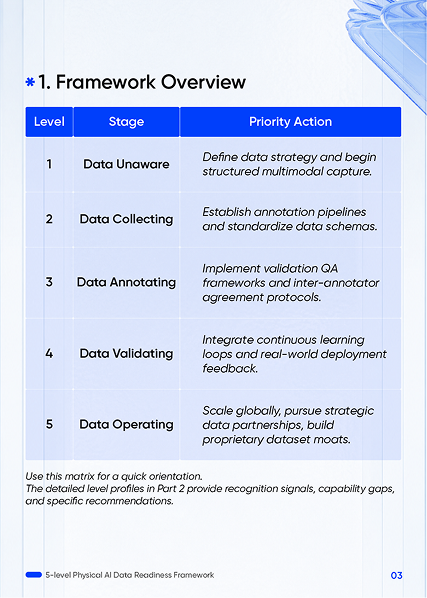
Evaluate organization's current maturity across the five stages of Physical AI data development.

Identify capability gaps
Discover the infrastructure, processes, and operational capabilities needed to progress to the next level.

Build a roadmap for scale
Learn how to prioritize improvements and develop deployment-ready data operations for Physical AI.
Ready to Build a Stronger Data Foundation for Physical AI?


