



A robot arm reaches into a bin packed with a hundred mixed parts and pulls out exactly one without disturbing the rest. On video, this looks simple. In practice, it’s one of the hardest unsolved problems in robotics.
This is robotic manipulation: the field concerned with how robots physically grasp, move, and interact with objects in the real world. For teams building Physical AI systems, humanoids, robotic arms, or autonomous warehouse fleets, manipulation is usually the hardest part of the stack to ship, and often the one that decides whether a robot can generalize past a single scripted task.
This guide breaks down what robotic manipulation actually is, what a manipulation system is built from, how it works end to end, and the main types you’ll run into when evaluating a robotics stack, a research paper, or a vendor. We’ll keep the math light and the practical detail high.
What Is Robotic Manipulation?
Robotic manipulation is the ability of a robot to change the state of an object in its environment through physical contact, typically by grasping, pushing, lifting, rotating, inserting, or otherwise moving it. If a robot arm picks a part off a conveyor and sets it in a tray, that’s manipulation. If a warehouse robot nudges a box a few inches to clear a path, that’s manipulation too, even though nothing gets grasped at all.
The term covers a wide range of tasks and an equally wide range of hardware, from a two-finger gripper on an industrial arm repeating the same pick-and-place motion for years, to a five-fingered dexterous hand learning to tie a knot it has never encountered before. What ties all of it together is the same underlying problem: a robot has to sense an object, decide how to touch it, and execute that contact accurately enough to reach a goal, often without knowing the object’s exact shape, weight, or friction properties in advance.
That’s also why robotic manipulation is treated as its own discipline rather than a subset of general robot control. Locomotion problems, how a robot moves itself through space, and manipulation problems, how a robot moves something else through space, share a lot of underlying math. But manipulation adds a layer that locomotion mostly avoids: contact. The instant a gripper touches an object, the physics stop being clean. Friction, deformation, slip, and uncertain mass distribution all enter the picture, and the robot has to handle them in real time, usually with incomplete information about the object it’s touching.
It’s worth contrasting this with how manipulation is often portrayed in demos. A single successful pick looks simple because the failure modes are invisible. What actually makes manipulation hard is the long tail: the object that’s slightly heavier than expected, the surface that’s more slippery than it looks, the grip that’s stable until the arm accelerates and the object shifts. A manipulation system that only works under ideal conditions isn’t really a manipulation system yet, it’s a demo.
At a system level, when people refer to a manipulation robotic system, they mean the entire stack working together: the arm or hand, the sensors that feed it information, and the software that turns that information into motor commands. That’s the setup we’ll unpack next.
What makes up a robotic manipulation system?
A robotic manipulation system is built from a handful of core components that show up in nearly every implementation, whether it’s a fixed-base industrial arm on a production line or a mobile humanoid navigating a warehouse floor.
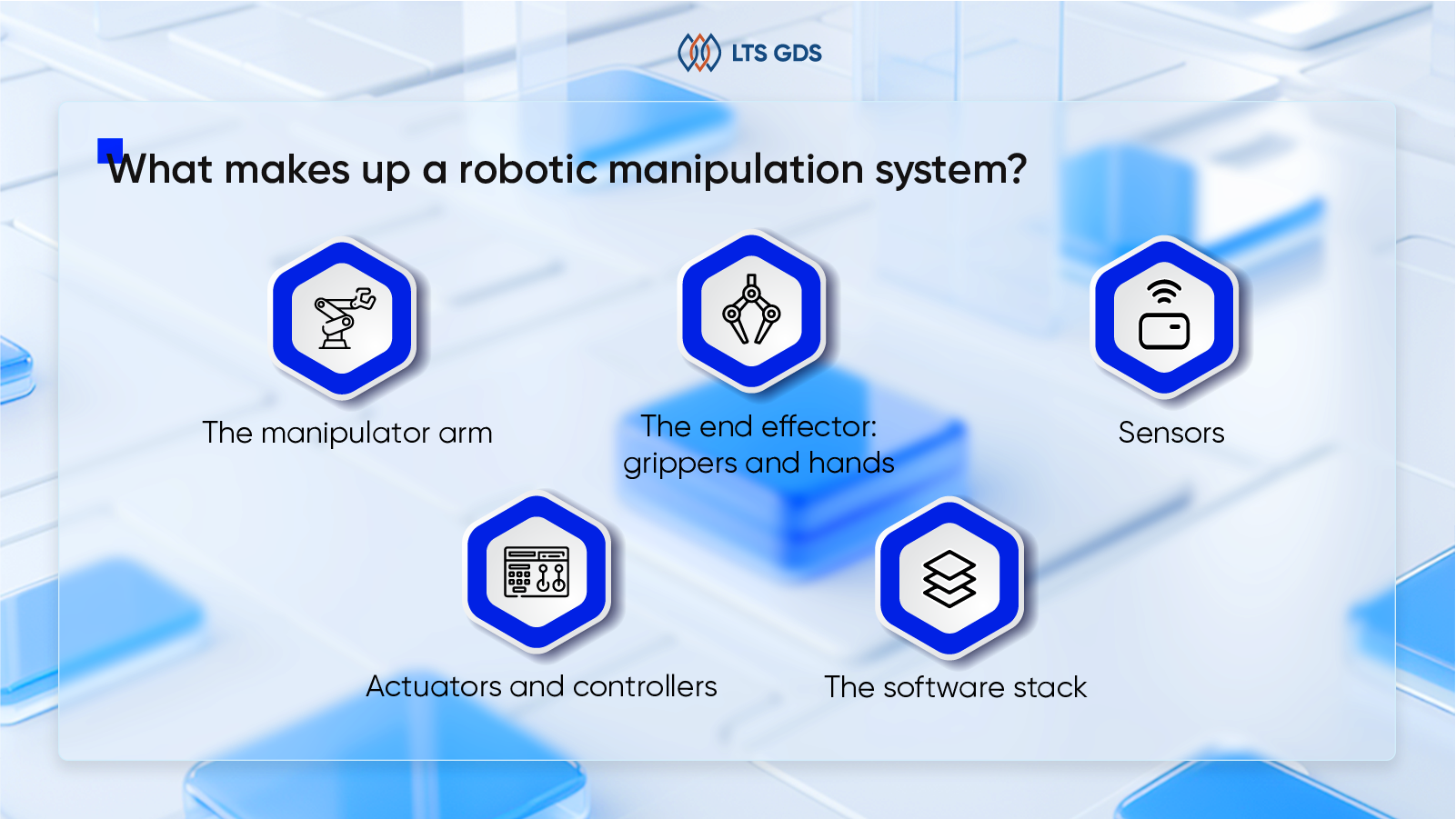
The manipulator arm
The arm is the structure that positions the end effector in space. Most industrial and research arms use a series of rigid links connected by rotary joints, typically somewhere between five and seven degrees of freedom. More joints generally mean more flexibility to reach around obstacles and orient the end effector at awkward angles, at the cost of a harder control problem.
The end effector: grippers and hands
This is where robotic arm manipulation actually meets the object, and it’s usually the first design decision that shapes everything downstream. There are three broad categories:
- Simple grippers. Parallel-jaw grippers, suction cups, and two-finger claws. Cheap, fast, mechanically reliable, and well suited to a narrow, repeatable range of object shapes, which is why they still dominate factory floors and fulfillment centers.
- Soft or underactuated grippers. These use fewer motors than joints, relying on mechanical compliance to passively conform to an object’s shape rather than controlling every joint precisely. That makes them useful for handling objects with unknown or irregular geometry without needing a detailed model of the object beforehand.
- Dexterous hands. Multi-fingered end effectors, often five-fingered and loosely modeled on human hands, with enough degrees of freedom to reorient an object inside the hand itself rather than just holding it still. Robotic hand dexterous manipulation is what makes tasks like in-hand reorientation, tool use, and two-handed assembly possible. It’s also the hardest end effector category to control well, since more joints mean a much larger space of possible contact configurations to reason about at every moment.
Sensors
Manipulation systems combine several sensor modalities, each covering a gap the others can’t:
- Vision. RGB and depth cameras for object detection, pose estimation, and general scene understanding, usually mounted on the wrist, the arm base, or overhead looking down at the workspace.
- Tactile sensors. Mounted at the fingertips or across the palm, tactile sensors measure contact, pressure distribution, and, in vision-based designs, fine surface geometry at the point of contact. This lets a robot detect, slip or confirm a stable grasp using touch rather than relying on vision alone, which matters most in cluttered scenes or once an object is already hidden inside the hand, where a camera has nothing useful to look at.
- Force-torque sensors. Usually mounted at the wrist, these measure the forces and torques the end effector experiences during contact. This is critical for tasks like insertion, assembly, or anything where too much applied force means a broken part or a damaged surface.
- Proprioceptive sensors. Joint encoders and inertial measurement units that tell the system where its own arm and joints currently are, independent of what the cameras or tactile sensors report.
Actuators and controllers
Motors, transmissions, and the low-level control loops that convert a desired joint angle, torque, or end effector pose into actual motor commands. These loops run anywhere from tens to several thousand times per second depending on the task, with contact-rich tasks generally demanding faster, tighter control than free-space motion.
The software stack
Everything above feeds into a perception, planning, and control pipeline, the layer that decides what the robot should do next based on what its sensors report and what goal it’s trying to reach. In most real systems, this pipeline runs as several layers operating at different speeds rather than one single loop. A high-level task planner might decide, once every few seconds, what the next sub-task should be, while a motion planner computes a trajectory a few times per second, and a low-level controller adjusts motor torques hundreds or thousands of times per second to track that trajectory and respond to contact. Keeping these layers cleanly separated, while still letting information flow back up when something unexpected happens, is a large part of what makes manipulation software architecture harder than it looks from the outside.
How Does Robotic Manipulation Work?
At a high level, every robotic manipulation task runs through the same loop: perceive the scene, decide on a plan, execute it, and adjust based on feedback. The specifics vary by task and hardware, but the loop itself is consistent enough across the field to be worth breaking down step by step.
Perception
The robot first has to figure out what’s actually in front of it. This usually means detecting objects, segmenting them from the background and from each other, and estimating each object’s pose, its position and orientation in 3D space. In a cluttered bin of mixed parts, this step alone is a substantial engineering challenge, since objects occlude each other, lighting shifts throughout the day, and the same object class can show up in dozens of orientations that all need to be recognized correctly.
Planning and kinematics
Once the robot knows what it’s looking at and what it wants to do, say, pick up a specific object and place it somewhere else, it needs to translate that goal into a sequence of joint motions. This is where kinematics comes in, and it’s one of the more mathematically dense parts of the stack, even though the underlying idea is intuitive.
- Forward kinematics calculates where the end effector will end up in space given a specific set of joint angles. This one is straightforward: plug in the angles, get a pose.
- Inverse kinematics works the other way around: given a desired end effector pose, it calculates what joint angles will get the arm there. This is the harder of the two problems, since multiple joint configurations can often produce the same end effector pose, and it’s typically the one that matters most when planning a grasp.
- Kinematic trajectory planning goes a step further than either of these. Rather than solving for a single target pose, it generates a full path of joint angles over time, one that avoids collisions with the environment, respects joint limits and velocity constraints, and brings the end effector to its goal smoothly rather than in a single jarring motion.
Control and the mechanics of robotic manipulation
Planning gets the robot to the point of contact. Control is what happens during contact, and this is where the mechanics of robotic manipulation gets genuinely difficult, and genuinely interesting. The instant an end effector touches an object, the robot has to reason about friction cones, contact forces, and how much the object might slip or shift under load, none of which can be perfectly predicted ahead of time from vision alone.
This is why manipulation controllers often blend position control, moving to a target location, with force or impedance control, regulating how much force is applied and how the arm responds when it meets unexpected resistance. A robot that only knows how to move to a position will crush a soft object or fail an insertion at a tight tolerance, since it has no way to notice it’s pushing too hard until something has already gone wrong. A robot that can also regulate force can adapt mid-motion, backing off, adjusting angle, or reattempting a grip, in the same way a person adjusts their hand pressure without consciously thinking about it.
Feedback and adjustment
Finally, the robot uses ongoing sensor feedback, tactile, force, and visual, to detect when something has gone wrong, a grasp is slipping, a part didn’t seat correctly, an object shifted mid-transport, and adjusts its plan accordingly. The tighter this feedback loop, the more robust the manipulation tends to be, which is a large part of why tactile sensing has become such an active area of both hardware design and machine learning research over the past several years. Vision alone can tell a robot what an object looks like before contact; only tactile and force feedback can tell it what’s actually happening once contact begins.
Data is the foundation of robotic manipulation
Perception, planning, and control increasingly depend on learned models, not just hand-coded rules. Classical, model-based approaches still outperform learning on narrow, well-specified tasks, but generalizing to new objects and environments largely comes down to data: imitation learning, reinforcement learning, and vision-language-action models trained on large manipulation datasets. That makes data collection, not hardware or algorithm design, the real challenges for most manipulation systems today.
A few sources matter most:
- Demonstration data. Teleoperation, where a human remotely operates a robot arm or hand, is still the most common data collection method for manipulation. Each episode captures synchronized video, proprioceptive state, and often tactile and force data, all implicitly labeled by the operator’s own actions.
- Simulation data. Simulated environments make large-scale data collection practical for reinforcement learning, where a policy may need millions of trials to converge. The trade-off is the sim-to-real gap: simulated contact and friction rarely match the real world exactly, so most teams still fold in real-world data to close it.
- Human video and cross-embodiment data. Video of humans performing tasks is far more abundant than any robot data collection effort can produce, but harder to use directly, since human hands and robot grippers don’t share the same kinematics.
None of this is useful in raw form. It needs to be curated and labeled: object poses and grasp outcomes in video, contact and slip events in tactile and force signals, success or failure at the level of the full episode. This annotation work usually takes longer than model training itself, and it’s what actually decides whether a policy generalizes or quietly overfits to a narrow set of demonstrations.
For teams building manipulation systems, the practical takeaway is that the data pipeline deserves as much attention as the model architecture. A smaller, well-curated dataset regularly outperforms a larger, noisier one.

Types of Robotic Manipulation
Robotic manipulation can be categorized based on the type of interaction involved and the level of dexterity required. Below are the main types of robotic manipulation and where they are commonly used.
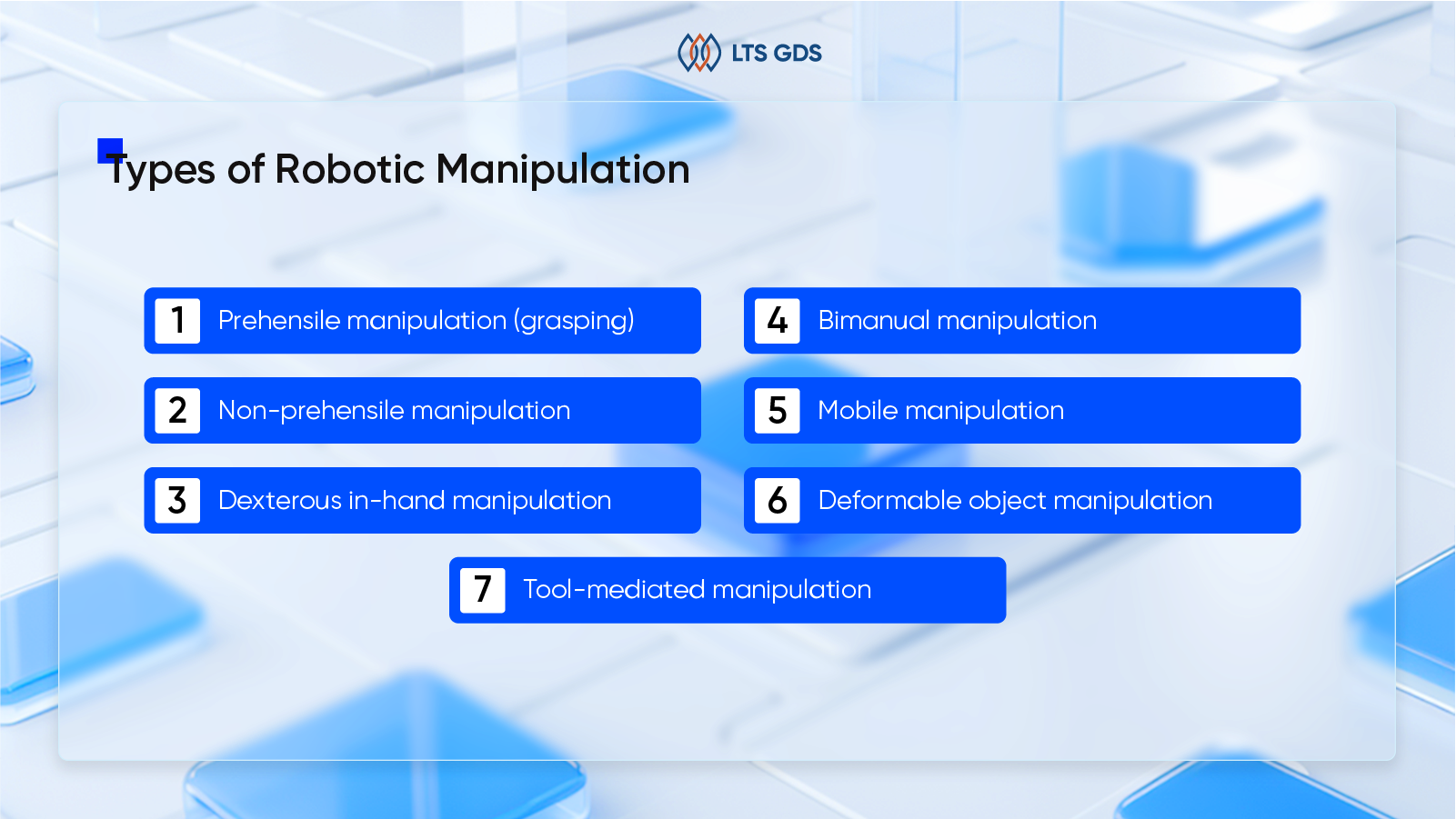
Prehensile manipulation (grasping)
The robot secures an object with a stable grip, using a gripper or hand, and moves it while maintaining that grip throughout the motion. This is the most common and best-understood category of robotic manipulation, covering everything from a suction cup lifting a cardboard box to a parallel-jaw gripper picking a part off a conveyor. Most industrial automation deployed today falls into this category.
Non-prehensile manipulation
The robot changes an object’s state without ever fully grasping it, through actions like pushing, sliding, toppling, or pivoting. This matters most for objects that are too large, too flat, or too oddly shaped to grasp directly, nudging a flat panel off a stack so it can be picked up edge-on, or repositioning an object that’s leaning against another one before a grasp is even attempted. It’s a less mature category than prehensile manipulation, largely because contact outcomes here are harder to predict without a grip holding the object in place.
Dexterous in-hand manipulation
Once an object is grasped, a multi-fingered hand can reorient it without ever setting it down, rotating a tool to the right angle for use, or repositioning a part before insertion. This category depends heavily on robotic hand manipulation research and on rich tactile feedback, since the hand needs to track how the object is shifting inside its grip in real time, often without a clear view of the object once it’s enclosed by the fingers.
Bimanual manipulation
Two arms working together, either symmetrically, both arms performing the same motion, like folding a large sheet, or asymmetrically, one arm stabilizing while the other acts, like holding a jar steady while the other twists the lid. Bimanual setups unlock tasks that are effectively impossible for a single arm, particularly with large, heavy, or flexible objects, but coordinating two arms roughly doubles the planning and control complexity, since each arm’s motion now has to account for the other.
Mobile manipulation
The manipulator is mounted on a mobile base, wheeled or legged, so the robot can navigate to an object before manipulating it. This adds a layer of complexity beyond a fixed-base arm: the robot has to reason about its own position and stability while simultaneously planning the manipulation task itself, and any error in navigation compounds directly into the manipulation step that follows.
Deformable object manipulation
Handling objects that change shape under contact, cloth, cables, bags, food items, rather than staying rigid throughout the interaction. This is one of the hardest open categories in the field, since the object’s state can’t be fully described by a single rigid pose, and the same action can produce very different outcomes depending on the object’s current configuration at the moment of contact.
Tool-mediated manipulation
Using an intermediate object, a hook, a spatula, a screwdriver, to extend the robot’s reach or capability rather than acting on the target object directly. This requires the robot to reason about the tool’s own geometry and dynamics in addition to the target object’s, effectively adding a second object into every planning and control decision.
Compare the above robotic manipulation techniques using the table below:
| Type | Description | Typical use case | Data and control demands |
| Prehensile grasping | Stable grip maintained throughout | Pick-and-place, bin picking | Moderate |
| Non-prehensile manipulation | Contact without a grasp | Clutter clearing, repositioning | High, outcomes are harder to predict |
| Dexterous in-hand manipulation | Grip maintained, object reoriented inside it | Tool use, assembly | Very high, needs dense tactile feedback |
| Bimanual manipulation | Two coordinated contact points | Large, heavy, or flexible objects | High, planning complexity roughly doubles |
| Mobile manipulation | Grip plus locomotion | Warehouse robots, home robots | High, navigation and manipulation combined |
| Deformable object manipulation | Contact changes the object’s shape | Cloth, cable, and food handling | Very high, object state is hard to define |
| Tool-mediated manipulation | Contact through an intermediate object | Hooks, scoops, screwdrivers | High, must model the tool plus the target object |
FAQs about Robotic Manipulation
What’s the difference between a robotic arm and a robotic manipulation system?
The arm is just the hardware that positions an end effector in space. A manipulation robotic system is the entire stack: the arm, the end effector, the sensors (vision, tactile, force), and the software that perceives the scene, plans a motion, and controls execution. The arm on its own can’t manipulate anything without the rest of the stack around it.
Why is dexterous manipulation harder than simple pick-and-place?
A simple gripper has one or two degrees of freedom and a small number of possible contact configurations. A dexterous hand has many more joints, which multiplies the number of ways an object can be grasped, shift, or reorient inside the grip, and the control problem scales up accordingly. It also demands much richer sensing, since the system needs to track contact state across multiple fingers simultaneously, often without a clear visual line of sight to the object.
What role do tactile sensors play in manipulation?
Tactile sensors let a robot confirm and adjust its grip using touch rather than vision alone. They detect contact, pressure distribution, and slip, which matters most in situations where vision can’t fully resolve what’s happening at the point of contact, objects hidden inside a hand, or clutter that blocks the camera’s view of the grasp itself.
Can robotic manipulation work without machine learning?
Yes, for narrow, well-specified tasks, classical model-based planning and control still work well and are often more predictable than a learned policy, since their behavior can be fully specified and tested in advance. Machine learning becomes more important as tasks require generalizing to new objects, new environments, or contact scenarios that weren’t explicitly programmed ahead of time.
How is robotic manipulation different from robotic locomotion?
Locomotion is about moving the robot itself through space, walking, driving, or flying. Manipulation is about moving something else. They share underlying tools like kinematics and control theory, but manipulation adds contact as a first-class problem: friction, slip, and deformation only enter the picture once a robot is touching an object it doesn’t fully control, which is why the two fields, despite the overlap, tend to need different sensors, different data, and often different specialists.
Advancing Robotic Manipulation with Better Data
Robotic manipulation is the layer where robots stop simply moving through the world and start acting on it. It’s built from a specific combination of hardware, arms, end effectors, and sensors, and software, perception, planning, and control, working together in a tight, continuous feedback loop. And increasingly, the systems that perform best aren’t necessarily the ones with the most sophisticated hardware. They’re the ones trained on the richest, most carefully curated manipulation data.
That last part is where most teams building Physical AI systems get stuck. Collecting multimodal manipulation data at scale, teleoperation demonstrations, tactile sequences, force curves, synchronized video, and then annotating it accurately enough to train a policy that actually generalizes, is a massive operational undertaking, one that’s easy to underestimate until a team is already deep into it. It also isn’t a one-time task. As robots take on new objects, new tasks, and new environments, the data pipeline behind them needs to keep growing right alongside the model.
If your team is building or scaling a robotic manipulation system and needs a partner for multimodal data collection, curation, or annotation, that’s exactly the kind of work we do at LTS GDS. Get in touch to talk through your data pipeline.
Read more: What is Embodied AI? The Next Evolution in Artificial Intelligence